
Wholesale price list by customer: how to stop emailing 5 different spreadsheets
For owners and sales managers at distributors, wholesalers, and manufacturers who run pricing out of spreadsheets today. You get a method for moving from several files to one master list with per-customer rules, and a plan to do it in two weeks.

It's 9:40 on a Monday. An order comes in by email from an account you've had for eight years. They want 40 cases of a product that went up 6% last Wednesday. The price on the PO is the old one. They pulled it from the sheet a rep sent last month, a file called Wholesale pricing v3 FINAL. There's another file, Wholesale pricing Sep, which is the right one. Nobody told them.
Now there are three options and all three cost money. Invoice at the old price and eat 6% on 40 cases. Call the customer, explain, and take the complaint. Or have the office rekey the order, on top of the 30 orders already in the queue that morning. Multiply by 900 orders a month and that Monday stops being an anecdote and becomes a fixed cost that never shows up on a P&L.
The problem isn't the rep or the customer. The problem is that the price lives in a file, and a file doesn't know who it belongs to, when it took effect, or how many copies of it are circulating.
Why a wholesale price list in a spreadsheet breaks on its own
A spreadsheet works fine while there's one list and one person sending it. It stops working the moment the second commercial condition shows up. And in wholesale it always shows up: the distributor buying full pallets, the small reseller paying on card, the key account that negotiated 8% off two years ago for reasons nobody remembers.
Every new condition spawns another file or another column. And every file has its own life cycle: someone copies it, edits it, forwards it. Six months later there are five lists, three reps, and two versions in force at the same time. That isn't sloppiness. It's what happens when the tool has no concept of "customer" or "effective date".
The scale makes it expensive. U.S. Census Bureau data released July 28, 2026 put wholesale inventories at $945.9 billion at the end of June, up 4.4% year over year. Inventory that large moves through millions of orders, and a pricing discrepancy on even a small share of them is real money.
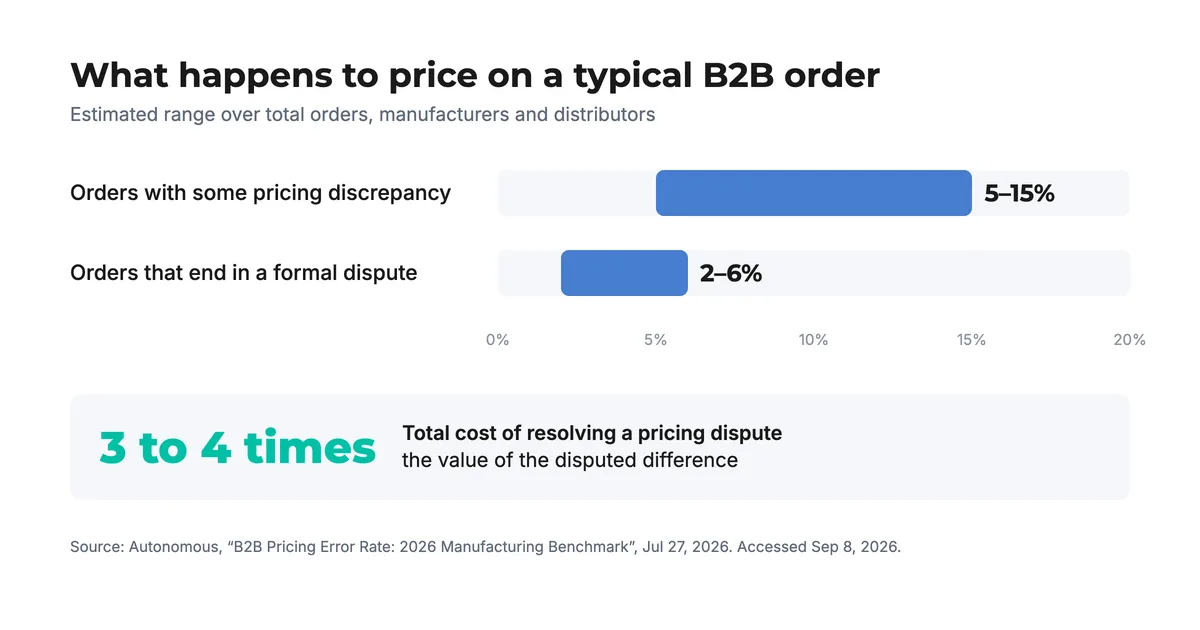
And the error rates are documented. A benchmark published in July 2026 on manufacturers and distributors estimates that between 5% and 15% of B2B orders carry a pricing discrepancy somewhere between quote and invoice. Only 2% to 6% become a formal dispute; the rest is quietly absorbed. Resolving each dispute costs three to four times the disputed difference once you add up finance, sales, and customer-service hours.
On the other side of the counter, the buyer has already changed. A Gartner survey of 646 B2B buyers, published in March 2026, found that 67% prefer to buy without going through a sales rep. A customer who wants to self-serve needs to see their price, not a generic file that someone corrects by hand afterward.
How to design a wholesale price list by customer: master list and rules
The fix isn't fewer lists. It's a different logic: one master list with the base price of every product, and a small set of rules that determine what price each customer sees. The rules are few and they combine.
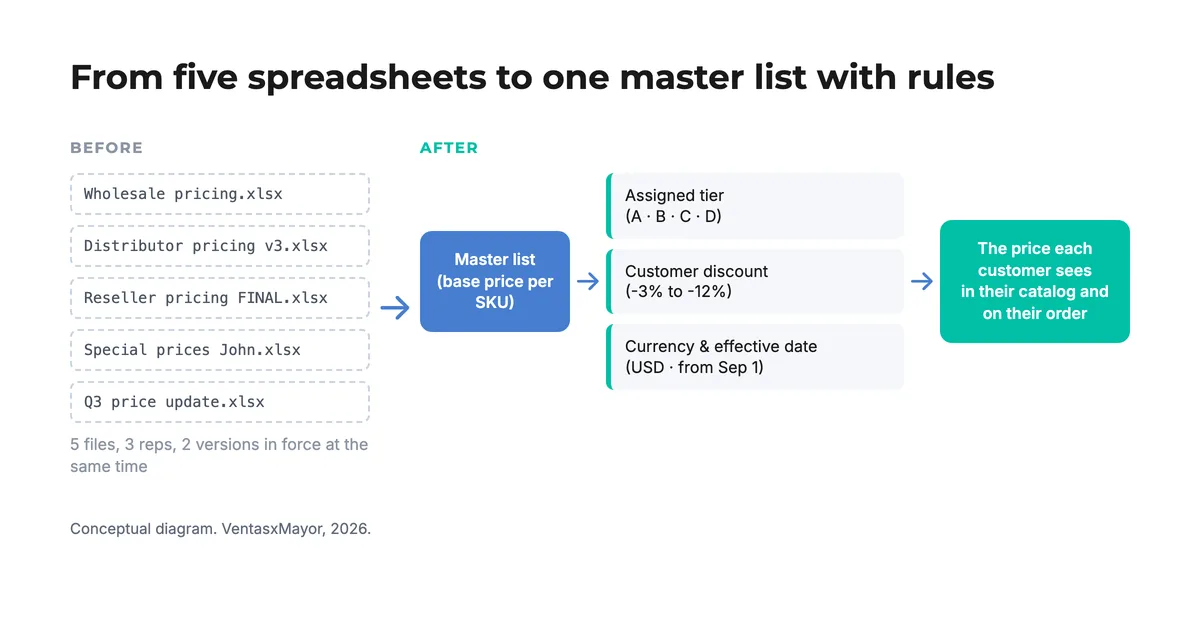
1. The master list
The base price per SKU. One list. Everything else derives from it. When replacement cost goes up, you change it here and the change cascades. Per product it should carry: item code, description, unit of measure (each, case, pallet), base price, currency, and effective date.
2. Derived lists (tiers)
Three to five tiers cover most operations. A typical setup:
| Tier | Who | How it's calculated |
|---|---|---|
| A · Reseller | Small retailers, frequent low-dollar orders | Base price |
| B · Wholesale | Buys by the case, mid-size monthly volume | Base −6% |
| C · Distributor | Buys by the pallet, covers a territory | Base −12% |
| D · Key account | Chains and large accounts under contract | Base −15% + contract terms |
The key is that each tier is defined as a rule on the master list, not as a separate file. If you define "B = base minus 6%", a change to the master is already in B without anyone copying it.
3. The per-customer discount
This is where exceptions get handled without another list. The account that negotiated an extra 3% carries it as its own attribute, on top of its assigned tier. The result: 340 accounts, four tiers, and maybe 60 individual discounts. Not 60 files.
4. Currency and effective date
A price without an effective date is a future argument. Every change to the master list needs a date from which it applies. Orders confirmed before that date are honored; later ones take the new value. If you import or sell across borders, the master list is often kept in one currency and converted with a defined reference rate, so a price update becomes a parameter rather than an event. Payment terms live next to the price: a tier-C distributor on net-60 and a reseller on net-30 are two different prices even when the number on the line is the same.
San Marcos Distribution: a case to make the method concrete
Before cleaning up pricing, San Marcos had five files: a wholesale list, a distributor list, a reseller list, a file of one rep's special prices, and a separate list for imported items. Every price increase took four days to reach all customers, because each rep applied it when they got to it. Of those 900 monthly orders, 38 came in at the wrong price: 4.2%, inside the benchmark range. The office spent 22 hours a month rebuilding lists and answering 19 pricing disputes.
The redesign took two weeks and required nothing more than commercial decisions:
- Week 1, master list. They consolidated the five files into a single base-price sheet. They found 14 products with different prices on two lists that were supposed to be identical. They set a unit of measure per SKU.
- Week 1, tiers. They classified the 340 accounts into four tiers using two criteria: average monthly spend over the last six months and usual order unit. 70% landed in A or B with no debate.
- Week 2, exceptions. They reviewed special terms. Of 61 accounts with a "special price", 23 were already covered by their new tier and 38 kept a documented individual discount, with who approved it and since when.
- Week 2, effective dates. They set one rule: increases are loaded with a date, announced 72 hours ahead, and apply to everyone at once.
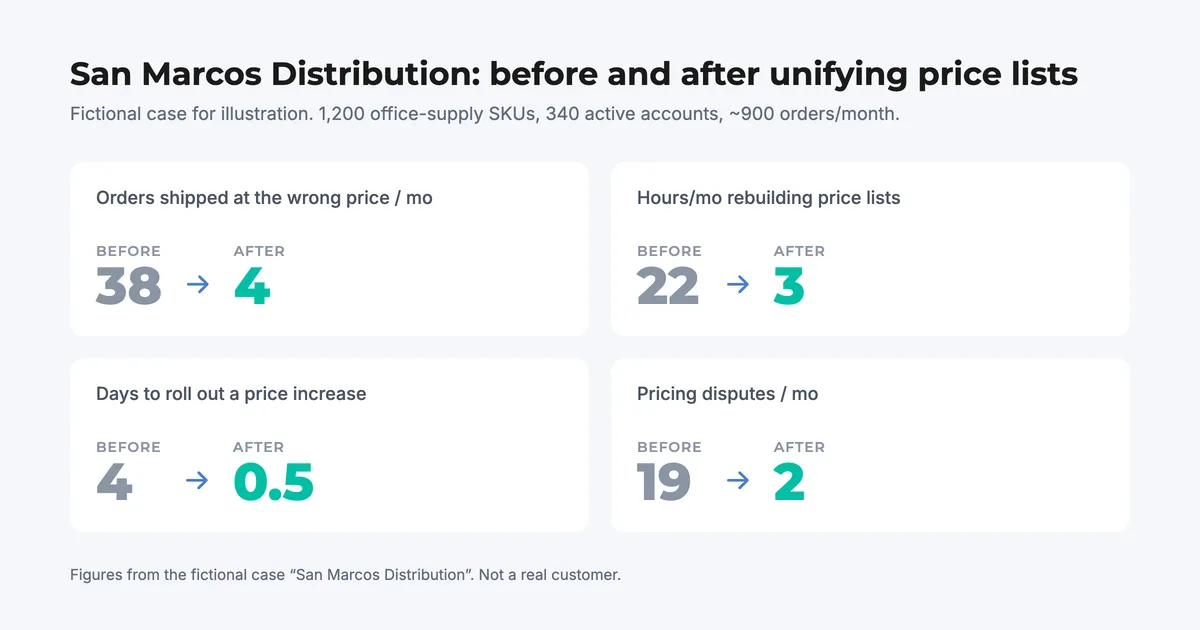
The outcome in the case: orders at the wrong price dropped from 38 to 4 a month, office hours spent on price lists went from 22 to 3, and an increase is live for every customer in half a day. The four orders that still come in wrong are from accounts that phone in orders from memory.
How to update a wholesale price list without losing customers
Organizing the lists solves half the problem. The other half is the update itself. Four practices that prevent the renegotiation:
- One moment of change. The increase takes effect for everyone on the same day at the same time. Orders confirmed before it are honored at the old price. No "I'll hold yours until Friday".
- Short, concrete advance notice. A message 48 to 72 hours ahead with the date and the average percentage. That pulls forward orders from customers who want to stock up, which is exactly what you want.
- Each customer sees their price, not someone else's. A file that circulates ends up in the wrong hands. A catalog behind a login shows each account only its own tier.
- A record of who approved what. Every individual discount with an owner and a date. At the next annual review you know which ones still make sense.
How VentasxMayor handles it
Everything above can be done with a well-built spreadsheet and discipline. What a spreadsheet can't do is let each customer see their own price and order against it, on their own, without anyone sending anything.
In VentasxMayor the digital wholesale catalog works with customer-specific pricing and tiered price lists: you load the lists and assign each account a tier and, where needed, its own discount. When the customer logs in to their portal they see the price that applies to them on every product and build the order at that value. A change to the list shows up in every catalog at once, and each customer's payment terms and account balance live on the same record. If you sell in more than one currency or country, the platform is multi-country and multi-currency, so the separate import list from the San Marcos case stops being a separate file.
The rep keeps selling. What they stop doing is emailing spreadsheets and fixing orders.
Checklist to start on Monday
- Gather every price list currently in use into one folder and note who uses each.
- Consolidate a master list: item code, description, unit of measure, base price, currency, effective date.
- Find products with different prices across lists and decide which is correct.
- Define three to five tiers with an explicit criterion (monthly spend and order unit).
- Express each derived list as a rule on the master, not as a file.
- List per-customer exceptions with an owner and approval date.
- Remove the exceptions the new tier already covers.
- Set the effective-date policy: one date, advance notice, confirmed orders honored.
- Pick the channel each customer will use to see their price, and stop sending files.
- Measure for a month: orders at the wrong price, office hours, disputes.
Frequently asked questions
How many price lists should a wholesaler have?+
Three to five base lists cover most operations: one per customer type (reseller, wholesale, distributor, key account). Individual adjustments are handled with a per-customer discount on top of the assigned tier, not a new list for every account.
How do you update a wholesale price list without losing customers?+
Announce the effective date in advance, load the increase with that date, apply it to every list from the master, and honor orders confirmed before the date. The most expensive mistake is each rep applying it at a different time.
Is it better to send the price list as a PDF or a spreadsheet?+
Neither, if the customer is going to order from it: both are stale the day a price changes. An online catalog showing each customer their own price eliminates the file and the order at last month's price.
What happens if a customer sees another tier's price?+
It's the most common leak from shared files and usually ends in a renegotiation. With customer-specific lists in a portal, each account logs in and sees only its own price.
Sources
- U.S. Census Bureau, Advance Economic Indicators Report, wholesale inventories for June 2026, released July 28, 2026. census.gov. Accessed September 8, 2026.
- Gartner, “Gartner Sales Survey Finds 67% of B2B Buyers Prefer a Rep-Free Experience”, March 9, 2026. Survey of 646 B2B buyers, August–September 2025. gartner.com. Accessed September 8, 2026.
- Autonomous, “B2B Pricing Error Rate: 2026 Manufacturing Benchmark”, July 27, 2026. goautonomous.io. Accessed September 8, 2026.
Next step
See customer-specific price lists running on your catalog
Bring your current list, even if it's five files. In 30 minutes we load it and show you what each customer type sees.

B2B customer portal: what it is, what it needs and how to roll it out
What a B2B customer portal is, what it needs for a wholesaler, how it differs from a rep portal and an online store, and how to launch it in five steps.

Wholesale orders on WhatsApp: the complete WhatsApp Business guide to automated messages
Set up automated messages, quick replies and connect WhatsApp with your B2B platform: the portal takes the order, WhatsApp notifies.

Wholesale stock control: how to measure turnover and stop losing money on your inventory
Learn how to calculate stock rotation index, identify dead products and apply strategies to optimize your wholesale inventory.