
Shopify B2B pricing: what wholesale really costs on Shopify, and the alternatives
For the wholesaler, distributor or manufacturer pricing out an online store with Shopify on the shortlist. Plans and prices checked on September 16, 2026, what Shopify B2B includes on core plans and what stays in Plus, the gateway surcharge, how Tiendanube compares in Latin America, and what no plan includes.
When a wholesaler decides to open an online store, Shopify is on the shortlist by default: it is the global brand and B2B is now part of the core plans. In Latin America the other name on the table is Tiendanube (Nuvemshop in Brazil), because it is everywhere and bills in local currency. Both are excellent at what they were built for: selling to consumers. The question no pricing page answers is what happens when the buyer is not a person but a store, with its own price list, minimum order and account terms.
This comparison does not argue which one is "better". It lays out the prices, checked on September 16, 2026, and dated because they change; explains what surcharge each one applies and why; details what Shopify B2B includes on core plans and what stays in Plus; and ends with what matters: what no plan on either platform includes for a wholesale business.
Shopify pricing in 2026 and what B2B includes
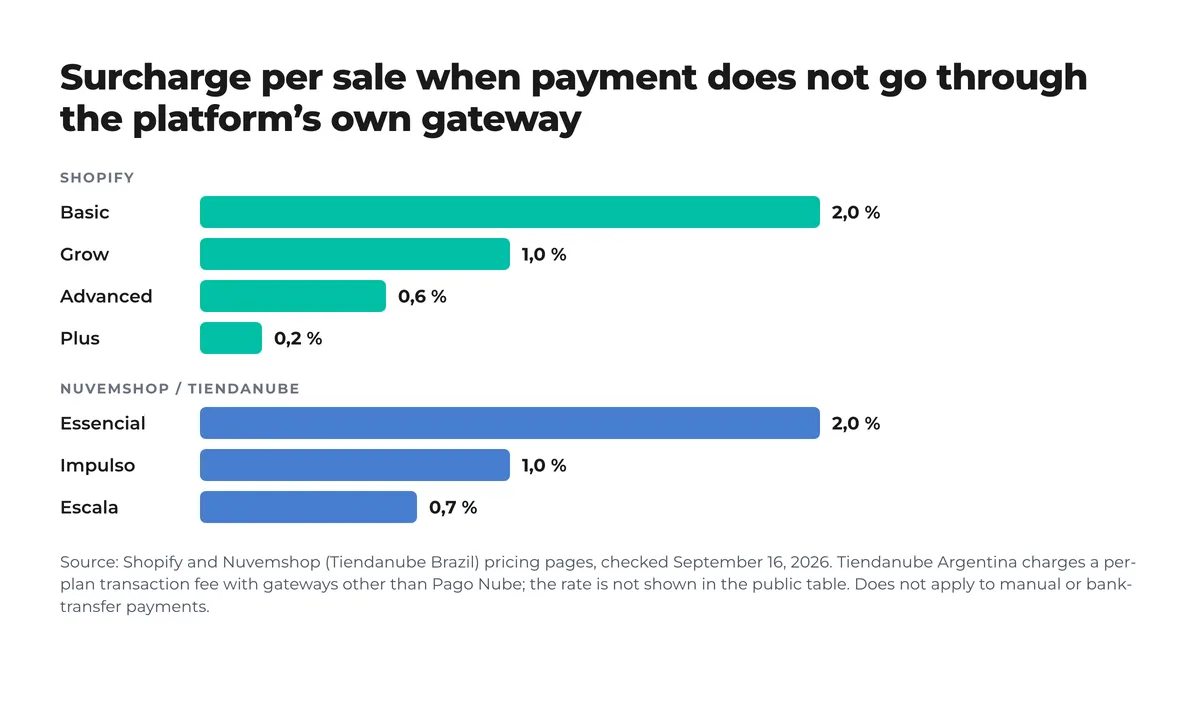
Shopify prices its plans in US dollars across Latin America and, on its pricing page checked on September 16, 2026, the B2B line reads the same on every core plan: up to 3 catalogs on Basic, Grow and Advanced, unlimited on Plus. Plus starts at 2,100 € a month on the European page we could reach; the dollar figure is on the US page. Below the plan price sits the number that matters for wholesale: the surcharge on sales that do not go through Shopify Payments.
| Plan | Shopify B2B | Staff accounts | External gateway surcharge |
|---|---|---|---|
| Basic | Up to 3 catalogs | — | 2 % |
| Grow | Up to 3 catalogs | 5 | 1 % |
| Advanced | Up to 3 catalogs | 15 | 0.6 % |
| Plus (from 2,100 €/month) | Unlimited catalogs, catalog assigned directly to a company | Unlimited | 0.2 % |
Three things the table does not say. First, Shopify bills in US dollars across Latin America, so for a wholesaler in Argentina, Mexico or Colombia the plan is a dollar cost against local-currency sales. Second, Shopify Payments is not available in Chile, Colombia or Peru, so card sales there necessarily go through an external gateway and pay the surcharge above; it does not apply to manual payments or bank transfers, which is how much of wholesale pays anyway. Third, and central to this post: "3 catalogs" means three price lists, but assigning a catalog directly to a company stays in Plus. A wholesaler with distributor, reseller and key-account pricing fits in three; one that needs to say "this company sees this list" is looking at 2,100 € a month.
Tiendanube: the regional alternative and its pricing
Tiendanube (Nuvemshop in Brazil) is the platform most Latin American small merchants start on: plans in local currency, its own payment processor (Pago Nube / Nuvem Pago) and no transaction fee when you use it. Argentina’s pricing page on September 16, 2026 listed a free plan, then roughly 27,000, 79,000 and 235,000 Argentine pesos a month, with an enterprise tier on request; Brazil listed R$ 59, 139 and 382 plus a R$ 1,399 tier. Prices are revised regularly, and with a gateway other than its own a per-plan transaction fee applies (2 %, 1 % and 0.7 % in Brazil). What matters here: none of its plans list a wholesale feature. No per-customer price list, no minimum order, no account terms, no rep with a portfolio. Where that exists, it comes through third-party apps with their own monthly cost. Tiendanube also does not operate in Peru.
What no plan includes for a wholesaler
Here is the opinion, and we stand by it: a consumer store behind a password is not a B2B platform, and "Shopify or Tiendanube plus a few apps" is not either. What defines a wholesale business does not appear on either pricing page:
- Per-customer pricing. Shopify solves it with catalogs (three on core plans, direct assignment to a company only in Plus); Tiendanube does not include it in any plan.
- Minimum order and case size. A customer should not be able to order 3 units of something sold by the case of 12, and the minimum changes per customer. On both it is an app.
- Net terms and credit. Selling on net-30 with a limit per customer is not a payment method: it is a commercial term. Neither has it natively.
- Reps with portfolios. The route rep logging in with their own user, seeing only their accounts and ordering on their behalf. Shopify staff accounts see everything; Tiendanube restricts users only on its upper plan.
- Local e-invoicing. No global platform ships first-party electronic invoicing for Latin American tax authorities; it is always a third-party app.
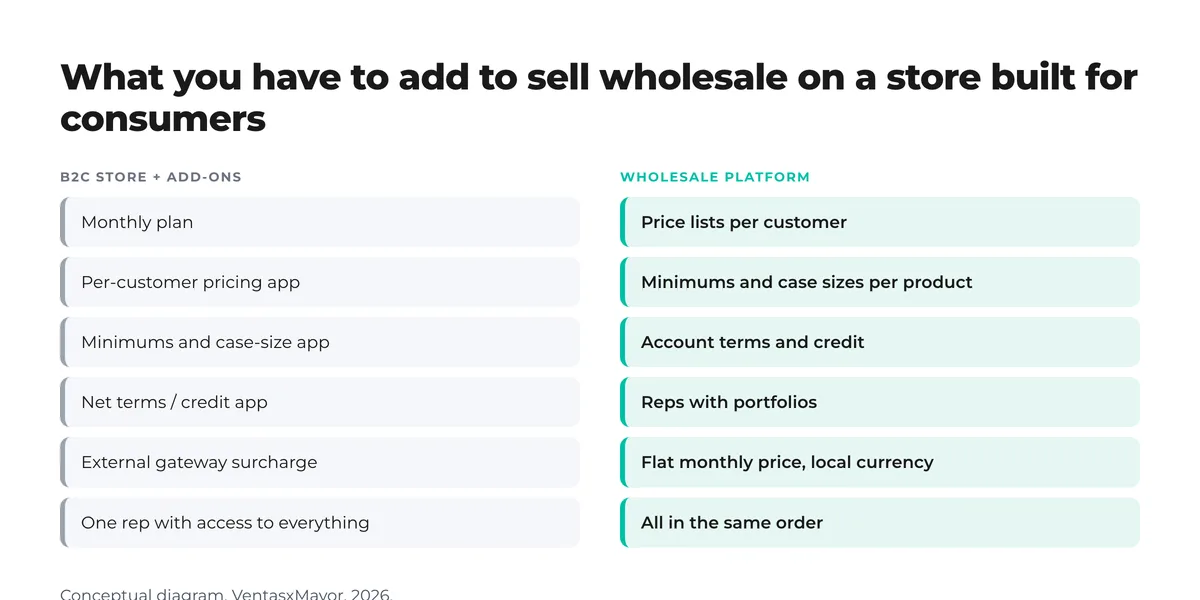
Each of those is one more app with its monthly fee, and one more place where the order can break. The diagram shows the full bill.
The real bill: a wholesaler prices both
When each one makes sense
- Shopify, when the brand sells to consumers across several countries or in dollars, or when B2B is secondary and fits in three price lists without per-company assignment. With a Plus budget, Shopify B2B is complete; without it, it is partial.
- Tiendanube, when the business sells to consumers in Argentina, Brazil or Mexico, wants to charge in local currency with Pago Nube and needs no per-customer terms. The simplest way to start selling B2C in the region. It does not operate in Peru.
- A wholesale platform, when per-customer pricing, minimums, net terms and reps with portfolios are the business and not an add-on. There, what you pay is one flat price, in local currency, with no surcharge per sale and no per-user fee.
That last one is what VentasxMayor does: price lists per customer, minimums, account terms and reps with their own portfolio are native, the price is a flat monthly fee and there is no charge per user or per rep. The detailed comparison with WooCommerce and Tiendanube is in this other post; the country-by-country pricing comparison, in compare with us.
Checklist for pricing any platform as a wholesaler
- What currency is the plan billed in and what currency do I sell in? If they differ, price it at today’s exchange rate and next year’s.
- What is the surcharge per sale if I do not use the platform’s gateway? Does it apply to transfers and account terms?
- How many price lists can I have, and can I assign each customer to theirs, on this plan?
- Are minimum order and case size native or an app? What does the app cost?
- Can I sell on net-30 with a credit limit per customer without an app?
- Can each rep log in with their own user and see only their portfolio? Is there a per-user fee?
- Is my country’s electronic invoicing native or third-party?
- Add plan + apps + surcharge + users and compare that total, not the plan price.
Frequently asked questions
How much does Shopify cost in Latin America?+
Shopify bills in US dollars across the region on Basic, Grow, Advanced and Plus; Plus starts around 2,100 € a month on the European page we could reach. On top of the plan, sales that do not go through Shopify Payments pay 2%, 1%, 0.6% or 0.2% depending on the plan, and Shopify Payments is not available in Chile, Colombia or Peru. Check the pricing page for your country on the day you decide.
Is Shopify B2B included in the Basic plan?+
Yes. Since April 2026, Basic, Grow and Advanced include Shopify B2B with up to 3 catalogs (price lists), payment terms and volume pricing. What stays in Plus is unlimited catalogs and assigning a catalog directly to a company. For a wholesaler that needs "this company sees this list", that distinction is the whole difference.
Does Tiendanube work for wholesale?+
It works for selling to consumers in Argentina, Brazil and Mexico. None of its plans lists a wholesale feature: per-customer pricing, minimum order, account terms or reps with portfolios come, where available, through third-party apps with their own monthly cost. It does not operate in Peru.
Which is cheaper for a wholesaler, Shopify or Tiendanube?+
Neither, once you add what wholesale needs. Both start cheaper than a wholesale platform on the plan price, and both end up more expensive once per-customer pricing, minimums, net terms and rep access are added as apps, plus the gateway surcharge on card sales. Compare the total, not the plan.
Does the gateway surcharge apply to bank transfers?+
No. On Shopify the external transaction fee applies to sales processed through a third-party gateway, not to manual payment methods such as bank transfer or account terms. That matters for wholesale, where a large share of orders is paid that way.
Sources
- Planes y precios de Tiendanube (Argentina) — consultado el 16 de septiembre de 2026
- Planos e preços da Nuvemshop (Brasil) — consultado em 16 de setembro de 2026
- Shopify pricing — tabla comparativa de planes (línea «Shopify B2B» y «cargos por transacción externos»), consultada el 16 de septiembre de 2026
- Comparar con nosotros — precios de plataformas por país, VentasxMayor, 2026
Next step
Wholesale features, native, at a flat price
In VentasxMayor per-customer price lists, minimums, account terms and reps with portfolios are included, at a flat monthly price in local currency, with no per-user or per-rep fees.
VentasxMayor vs WooCommerce vs Tiendanube: which is the best platform for wholesale selling
Complete platform comparison for B2B wholesale. Features, costs, support and integrations head to head.

VentasxMayor vs Wix: which one is right for a wholesaler, manufacturer or distributor?
A website builder versus a 100% wholesale platform: per-customer price lists, minimums, sales reps, pre-orders and ERPs, head to head.

Wholesale price list by customer: how to stop emailing 5 different spreadsheets
One master list, three to five tiers, per-customer discounts and an effective-date policy. The method for ending the spreadsheet chase and invoicing the right price.