
How to Measure Stock Rotation and Stop Losing Money on Your Wholesale Inventory
For wholesale owners and purchasing managers who suspect there is money sleeping in the warehouse. You leave with the rotation formula, a benchmark by industry and five strategies to move what is not turning.

If you are a wholesaler, there is a number you are probably not tracking that is costing you a lot of money: stock rotation. Every product sitting idle in your warehouse is not just taking up space — it represents tied-up capital, risk of obsolescence, and a missed opportunity to invest in what actually sells. In a wholesale business where margins are already tight, having "sleeping" merchandise can be the difference between profit and loss.
In this article, we show you how to measure your inventory rotation, how to identify the products that are holding you back, and what strategies you can apply today to make your stock work for you, not against you. All based on what we see every day working with real wholesalers across Latin America.

What is the stock rotation index and why it matters
The stock rotation index (or inventory turnover) is a metric that tells you how many times you sell and replenish your inventory in a given period. In other words, it shows you how fast your merchandise moves. A high index means you sell quickly and replenish efficiently. A low index means you have products piling up, taking up space, and freezing your capital.
The basic formula
The most commonly used formula is:
Stock Rotation = Cost of Goods Sold (COGS) / Average Inventory
For example, if your cost of goods sold in a year was $10,000,000 and your average inventory was $2,000,000, your rotation is 5. That means you renewed your stock 5 times in the year, or in other words, each product took an average of about 73 days to sell.
To calculate days of inventory (how many days it takes for your stock to sell), use this variant:
Days of Inventory = 365 / Stock Rotation
In our example: 365 / 5 = 73 days. If that number is too high for your industry, you have a problem.
What is considered a good rotation
There is no universal magic number, because it depends heavily on the industry. But as a general reference for wholesalers:
| Industry | Annual rotation | Why |
|---|---|---|
| Food and beverages | 8 to 15 times (high) | The product is perishable, so it needs to move fast. |
| Clothing and footwear | 4 to 8 times (medium) | Seasons dictate the cycles. |
| Hardware and materials | 3 to 6 times (medium-low) | More stable products but with obsolescence risk. |
| Cosmetics and beauty | 6 to 10 times (medium-high) | Trends and expiration dates drive movement. |
| Home goods and decoration | 2 to 5 times (low-medium) | Wide catalogs with lots of variety. |
If your rotation is below the range for your industry, you have excess stock. And that excess stock is money that is not working for you.
How to identify slow-moving stock and dead stock
It is not enough to calculate the overall rotation of your inventory. You need to go product by product (or at least category by category) to find the ones holding you back. There are two types of problematic products:
Slow-moving stock: products that sell, but very slowly. They have been there for months, taking up warehouse space and freezing capital you could use to buy what actually sells fast.
Dead stock: products that simply do not sell. They have had no movement for 6 months, a year, or more. Every passing day they lose more value and the probability of selling them at a reasonable price decreases.
To identify them, you need to cross-reference two data points: units in stock and units sold in the last 90 days. If a product has 500 units in stock and sold 10 in the last 3 months, it will take you over 12 years to clear it at the current rate. That is a serious problem.
What you should monitor:
- Products with more than 90 days without a single sale.
- SKUs whose current stock exceeds 6 months of projected sales.
- Categories where stock grew but sales stayed flat or declined.
- Products that only sell when you put them on promotion (a sign that the base price is wrong or the product no longer has organic demand).
5 practical strategies to improve your stock rotation
1. Smart promotions and clearances
Do not wait for dead stock to pile up for a year. Create a systematic process: every 30 days review slow-moving products and launch promotions before it is too late. A 20% discount today is better than a 50% discount 6 months from now when the product has already lost all its appeal.
Tiered promotions work very well in B2B: "buy 5 boxes and get the 6th at half price." This moves stock without destroying your margin across the entire line.
2. Strategic bundles and packs
Combine slow-moving products with star products. If you sell a pack of 3 high-demand products along with 1 slow-mover at an attractive price, you move inventory without the client feeling like you are pushing something on them. In the wholesale world, bundles also serve to increase the average order value and simplify the retailer's purchasing decision.
3. Seasonal planning and smart purchasing
The best way to avoid dead stock is to not buy it in the first place. Use historical sales data to plan your seasonal purchases. If a product only sells strongly in summer, do not buy enough to have stock all year. If a category has been declining quarter after quarter, reduce the quantities in your next order.
Buy based on data, not intuition. And if you do not have reliable data, that is your first problem to solve.
4. Customer segmentation and targeted offers
Not all your clients buy the same things. If you have accumulated stock of a specific product, identify which clients buy that category and send them a personalized offer. A cosmetics wholesaler with excess stock of a brand can send a promotion only to beauty salons that previously purchased that brand. This is much more effective than a generic discount for everyone.
5. Assortment review and product discontinuation
Sometimes the best decision is to stop selling a product. If a SKU has zero rotation for 6 consecutive months, liquidate it and remove it from your catalog. It is better to have a smaller catalog with high rotation than a huge catalog where half the products do not sell. Every dead product in your catalog takes visibility away from the ones that actually perform.
How a B2B eCommerce platform helps you optimize your stock
Managing stock rotation with Excel spreadsheets is like trying to drive a truck by looking in the rearview mirror: you see what already happened, but not what is coming. A B2B eCommerce platform like VentasxMayor completely changes the game because it gives you real-time visibility and tools to act immediately.
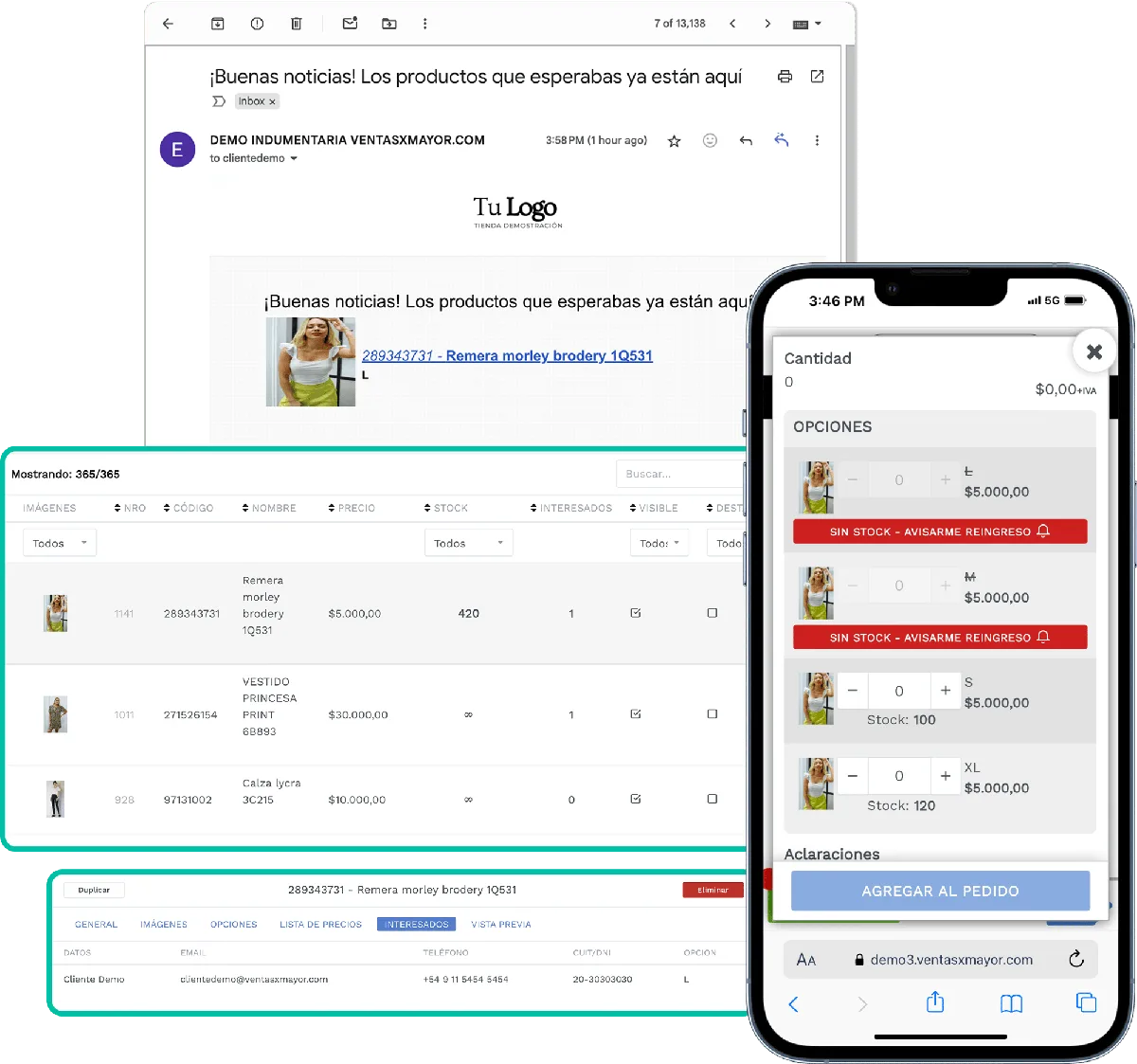
Real-time sales data: you know exactly what sold, how much, to whom, and when. You do not have to wait until the end of the month to discover that a product did not move. You can detect trends week by week and react before the problem grows.
Automatic alerts: set up alerts for products with high stock and low sales. The system notifies you before a product becomes dead stock, giving you time to act with promotions or price adjustments.
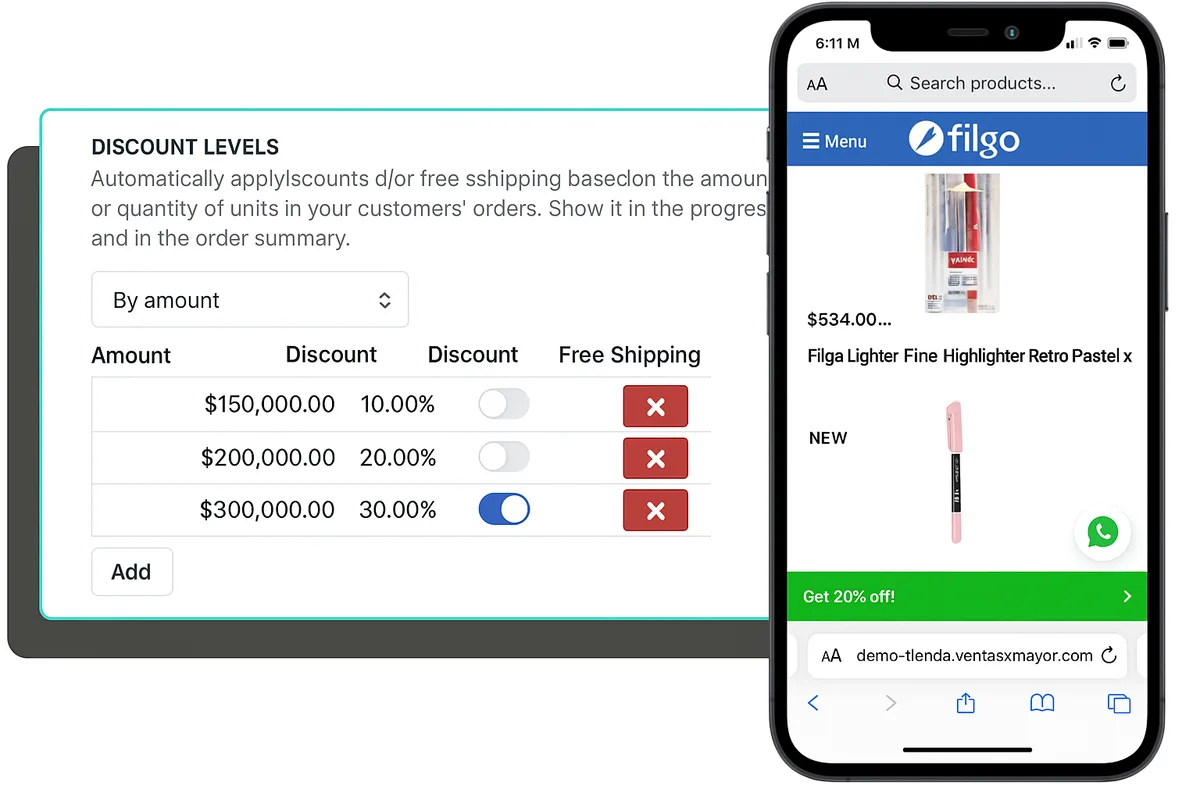
Automatic discounts and promotions: create discount rules that activate automatically. For example: "if a product has had no sales for more than 90 days, apply a 15% discount automatically." This allows you to move stock without having to review product by product manually every week.
ERP integration: when your eCommerce platform is connected to your management system, stock data syncs automatically. There is no double data entry, no counting errors, and you always know exactly how much you have of each product.
Rotation reports by category and product: stop guessing and start making decisions with data. The platform reports show you which are your star products (high rotation, good margin), which need attention, and which you should discontinue.

From intuition to data: the shift that transforms your wholesale business
Stock rotation is not a sophisticated metric reserved for large corporations. It is a practical tool that any wholesaler can (and should) use to make better purchasing decisions, optimize working capital, and increase profitability.
The first step is to measure. Calculate your overall rotation and then drill down to the detail by category and product. You will find surprises: products you thought were selling well but are actually sitting in your warehouse, and products you underestimated but are the ones really driving your business.
The second step is to act. Use the strategies we shared to move what is stagnant, plan your purchases better, and maintain an agile inventory that maximizes your return on investment.
And the third step is to go digital. With a B2B eCommerce platform, you stop relying on spreadsheets and your sales team's memory. You have reliable data, automatic alerts, and tools to act fast. Your stock stops being a problem and becomes your competitive advantage.
Frequently asked questions
How is stock rotation calculated?+
Divide the cost of goods sold (COGS) for the period by the average inventory. If annual COGS was $10,000,000 and average inventory $2,000,000, rotation is 5: you renewed your stock 5 times. To convert it to days, divide 365 by the rotation (365 / 5 = 73 days).
What is a good stock rotation for a wholesaler?+
It depends on the industry. As a reference: food and beverages between 8 and 15 times a year, cosmetics between 6 and 10, clothing between 4 and 8, hardware between 3 and 6 and home goods between 2 and 5. If your number is below your industry's range, you have excess stock.
When is a product considered dead stock?+
When it simply does not sell: 6 months, a year or more without movement. To detect it, cross-reference units in stock with units sold in the last 90 days; a product with 90 days without a single sale or more than 6 months of projected sales sitting in the warehouse is a warning sign. If a SKU has zero rotation for 6 consecutive months, liquidate it and remove it from the catalog.
Next step
Spot idle stock before it becomes dead stock
VentasxMayor shows you what sold, how much and to whom, with automatic alerts and discounts to move what is not turning.

How to Digitalize Your Wholesale Business and Scale in 2026
Step-by-step guide to transform your wholesale business: from manual orders to a professional B2B platform with real results.

Upselling and cross-selling in wholesale: strategies to sell more
How to increase average order value from wholesale customers using cross-sell and upsell techniques in your B2B portal.

B2B eCommerce glossary: 50 essential terms for wholesalers
From API to delivery zone: the 50 terms every wholesaler needs to know to digitalize their operation, grouped by topic.