
Automatic discounts for wholesalers: how to build promotions that apply themselves
For owners and sales managers at wholesalers, distributors, and manufacturers who negotiate every discount by hand today. You get the full map of a discount engine: volume tiers, bundles, free shipping, coupons, and the stacking and cascading rules to combine them without giving margin away.
At most wholesalers, the discount lives in the rep's head. "This one gets 10 because they buy every month. If they take 50 cases, 15. A bit more if they pay by wire." Every quote is a fresh negotiation, every rep carries their own mental table, and two identical customers end up paying different prices depending on who picks up the phone and on which day.
The cost of that system never shows up in a report. It's the margin point given away out of habit, the promo a rep keeps applying three months after it "ended", the big account that finds out someone else paid less. And there's a quieter cost: all the orders that stayed small because nobody told the buyer, at the right moment, that two more cases would drop the price on every one of them.
The stakes aren't small: according to McKinsey, improving realized price by 1% lifts operating profit by roughly 8.7% if volume holds. Discounts are exactly that, realized price. They deserve the same rules your price list gets.
What an automatic discount is and what it changes for a wholesaler
An automatic discount is a commercial rule written once that the system applies on its own, in the cart, to every customer who qualifies. No code to enter, no rep who has to remember, no spreadsheet of exceptions. Its counterpart is the coupon: the same rule, unlocked by a code. Everything else in this article applies to both.
For a wholesaler the change is twofold. Inward, the discount stops being an individual call and becomes commercial policy: the same rule for everyone who meets the condition, with a start, an end, and a cap. Outward, the discount becomes a reason to buy more now: the buyer sees the full ladder on the product page and decides on their own whether stretching to the next tier is worth it. That detail matters more every year, because the B2B buyer no longer wants to negotiate every order by phone: according to Gartner, 67% outright prefer a rep-free buying experience.
The five pieces of any wholesale promotion
A well-designed discount engine doesn't have fixed "promotion types": it has pieces. Each discount is built by answering five questions, and whatever is left blank means "no restriction".
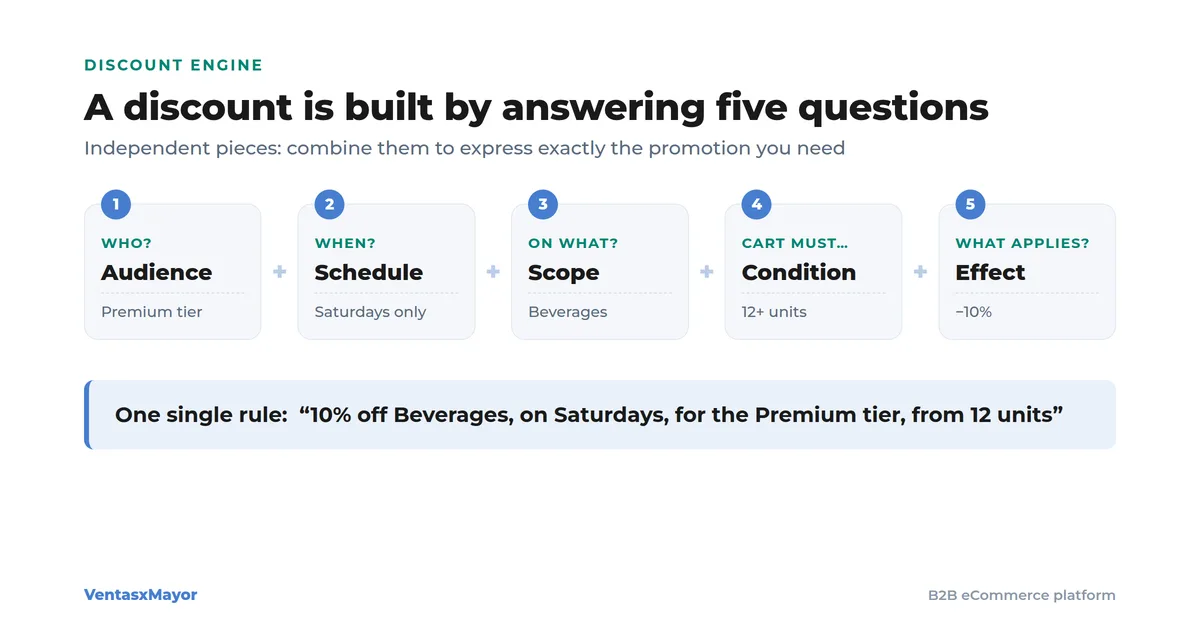
| Piece | Question | Examples |
|---|---|---|
| Audience | Who gets it? | Price tier, specific accounts, first purchase, inactive segment, payment method |
| Schedule | When is it active? | Always, date range, Saturdays only, time window, event calendar |
| Scope | On which products? | Whole cart, products, categories, variants, tiers; with exclusions |
| Condition | What must the cart meet? | Always, minimum quantity, minimum amount, volume tiers, complete bundle |
| Effect | What discount applies? | Percentage, fixed amount, fixed price, BOGO, bundle, free shipping, gift |
Because the pieces are independent, the possible combinations run into the thousands. "10% off Beverages, on Saturdays, for the Premium tier, from 12 units" is one rule. "Free shipping over $5,000, only for accounts that haven't ordered in 60 days" is another. The question stops being "does the system have this promo?" and becomes "what do I want to reward?".
The volume discount: the promotion that pays the bills
In wholesale, price moves with quantity, so the volume discount is the one used most and the one that moves the most margin. It's configured in tiers: thresholds by unit count or by amount, each with its own benefit. An industry benchmark estimates that a well-placed volume ladder lifts average order value by 15% to 25% without eroding profitability, because the extra discount is funded by the additional units.
This is what it looks like from the buyer's side, on a product page of a sample wholesale store (in Spanish, from an Argentine demo): the full tier table, the current tier highlighted, and the nudge showing how little is missing for the next price.
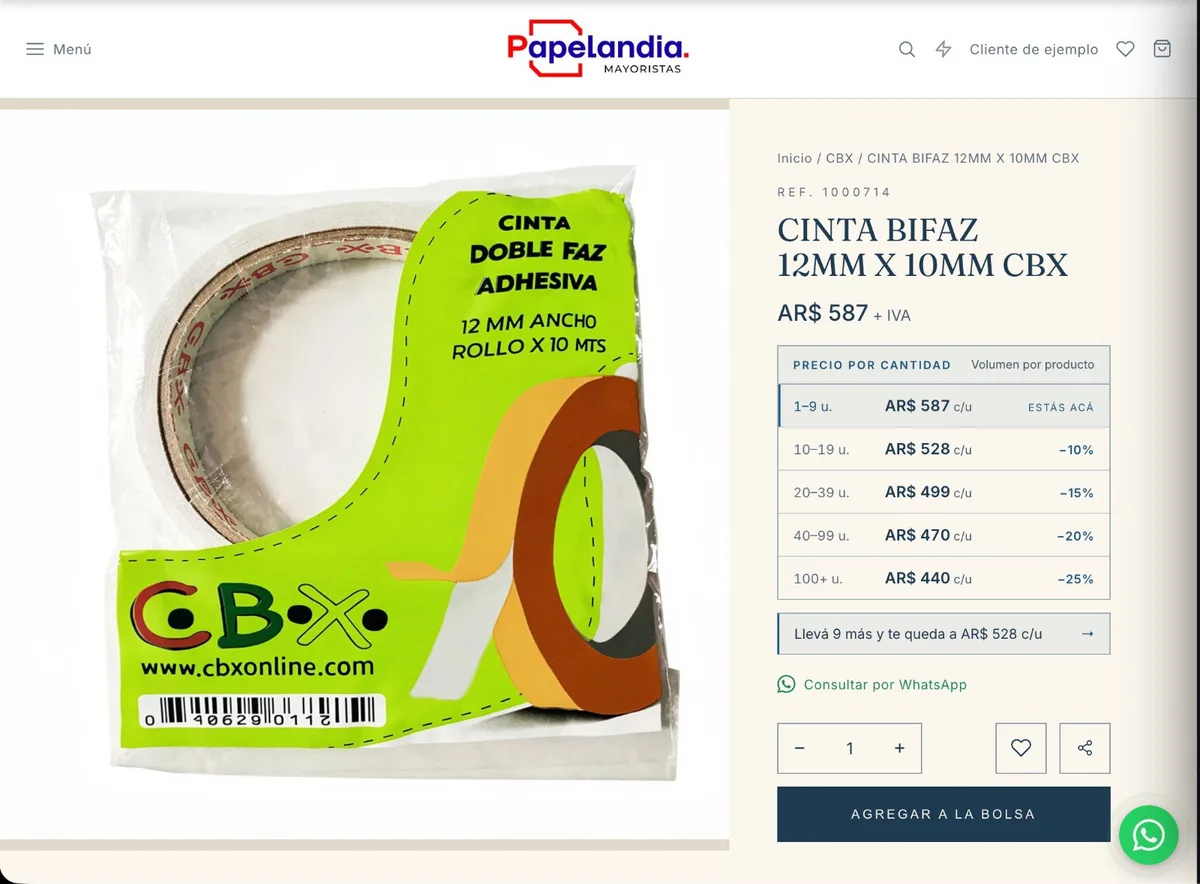
When building the ladder, three decisions define the outcome:
- How the threshold is measured: by units ("from 10 u.") or by amount ("from $2,000").
- Where it's counted: on a single line (10 units of the same item), across the products the promo covers (10 units spread over the SKUs on promotion) or across the whole cart. With the same threshold, the three options produce different results.
- How tiers apply: retroactive (reaching 10 units puts all 10 at the discount; the wholesale standard), full-case (111 units = 1 case of 100 + 1 of 10 + 1 loose, each block at its price) or marginal (only the units above the threshold get the discount).
Pick "round" thresholds that invite completion: if the case holds 12, the tier starts at 12, not 10. The "2 more for the next price" nudge works on its own, but only if the jump is reachable.
BOGO, bundles, free shipping and the other classic promotions
Volume is the core, but not the only tool. The other effects serve different goals, and it pays to pick them by goal, not by fashion:
| Goal | Promotion | Example |
|---|---|---|
| Move slow stock | BOGO / 3-for-2 / NxM | "Take 3 of the same item, pay for 2" |
| Raise order value | Free shipping by amount | "Free shipping over $5,000"; the store shows what's missing |
| Build fuller carts | Fixed-price bundle | "3 products from this selection for $999"; shows "2 of 3" progress |
| Push a complementary item | Cross-sell | "With the machine, spare parts 30% off" |
| Clear stock remnants | % with stock condition | "50% off items with 5 units or fewer left" |
| Reward without cutting price | Gift | "Over 20 cases, the display rack ships free of charge" |
All of these also cross with audience and schedule: the BOGO can be only for the Distributor tier, the clearance only in February, free shipping only for inactive accounts worth winning back. That's where the fine-grained promos come from: "extra 5% paying by wire", "welcome discount on the first order", "seasonal bundle only the first 5 days of the month".
Combined discounts: stacking, priority and cascading
With three or four active rules, sooner or later two land on the same product. This is where a serious engine parts ways with a coupon plugin: every discount declares how it coexists with the rest. There are three behaviors: stacks with everything (adds to any other), competes (if several fight over the same product, the one that saves most wins and the rest are ignored for that product) or replaces (if it applies, it blocks everything else in the cart; the "exclusive, non-combinable" promo). And when two can't coexist, priority decides: the order in the discount list.
When two discounts do stack, one more decision remains, and it's the one that moves the most money: is the second discount computed on the list price, or on the price already reduced? That is the cascading discount.
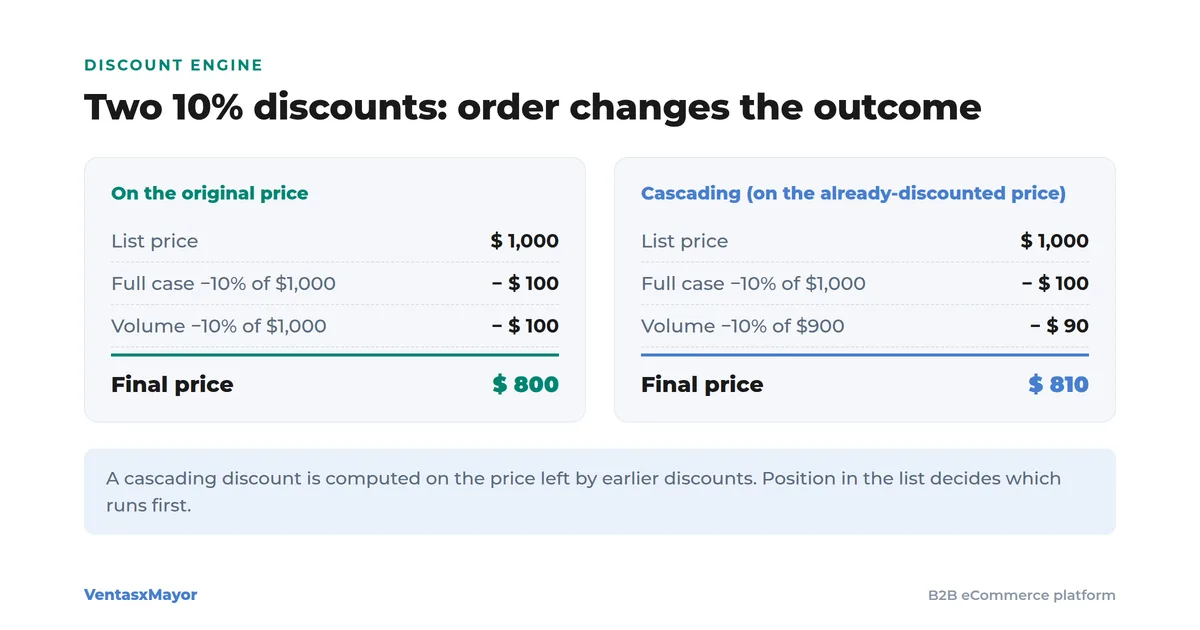
A detail that matters: the cascade takes the discounts that run before it, so the order of the list defines the final result. If the volume ladder must be computed on the full-case price, it goes after it in the list. And so no promo escapes the budget, you add caps: a per-cart limit ("BOGO at most 3 times per order") and a per-customer savings cap ("10% up to $2,000 per month"). With caps, even the most aggressive promo has a maximum cost known in advance.
The buyer never sees the machinery: the store shows the resolved result, with the discount that won. Never promise two benefits and apply one.
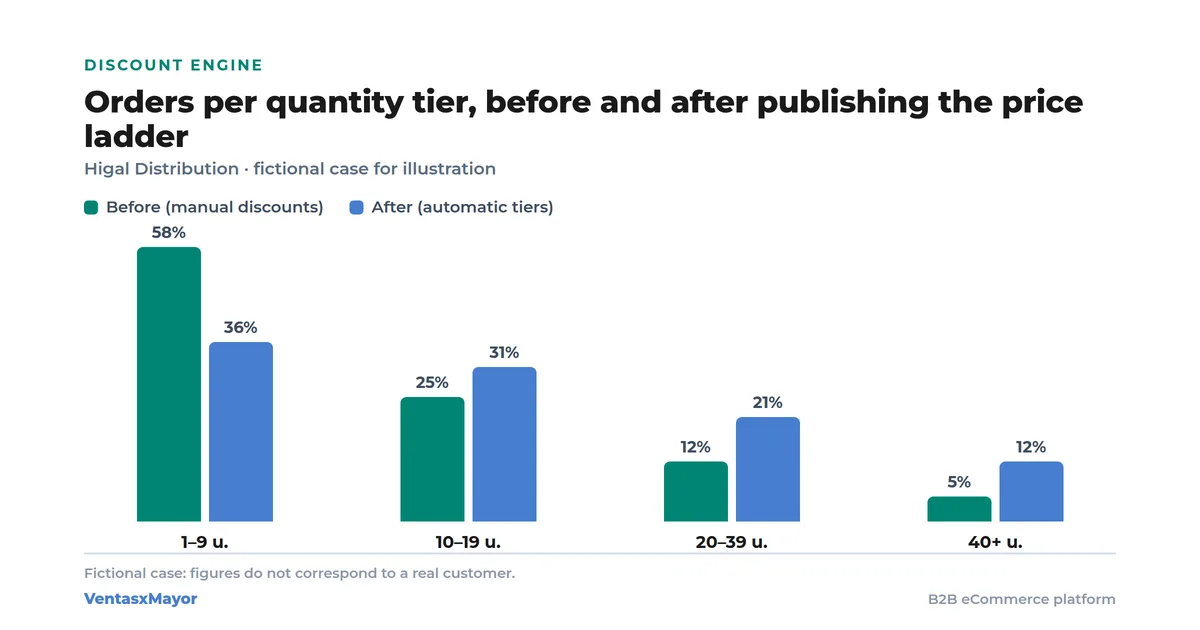
Higal Distribution: four rules instead of a thousand negotiations
The effect in the case, three months in: order distribution shifted toward the higher tiers, average order value rose 19%, and manual price corrections dropped from 15 a day to 2. The most interesting number isn't the average: 43% of the carts that reached 8 or 9 units ended up adding the missing ones to hit the 10-unit tier, pushed by the nudge on the product page.
How VentasxMayor solves it
Everything described in this article is VentasxMayor's discount engine: the five pieces, the three volume modes (retroactive, full-case and marginal), the classic promotions, stacking with cascade, priority by order and caps per cart and per customer. Rules start from ready-made templates — volume ladder, BOGO, free shipping, stock clearance, VIP accounts — and each one is tested before going live in a simulator that builds a test cart and explains which discount applied, which didn't, and why.
The store communicates each benefit in the right place with no extra setup: the price ladder and the "add N more" nudge on the product page, per-line savings and the "Your discounts" summary in the cart, bundle progress, and how much is left for free shipping. The discount the buyer sees is the one invoiced, it stays frozen on the order, and the reports later show which rule fired how many times and how much it granted, so the one that doesn't perform gets switched off. Discounts coexist with per-customer price lists: the list sets each account's base price, and the rules discount on top of that.
Monday checklist
- Write down the promotions that live in your reps' heads today: what discount, for whom, under what condition.
- Pick the three most used and write them out as the five pieces: audience, schedule, scope, condition, effect.
- Define the business's volume ladder: 3 or 4 tiers, with thresholds that match the case or pack size.
- Choose the mode: retroactive for the standard ladder; full-case if your logistics run by the case.
- Decide for each rule how it coexists with the rest: stacks, competes, or replaces.
- If two rules stack on the same product, decide whether the second cascades, and order the list accordingly.
- Cap every aggressive promo: times per cart or amount per customer.
- Test each rule on one case where it must apply and one where it must not, before switching it on.
- After 30 days, read the report: turn off what isn't used, replicate what performs.
Frequently asked questions
Can several discounts combine on the same order?+
Yes, if the rules allow it. Each discount declares its behavior: it stacks with everything, competes with similar ones (the biggest saving wins) or replaces the rest. When two stack on the same product, you also define whether the second is computed on the original price or cascades on the already-reduced price.
Should a volume discount be retroactive or marginal?+
Retroactive is the wholesale standard: once the threshold is reached, every unit takes the new price, and it's what buyers expect. Marginal discounts only the units above the threshold: it protects margin better but is harder to communicate. Full-case is the right choice when logistics sell by the case: each complete block at its price and the loose remainder at regular price.
Is the discount applied before or after tax?+
Before. The discount is computed on the net price and taxes are recalculated on the discounted amount. And what the buyer sees in the cart is exactly what gets invoiced: the discount is frozen on the order as it was applied at purchase.
How do I keep a promotion from destroying my margin?+
Four brakes: caps (times per cart and savings amount per customer), scope exclusions (the low-rotation, good-margin category stays out), the right stacking rule (an aggressive promo set to "competes" or "replaces" doesn't add to the ladder) and testing first: simulate the worst possible cart before switching it on. Each promo's maximum cost should be known before publishing it, not on the month's invoices.
Sources
Next step
See the discount engine running your own promotions
Bring your three most-used promotions, even if they live in a rep's head today. In 30 minutes we build them as rules and you watch them apply themselves in a real cart.
Wholesale price list by customer: how to stop emailing 5 different spreadsheets
One master list, three to five tiers, per-customer discounts and an effective-date policy. The method for ending the spreadsheet chase and invoicing the right price.
Upselling and cross-selling in wholesale: strategies to sell more
How to increase average order value from wholesale customers using cross-sell and upsell techniques in your B2B portal.
B2B customer portal: what it is, what it needs and how to roll it out
What a B2B customer portal is, what it needs for a wholesaler, how it differs from a rep portal and an online store, and how to launch it in five steps.