
How to choose a B2B ecommerce platform: 12 questions before signing
For the wholesaler, distributor, manufacturer or importer with three pricing pages open and a demo booked for Thursday. What the search results will not say, how to compare a store with a B2B add-on, an enterprise suite and a wholesale platform on the same sheet, and the 12 questions that separate a good decision from a plan that gets replaced within a year.
Search for "B2B ecommerce platform" and the first page of Google is a list of enterprise suites, a comparison table written by one of them, and a consumer store builder whose full B2B lives in a plan that starts at four figures a month. None of it is written for a distributor with 400 accounts, five reps and an ERP that already runs the business.
We have spent more than 8 years watching wholesalers choose, and the pattern repeats: the decision gets made on the demo. Somebody shows twelve screens, the team likes the design, the contract gets signed, and three months later it turns out the platform cannot show each customer its own price list, or charges per rep, or needs an app for minimum order quantities. Having technology is not the same as having digitized the operation. The platform that works is the one that reproduces the commercial rules the company already has: lists, minimums, terms, portfolios. Not the one with the longest feature list. This guide is that sheet.
Start with the rules, not with the platform
Before the first demo, one page describing how the company sells today. It does not need a consultant: the owner or the sales manager writes it in an afternoon with the ERP open on the side.
- Price lists: how many actually exist (not how many there should be), how each customer is assigned to one, and how many accounts have negotiated prices outside every list.
- Minimums: per order, per product, per case; whether they change by customer or territory.
- Terms and credit: who buys on net terms, with what limit, who approves an order that goes over it.
- Reps: how many, with which portfolio, what commission, what they are allowed to see.
- ERP and invoicing: which system holds stock and invoices, and what has to travel without anyone retyping it: customers, products, prices, orders.
- Today's channels: what share of orders arrives by WhatsApp, email, phone and rep.
That sheet is the demo script. The vendor is asked to load three real customers with their three lists, and to have a rep place an order with a minimum and net terms. If the platform cannot reproduce that in the meeting, it will not do it in production.
What is not on the sheet does not get evaluated. A feature that impresses in the demo but answers no rule on the sheet scores nothing: it is the most common way to end up paying for what never gets used.
The three kinds of B2B ecommerce platform
Behind the brand names there are three routes, and each was built for a different kind of company. Mixing them up is the root error behind most of the migrations we see a year after signing.
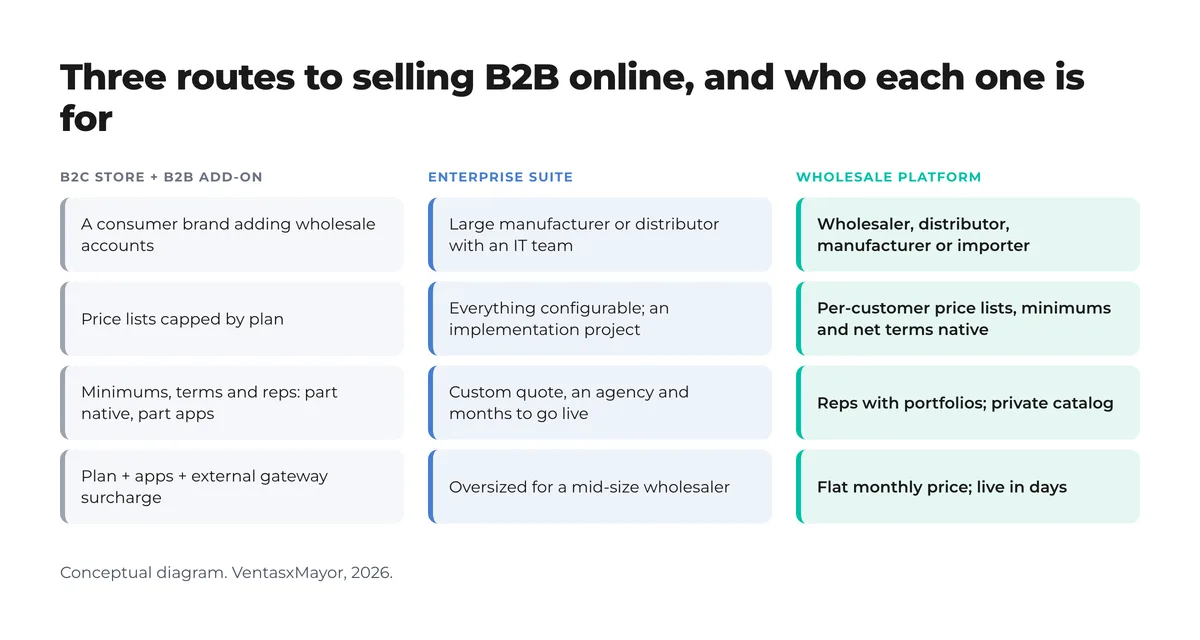
B2C store with a B2B add-on
Shopify is the clearest and most searched example. According to its Help Center, checked on September 17, 2026, B2B is included on Basic, Grow and Advanced with up to 3 catalogs (price lists) assignable to B2B markets; assigning a catalog directly to a company, which is what a wholesaler calls "this account sees this list", stays on Plus, as do deposits and partial payments. Quantity rules and net terms are native on every plan. It is a good route for a consumer brand adding a handful of wholesale accounts. It stops being one when every customer has its own price: a B2C store behind a password is not a B2B platform, and the apps stacked on top to make it look like one cost money, step on each other and break on every update.
Enterprise suite
These are the ones that dominate the search results: sold by quote, implemented with an agency over months, and designed for a large manufacturer or distributor with its own IT team. When there are thousands of SKUs with configurators, several warehouses and procurement integrated into the customer's system, they are the right answer. For a mid-size wholesaler they are a project, not a service: the real cost is not the license but the implementation and every change after it.
Wholesale platform
Built from the start for the rule sheet above: per-customer price lists, minimums per product, net terms, reps with portfolios, a private catalog. It does not ship gift carts or a consumer checkout because it does not need them. It is bought as a service, at a flat monthly price, and goes live in days because the rules already exist in the system: they only have to be loaded. It is what we build, and we say so in the last section, not before.
| Rule on the sheet | B2C store + add-on | Enterprise suite | Wholesale platform |
|---|---|---|---|
| Price list per customer | Capped by plan; per company only on the top plan | Yes, configurable | Yes, native |
| Minimums and case sizes per product | Native on some; an app on others | Yes | Yes |
| Net terms and credit limit | Terms yes; per-customer limit depends on plan or app | Yes | Yes |
| Reps with their own portfolio | Staff permissions; portfolio and commission, an app | Yes | Yes, with commissions |
| ERP integration | Connectors and apps | Integration project | API and connectors for the main ERPs |
| Cost model | Plan + apps + external gateway surcharge | Quote + implementation + agency | Flat monthly price, no per-user fee |
| Time to launch | Weeks | Months | Days |
The 12 questions before signing
They go in this order because the first ones eliminate the most candidates. Each is answered "yes", "no" or "with an app at X a month"; the third answer counts as "no" until the app is seen working with the company's own data.
- Can each customer be assigned their own price list, and how many lists does this plan allow? If the answer starts with "on the higher plan", that is the real price.
- Can one product carry a different price, minimum and case size per list? That is the difference between a price list and a blanket discount.
- When a price changes, does the buyer see it immediately, without re-uploading a spreadsheet? With cost changes and currency swings, this happens weekly.
- Is the minimum order, per order and per product, native or an app? And if an app: what it costs and who maintains it.
- Can a buyer reorder from history on a phone, in under a minute, without calling anyone? Replenishment is the majority of wholesale orders.
- Does the order reach the ERP without anyone retyping it? Which ERPs, and how: API, connector, or "export to Excel".
- Does each rep log in with their own user and see only their portfolio and commissions? A rep who can see every account is a problem the day they leave.
- Is there a fee per user, per rep or per order? Ask for the price with 10 reps, not 2.
- Can a rep place an order on behalf of a customer, at that customer's price? Digitizing orders does not mean removing the rep.
- Are net terms and a credit limit per customer native? Who blocks an order over the limit: the system or a person?
- What is the surcharge when the customer pays by bank transfer or on account rather than through the platform's gateway? In wholesale, that is most orders.
- What currency is the plan billed in, and what does the total (plan + apps + surcharges + users) come to at the company's order volume? Compare that number, not the plan price.
Questions 5 and 9 have a number behind them. In a Gartner survey of 646 B2B buyers, run between August and September 2025 and published in March 2026, 67% prefer to complete a purchase without talking to a sales rep. That does not make the rep expendable: it makes it absurd for the buyer to have to ask the rep for a price in order to place a replenishment order. The portal is for the buyer; the rep develops accounts.
- 67%of B2B buyers prefer to buy without talking to a sales repGartner, mar 2026
- 45%used AI tools in a recent purchase to evaluate suppliersGartner, mar 2026
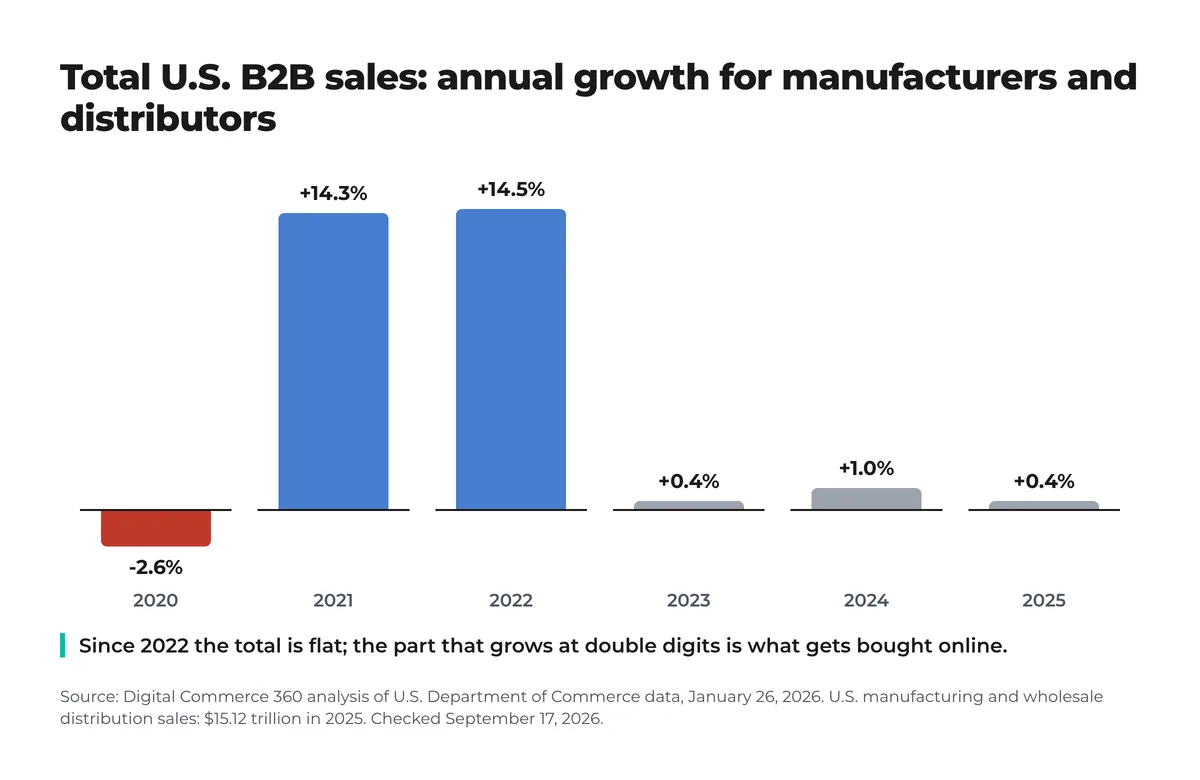
- +0.4%growth in total U.S. B2B sales in 2025; digital, at double digitsDigital Commerce 360, Jan 2026
The costs the plan price hides
The plan price is the smallest number on the bill. These are the ones that show up afterwards, in the order we see them appear.
- Per-user or per-rep fees. They penalize precisely the company that adopts the system most: when all five reps use it and a sixth joins, the price goes up. A wholesaler with 10 reps has to ask for the quote with 10, not 2.
- Stacked apps. Per-customer pricing, minimums, net terms, rep portfolios: on a B2C store each one is an app with its own fee, its own support and its own way of breaking when the platform updates.
- External gateway surcharge. On consumer store builders, selling through a payment method other than the platform's own adds a percentage per sale: on Shopify, per its pricing page checked on September 16, 2026, 2%, 1%, 0.6% or 0.2% depending on the plan. In wholesale most orders are paid by transfer, ACH or on account, so ask which orders it applies to.
- Currency. For a company selling outside the U.S., a plan billed in dollars against sales in local currency is a cost that moves on its own. Price it at today's exchange rate and next year's.
- Implementation and agency. On an enterprise suite the license is the small part; going live and every change after it are agency hours.
- Migration. Customers, lists, terms and photos have to get in. Ask who loads them, in what format and in how many days.
Real cost = plan + apps + gateway surcharge × card sales + extra users + implementation hours. Compare that number.
How VentasxMayor answers the 12 questions
We are the third route, so it is worth saying plainly what we answer. Price lists per customer with no cap by plan, with price, minimum and case size per product on each list, and changes visible instantly (questions 1 to 3). Native minimums per order and per product, and one-tap reorder from the phone (4 and 5). An open API and integration with the main ERPs (Dux, Contabilium, Bling, Dragonfish, among others; the list keeps growing), so the order arrives without retyping (6). Reps with their own portfolio and automatic commissions, who place orders on behalf of their accounts at each account's list, plus Pro Mode for long orders (7 and 9). Net terms and a credit limit per customer (10). And the commercial model: a flat monthly price, no per-user or per-rep fee, no surcharge for how the customer pays, live in days (8, 11 and 12).
The honest answer includes the "no" as well: if the company is a consumer brand adding a handful of wholesale accounts, the first route may be enough, and we say so in the demo. A wholesale platform is for when wholesale is the business.
Checklist for next week
- Write the rule sheet in one afternoon: lists, minimums, terms, reps, ERP, channels.
- Count the real price lists and the accounts with negotiated prices outside every list.
- Measure what share of orders arrives today by text, email and phone.
- Pick one candidate per route (store + add-on, suite, wholesale platform) and book the demo with the sheet.
- Require three real customers with their three lists and one order placed by a rep in the demo.
- Answer the 12 questions in writing, with "an app at X a month" counted as "no".
- Ask for the total price with the real number of reps and the company's order volume.
- Confirm with the ERP vendor that the integration exists and which fields travel.
- Ask who loads customers, lists and photos, and in how many days it goes live.
Frequently asked questions
What is a B2B ecommerce platform?+
It is the system a company uses to sell online to other businesses: a private catalog where each customer logs in, sees its own price list, respects its minimums and buys on its own payment terms, and where orders reach the ERP without being re-entered. It differs from a consumer store in that price, minimum and terms depend on who is buying. More on what B2B ecommerce is.
Is Shopify a B2B ecommerce platform?+
It works for a consumer brand adding a handful of wholesale accounts. Per its Help Center (September 17, 2026), Basic, Grow and Advanced include B2B with up to 3 catalogs assignable to markets; assigning a catalog directly to a company, deposits and partial payments stay on Plus. When every customer has its own price and there are reps with portfolios, the bill for apps plus the top plan usually exceeds a wholesale platform.
How much does a B2B ecommerce platform cost?+
It depends on the route. A B2C store with an add-on is paid as plan plus apps plus gateway surcharge. An enterprise suite is quoted per project and its big cost is implementation. A wholesale platform is bought at a flat monthly price. What to compare is the one-year total at the real number of reps and orders, not the plan price; prices by country are on Compare with us.
How long does it take to go live?+
An enterprise suite, months, because it is configured from scratch with an agency. A B2C store with apps, weeks, between choosing and tuning each app. A wholesale platform, days: the rules already exist in the system and the work is loading customers, lists and photos. What takes longest in any case is having the rule sheet and clean price lists before starting.
Sources
- Digital Commerce 360 — U.S. B2B sales top $15 trillion, ecommerce redefines how companies buy (26 de enero de 2026; consultado el 17 de septiembre de 2026)
- Digital Commerce 360 — Gartner: two-thirds of B2B buyers prefer rep-free purchasing (17 de marzo de 2026; encuesta a 646 compradores, ago–sep 2025)
- Shopify Help Center — Shopify B2B features by plan (consultado el 17 de septiembre de 2026)
- Comparar con nosotros — precios de plataformas por país, VentasxMayor, 2026
Next step
The 12 questions, answered with real price lists
In a VentasxMayor demo the rule sheet gets loaded as is: per-customer price lists, minimums, net terms and reps with portfolios. If a question comes back "no", it is said in the meeting, not after signing.
What is B2B eCommerce: Complete Guide for Wholesalers in 2026
Definition, differences from B2C, platform types, key features and high-impact sectors in Latin America.
VentasxMayor vs WooCommerce vs Tiendanube: which is the best platform for wholesale selling
Complete platform comparison for B2B wholesale. Features, costs, support and integrations head to head.
B2B customer portal: what it is, what it needs and how to roll it out
What a B2B customer portal is, what it needs for a wholesaler, how it differs from a rep portal and an online store, and how to launch it in five steps.