
AI for wholesale eCommerce: ChatGPT, Claude or Gemini running the store, not just writing descriptions
For the wholesaler who already uses ChatGPT or Claude to write and wants it to also load products, move prices and review orders. What an AI agent connected to the store can do today, under which rules, and how it connects in 15 minutes.
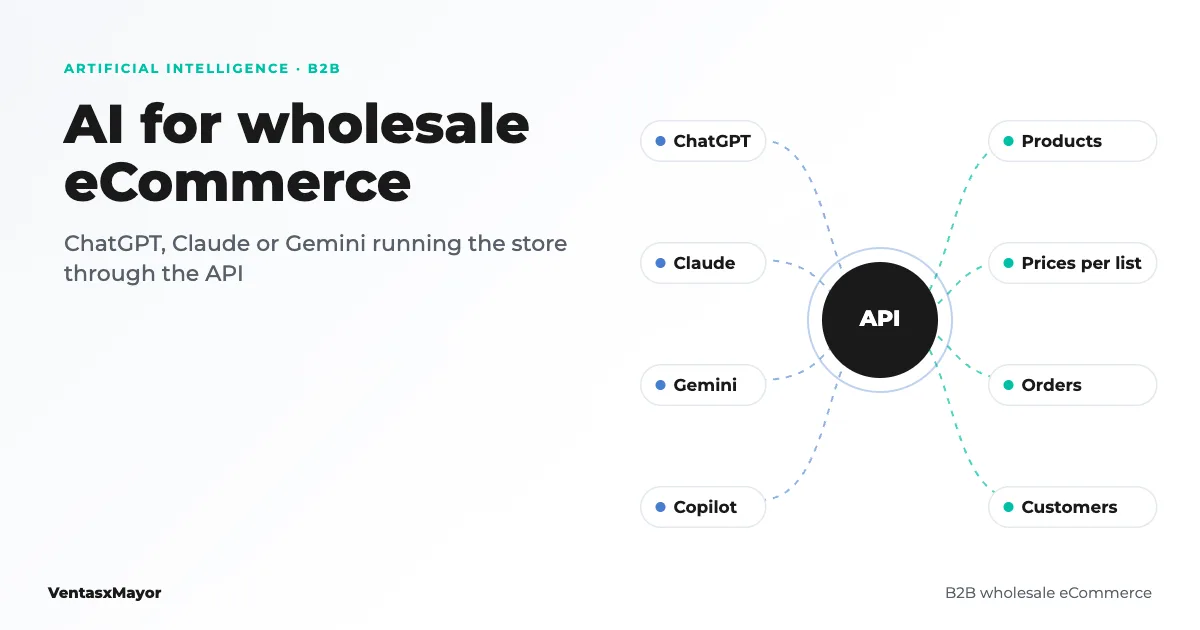
We hear it more and more often: a wholesaler tells us they use ChatGPT to write a product description or the monthly promo email, and in the same breath complains that Tuesday cost them three hours loading the supplier's new list, checking by hand which orders came in unpaid and blocking the customers accounting flagged as overdue. The AI is already on their desk. What it isn't in is their store.
That's the difference worth understanding before talking about "AI for eCommerce". One thing is a chat that writes for you. A very different thing is an agent that gets into the store, reads the 142 products in a category, shows you a table with the new price next to the old one, waits for your OK and applies it. The first saves half an hour. The second changes how a wholesale business is run.
AI for eCommerce: the one that writes and the one that operates
A while ago we published how to use ChatGPT in a wholesale eCommerce: descriptions, campaigns, customer replies. It still holds, but it fell short. In 2026 every assistant (ChatGPT, Claude, Gemini, Copilot, Grok, Mistral, DeepSeek) has a version that works on your computer, reads documentation and uses external tools. Which means: if the store has an API, the AI can operate it.
Our opinion is simple: an AI that doesn't touch your operation is an expensive copywriter. The real value shows up when the AI does what costs a team member hours today: loading and updating the catalog, moving whole price lists, reviewing the day's orders, cross-checking customers with debt, building the weekly report. All of that lives in the store, not in a Word document.
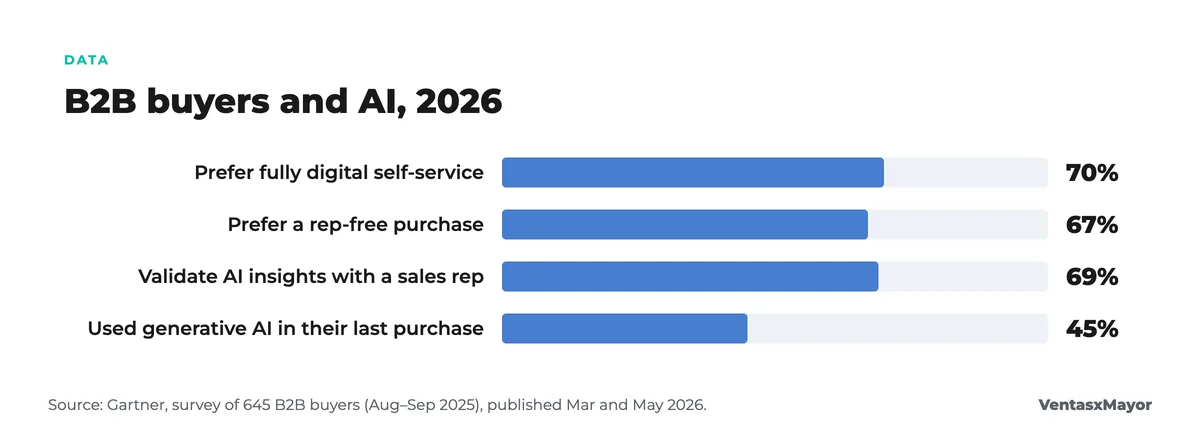
Buyers are already ahead. According to Gartner, 67% of B2B buyers prefer to buy without going through a sales rep and 45% used generative AI in their last purchase; at the same time, 69% validate what the AI told them with a person. And Deloitte found that 38% of B2B buyers use AI agents to evaluate products and configure orders, while only 13% of suppliers have their systems integrated end to end. The buyer already uses AI. The seller still doesn't have it in the store.
Everything an AI agent can do in the wholesale store
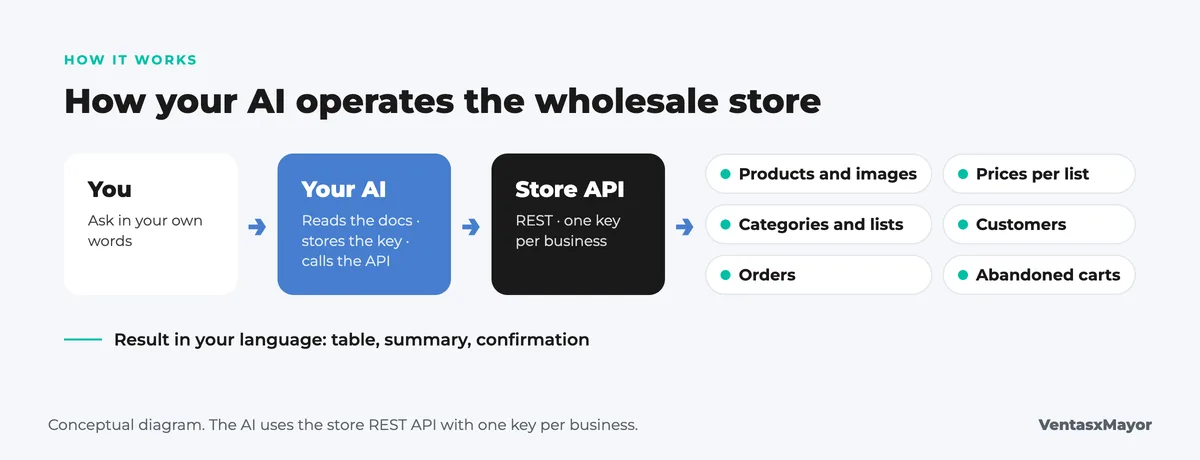
The rule is one: the AI can do everything the store's API allows. At VentasxMayor that is, today:
- Products and images. Create, edit and delete products by code, with their variants and categories. Upload and remove photos. Load 300 products from a spreadsheet, photos included, in a single instruction.
- Prices per list. Read and write the price of every product and variant on each wholesale list, without touching the others. "Raise the Wholesale B list 8% in Cleaning" is a sentence, not an afternoon.
- Categories and price lists. Create, rename, nest, sort and hide categories. Create new lists.
- Customers. Onboard buyers, edit their data and tax status, assign them a list and block them. They are never deleted: the history stays.
- Orders. List and read every order with items, totals, payment and shipping. Create orders on behalf of a customer, with the prices and discounts the store itself computes. Void and leave internal notes.
- Abandoned carts. See which customers left a cart built but not closed, so a rep can call them.
- Reports and routines. Cross all of the above to build the report that is done by hand today, and leave it running on its own every week.
And the list keeps growing: the API is the same one the integrated ERPs use, so every resource opened for an ERP becomes available to the AI the same day.
A day with the AI in a distributor
How the AI connects to the store: three steps and one prompt
Here's the part that surprises most people: there's nothing to code. We show it in under two minutes:

- Activate the API and copy the key. In the panel, under Settings → ERP, the API Token card. You activate the service and the key appears, with a Copy token button. It's the business's master key: treat it like a password.
- Open an AI that works on your computer. The browser chat isn't enough: you need the version that reads documentation and runs things. The Claude app (Code tab), Codex in ChatGPT, Gemini CLI, Copilot or Cursor. Any of them, with a new folder.
- Paste a prompt and fill in two values. The store address and the key. The prompt tells the AI where the full API documentation is, how to store the key without repeating it, how to test the connection and which rules to follow. The AI reads, connects and replies with what it can do.
The full prompt, each AI's menus and what to do if something fails are in the step-by-step guide to connect ChatGPT, Claude or Gemini to the store. What you'll type is two values; the AI does the rest.
The rules for handing over the keys without losing control
An AI connected to the API has the same power as an admin. That's why the connection isn't "I give it the key and that's it": it's "I give it the key and these rules". The four we see working:
- Read first. The first week, only queries and reports. Changes come once you've seen it understands your catalog, your lists and your customers.
- Confirm before changing. Every change is announced and waits for an OK. On big batches, a table with before and after and how many records it affects.
- The key never travels through the chat. It's stored once in the tool's settings and never shared with other people by message.
- Close with a summary. What changed, how many records, what's pending. On orders, internal notes leave the trail of who asked for what.
And there are two limits set by the store itself, not the AI: the orders it creates go through the same pricing, discount and stock engine as the cart (it can't make up a price), and customers are never deleted, only blocked. It matches what Gartner found: the buyer wants self-service but validates with a person. On the selling side it's the same: the AI executes, a person approves.
If a task is one a new employee would do with a checklist and without asking, give it to the AI. If they'd do it by asking, still give it to the AI, but with the confirm-before-changing rule.
What's next: the API keeps growing
Today the main path is the AI on your computer talking directly to the store's REST API. It's the simplest and the one that works with any assistant. From there, the same connected AI can build the more technical paths for you: a connector to use the store from the Claude, ChatGPT or Gemini chat app (the standard those apps use for external tools), an assistant for the whole team in ChatGPT or Microsoft 365 Copilot, or an automation that runs on its own every morning with n8n, Make or Zapier.
And the horizon is bigger than internal operations. Gartner projects that by 2028 most B2B purchasing will be intermediated by AI agents on the buyer's side: an agent that finds suppliers, compares lists and builds the order. When that arrives, the wholesaler whose store is already open through an API will be on the right side of the table. The VentasxMayor open API grows with every new resource it opens, and what the AI can do grows with it.
How VentasxMayor solves it
Everything above runs on the store's open API: the same one the integrations with Dux, Contabilium, Bling or Dragonfish use, with one key per business activated from the panel. An AI needs nothing special: it reads the API documentation, which is public, and operates. The AI agents page details what it can manage and the guide has the prompt to connect it.
There's a second AI on the platform, built for the other side of the counter: the AI Salesperson serves your buyers inside the store and quotes respecting each customer's price list. Two different things that complement each other: one sells, the other operates.
Monday checklist
- Write down the 5 store tasks that eat the most hours per week (price loads, unpaid orders, customer onboarding, reports).
- Pick an AI that works on your computer: Claude app, Codex in ChatGPT, Gemini CLI, Copilot or Cursor.
- Activate the API in the panel (Settings → ERP → API Token) and copy the key.
- Paste the guide's prompt with the store address and the key; let the AI read the documentation and test the connection.
- First week in read-only mode: the day's orders, out-of-stock products, list comparison.
- Second week, first change with a preview table and an OK: a price increase in a single category.
- Define who approves what: one person for prices and blocks, another for catalog.
- Ask the AI for the weekly summary as a routine and set a time to read it.
Frequently asked questions
What is AI for eCommerce and how is it different for a wholesaler?+
In consumer eCommerce, AI usually means recommendations and search. In wholesale, what weighs is the operation: hundreds of products, several price lists, customers with different terms and large orders. There, the useful AI is the one that operates the store through its API, with rules, not the one that suggests one more product in the cart.
Can I connect ChatGPT to my store without knowing how to code?+
Yes, if the store has a documented API. The path is to activate the API, copy the key and paste a prompt into the version of ChatGPT that works on your computer (Codex), or into Claude, Gemini or Copilot. The AI reads the documentation and connects on its own; the only things you fill in are the store address and the key.
Is it safe to give an AI access to the store?+
As safe as the key and the rules. The key is stored once in the tool and never shared over chat; the AI works read-first, confirms before changing and summarizes when done. The store also sets its own limits: created orders go through the pricing and stock engine, and customers are blocked, never deleted.
Does the AI replace the sales rep or the admin person?+
No. It replaces the copying, loading and checking part. The admin person moves from typing to approving, and the rep stops re-entering orders to focus on the customers who stopped buying. Digitizing orders was never about removing the rep; connecting an AI isn't either.
Sources
- Gartner Sales Survey Finds 67% of B2B Buyers Prefer a Rep-Free Experience, Gartner, 9 de marzo de 2026
- Gartner Survey Finds 69% of B2B Buyers Turn to Sales Reps to Validate AI-Generated Insights, Gartner, 20 de mayo de 2026
- Deloitte: 38% of B2B Buyers Now Use Agentic AI, MarketScale sobre el estudio de Deloitte, marzo de 2026
Next step
The AI you already use, with the keys to your store
VentasxMayor has an open API and a 3-step guide to connect ChatGPT, Claude, Gemini or Copilot without writing code. If you don't have the store yet, the demo shows it running with your catalog.

How to Use ChatGPT to Improve Your Wholesale eCommerce and Sell More
Discover how to use artificial intelligence to write product descriptions, create marketing campaigns, improve your SEO and sell more.

ERP integration for a B2B store: what to sync and what not to
What data must sync in real time, what can run on a batch, and the 6 ERP-store integration mistakes that break stock.
B2B customer portal: what it is, what it needs and how to roll it out
What a B2B customer portal is, what it needs for a wholesaler, how it differs from a rep portal and an online store, and how to launch it in five steps.