
What is a packing slip: what it is for, what it carries and a template to print
For the wholesaler who ships goods every day and for the buyer who just received a packing slip and is not sure whether it is a bill. What it is, how it differs from the invoice and the purchase order, which fields it must carry and a template ready to use.
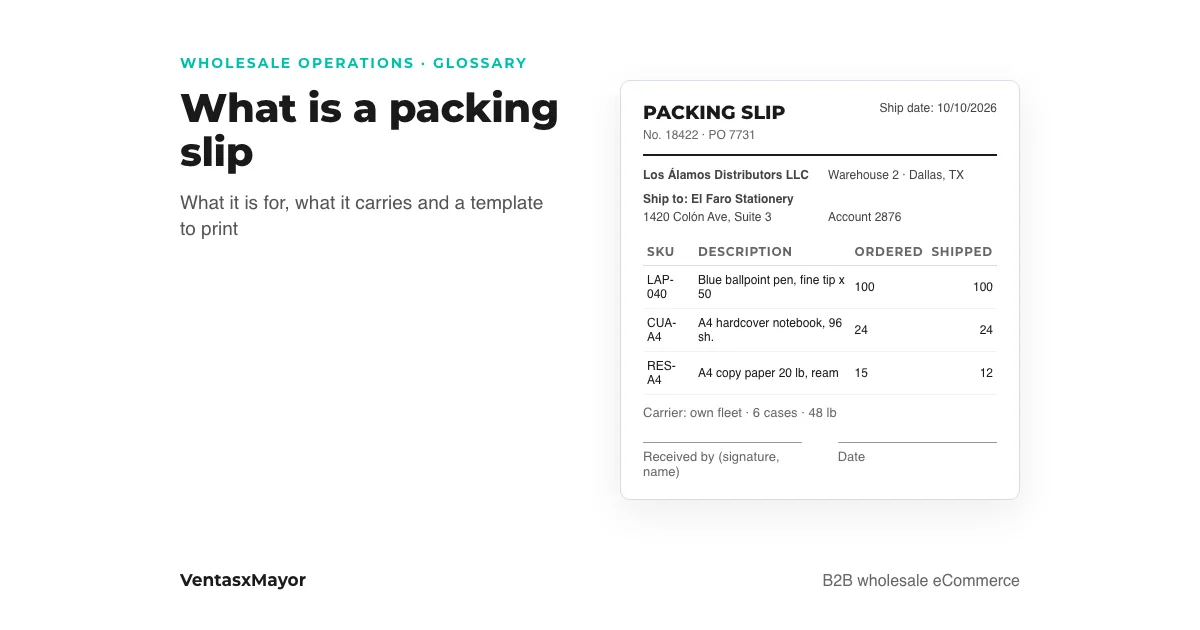
The truck pulls up, the driver unloads three cases and a sheet of paper, the receiving clerk signs and the sheet disappears into a drawer. Two weeks later, accounting calls because "a case was missing" and nobody can find the signed slip. Or the other way around: a store receives a packing slip and messages the supplier asking whether that is what they have to pay. Both scenes repeat at distributors in every category, and both come from the same place: the packing slip is the most used document in wholesale trade and the least explained.
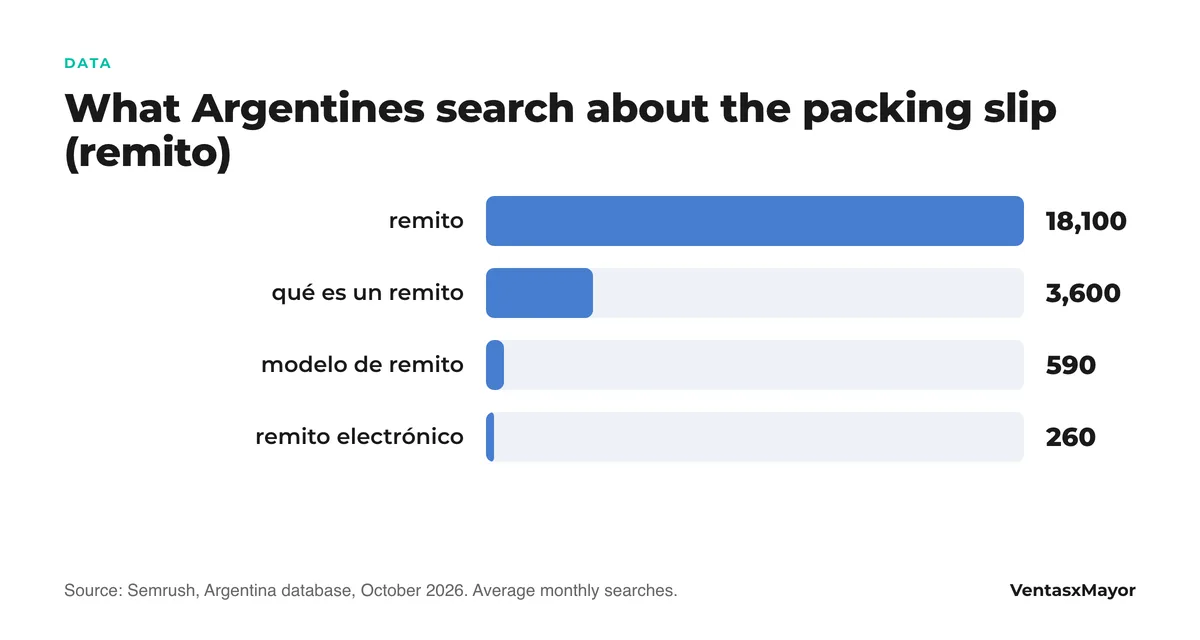
This article settles it: what a packing slip is, what it is for, how it differs from the invoice, the sales order and the purchase order, which fields it has to carry, what the digital version changes and a template to print or copy. In Latin America the same document has a different name in every country: remito in Argentina and Uruguay, nota de remisión in Mexico, guía de despacho in Chile, romaneio in Brazil. The job is the same everywhere: it travels with the goods and proves they were delivered.
What is a packing slip
A packing slip (also called a delivery note) is the document that travels with the goods from the seller’s warehouse to the buyer’s address and, once signed on receipt, proves what was delivered, how much and when. It does not replace the invoice: a packing slip does not need prices and is not paid.
In most of Latin America the document also has a legal role: in Argentina, when goods travel without the invoice, the remito is the mandatory document that backs the transport (General Resolution 1415 of the tax authority, now ARCA), and a delivery truck stopped at a checkpoint has to show one for everything on board. In the United States the packing slip has no tax role; the invoice and, for the carrier, the bill of lading do that work. The commercial role is the same everywhere: it is the proof of delivery.
What many distributors discover late is that the packing slip is also their best commercial defense. When a customer says "two cases were missing", the answer is not the driver’s memory: it is the signed slip where the receiving clerk accepted three. And when a customer disputes an invoice, the packing slip is the link between what was ordered, what was delivered and what is being charged.
At distributors that have taken orders over WhatsApp for years, the packing slip is often the only document that exists between the order and the invoice. When it is also written by hand or in a spreadsheet, every difference between what was ordered and what was shipped gets settled from memory. The problem is not the paper: it is that the slip gets written twice, once when the order is taken and again when it is picked.
Packing slip, invoice, sales order and purchase order: the differences
All four documents show up in the same sale and get mixed up because they carry almost the same data. The difference is who issues each one, when and for what:
| Document | Who issues it | When | What it is for | Prices? | Is it paid? |
|---|---|---|---|---|---|
| Purchase order | The buyer | Before the sale | Formally request the goods and set the terms | Yes | No |
| Sales order | The seller | When the order is taken | Record what the customer ordered and at what price | Yes | No |
| Packing slip | The seller | When the goods ship | Travel with the goods and prove delivery | Optional | No |
| Invoice | The seller | At the sale (before, with or after delivery) | Document the sale and the tax; it is what gets paid | Yes | Yes |
The most expensive confusion is packing slip versus invoice. A packing slip is never a bill, and a store should not pay against one: it pays against the invoice. The reverse is also true: a distributor that invoices but never issues packing slips has no proof of delivery, and loses every argument about shortages. The healthy setup is one signed packing slip per delivery, and an invoice that references it, whether it is issued on the spot or at the end of the fortnight for customers on net terms.
What a packing slip has to include
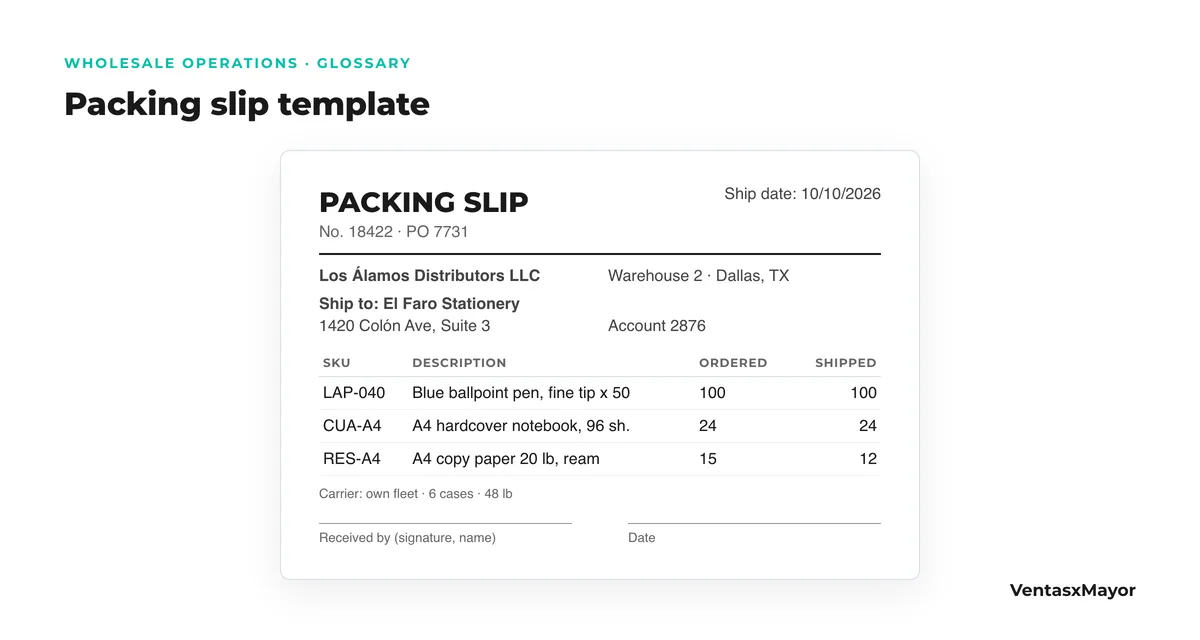
There is no single legal list in the United States, but a packing slip that does its job carries:
- Seller details: company name, address, phone and the warehouse it ships from.
- The words «PACKING SLIP» and a sequential number, with the ship date.
- References: the customer’s purchase order number and the sales order number, so receiving can match it in seconds.
- Ship-to details: company, delivery address, contact and the account number.
- Line detail: SKU, description, quantity ordered, quantity shipped and quantity back-ordered. Prices are optional and many distributors leave them out so the receiving dock does not see them.
- Packaging: number of cases or pallets, weight and carrier, plus the bill of lading or tracking number.
- Signature and printed name of whoever receives, with the date. No regulation requires it; common sense does.
In Latin America the lists are stricter: in Argentina the tax authority requires the issuer’s tax ID, the letter R in the header, an authorization code (CAI) and sequential numbering; in Brazil the fiscal role belongs to the NF-e and the packing slip (romaneio) is internal. If the goods cross a border, the commercial invoice and the packing list for customs are separate documents.
Packing slip template to print
The template below has every field from the list above in the order the receiving clerk reads them: first who ships and who receives, then what is coming, and the signature at the end. Copy it into a spreadsheet or a word processor, or use it as the checklist for the packing slip your ERP or your order management system prints.
Electronic and digital packing slips
In most countries the paper slip is on its way out. In Argentina, since April 2025 the tax authority allows system-generated packing slips to be shown and stored digitally, without printing, as long as the recipient gets an electronic copy, can confirm receipt and the issuer keeps it for at least two years. In the United States nothing stops a distributor from sending the packing slip as a PDF with the shipping notification and collecting a proof of delivery on the driver’s phone.
For a distributor this means the driver can show the slip on a phone and the delivery confirmation can be a tap or an on-screen signature instead of a crumpled sheet coming back on Friday. Whoever already prints packing slips from a system gets the change almost for free.
How the packing slip flows through a distributor
The packing slip is born from the order and ends in the invoice. Between those two points it passes through four pairs of hands, and at each one it can get lost or altered:
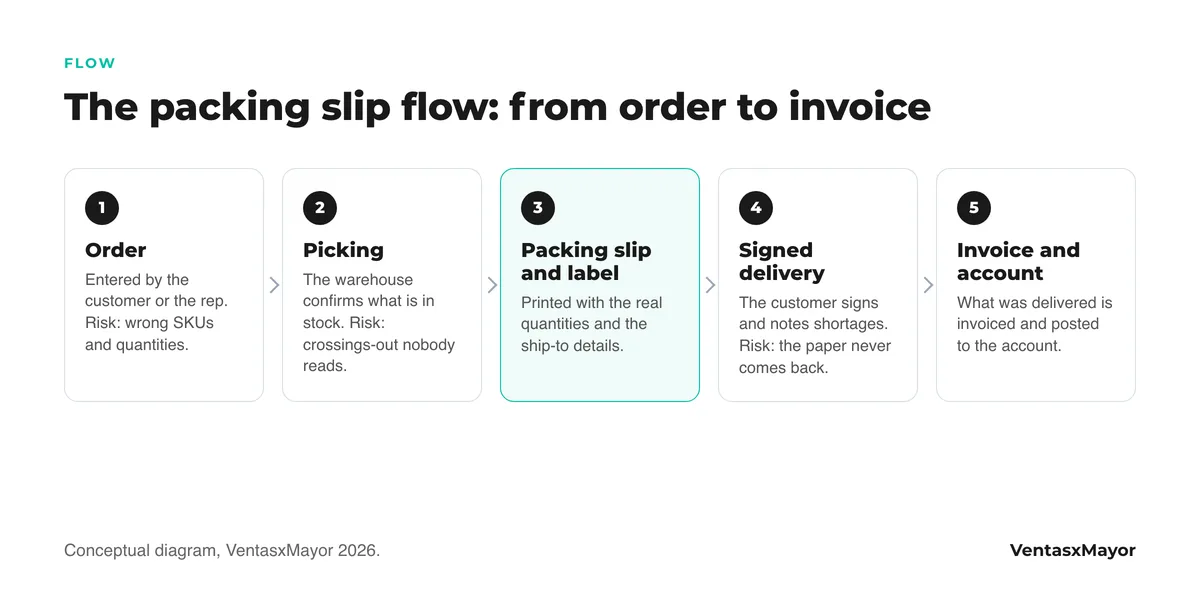
Here is the opinion, because we have one: a packing slip should never be written by hand or "copied over" from anywhere. If the order already exists in a system, the slip has to come out of that order, with the quantities the warehouse confirmed, and the invoice has to come out of the slip. Every time someone retypes a packing slip there is a shortage nobody will be able to prove. And every slip that comes back on paper on Friday is a customer who can dispute until Monday without anyone knowing what they signed.
How VentasxMayor solves it
In VentasxMayor the packing slip is not written: it is generated. The customer builds the order in their portal (or their rep enters it), the warehouse confirms it in order picking and the slip comes out of that, with the buyer’s details, the real quantities, line discounts and taxes itemized, sorted and grouped the way the warehouse wants it. The case label and the order spreadsheet for the ERP come out with it.
The slip stays in order management with a link to forward on WhatsApp, and the buyer sees it in their portal next to everything they ordered before. When the ERP is integrated, the invoice comes out of the same order, with nothing retyped. What Romina did on Mondays stops existing.
Checklist to get packing slips in order
- Every delivery has a packing slip, even for trusted accounts or sales on net terms.
- The slip comes out of the order already in the system, not copied by hand or from WhatsApp.
- The quantities on the slip are the ones the warehouse confirmed, not the ones the customer ordered.
- It carries a sequential number, the ship date, the customer’s PO number and the ship-to address.
- It has room for signature, printed name and date of receipt, and the driver does not leave without them.
- Shortages are written on the slip before signing, not in a message afterwards.
- The invoice references the packing slip number, whether it is immediate or end-of-month.
- Signed slips are kept (or scanned) for at least two years.
- The customer can see their packing slip without calling: in the portal, by link or by email.
Frequently asked questions about packing slips
Is a packing slip the same as an invoice?+
No. The packing slip travels with the goods and proves delivery; the invoice documents the sale and is what gets paid. A packing slip is never a bill, and a store should not pay against one.
Does a packing slip include prices?+
It is optional. Many distributors leave prices off so the customer’s receiving staff does not see the wholesale price; others include them so the slip doubles as a sales note. What must be there is the description and quantity of every line.
Who signs the packing slip and what if goods are missing?+
Whoever receives the goods on behalf of the buyer signs, with printed name and date. If something is missing or damaged, it is written on the slip before signing: that annotated slip is the proof for the claim and for the credit memo. A slip signed without remarks counts as delivery accepted.
Can a packing slip be digital, without printing?+
Yes. Nothing requires paper: the slip can go out as a PDF with the shipping notice and the proof of delivery can be collected on the driver’s phone. In Argentina, since April 2025 the tax authority expressly allows system-generated slips to be shown and stored digitally, as long as the recipient gets a copy and can confirm receipt.
Sources
- Resolución General 5678/2025: remitos en formato digital — Contadores en Red, abril de 2025
- ARCA habilita remitos digitales sin impresión obligatoria — Blog del Contador, abril de 2025
- El Código de Operación de Traslado (COT) en Argentina — Edicom, consulta de octubre de 2026
- Romaneio de transporte: o que é e como fazer — TOTVS, consulta de outubro de 2026
- Semrush, volumen de búsquedas en Google Argentina — octubre de 2026
Next step
The packing slip comes straight out of the order
In VentasxMayor every order generates its packing slip and its label with the buyer’s details, sorted the way the warehouse needs it, with a link to forward on WhatsApp and a copy in the customer portal.

B2B eCommerce glossary: 50 essential terms for wholesalers
From API to delivery zone: the 50 terms every wholesaler needs to know to digitalize their operation, grouped by topic.

Wholesaler, distributor and retailer: what each one is, the differences, margins and how they sell
What a wholesaler and a distributor are and how they differ: who they buy from and sell to, margins, minimums, terms and how they sell today. With 2026 data.

Net 30 terms explained: how to offer wholesale customers credit without losing money
What net 30, net 60 and 2/10 net 30 mean, how to set a credit limit per customer, what happens on day 31 and how to collect without chasing invoices. With Atradius 2026 data.