
Net 30 terms explained: how to offer wholesale customers credit without losing money
For the wholesaler, distributor or manufacturer who extends terms "because everyone does" and has nothing written down about who, how much or until when. What net 30, net 60 and 2/10 net 30 mean, how to set a credit limit per customer, what happens on day 31, and how to collect without the rep chasing invoices.
Almost every wholesaler extends terms. Almost none has them written down. We keep seeing the same scene: a new account asks for "net terms like everyone else", the rep says yes so as not to lose the order, nobody sets a limit, and four months later there is a balance of three invoices the owner discovers while checking the bank. The rep, paid a commission for selling, turns into a phone collector, which is what they do worst and get paid least for.
Net 30 is not a courtesy: it is credit. Per Atradius, in North America 43% of business-to-business sales are made on credit and 23% of those invoices are paid late. This post explains what the terms used in wholesale mean, how to decide who gets them and how much, and how to make day 31 something the system handles rather than a person.
What net 30, net 60 and 2/10 net 30 mean
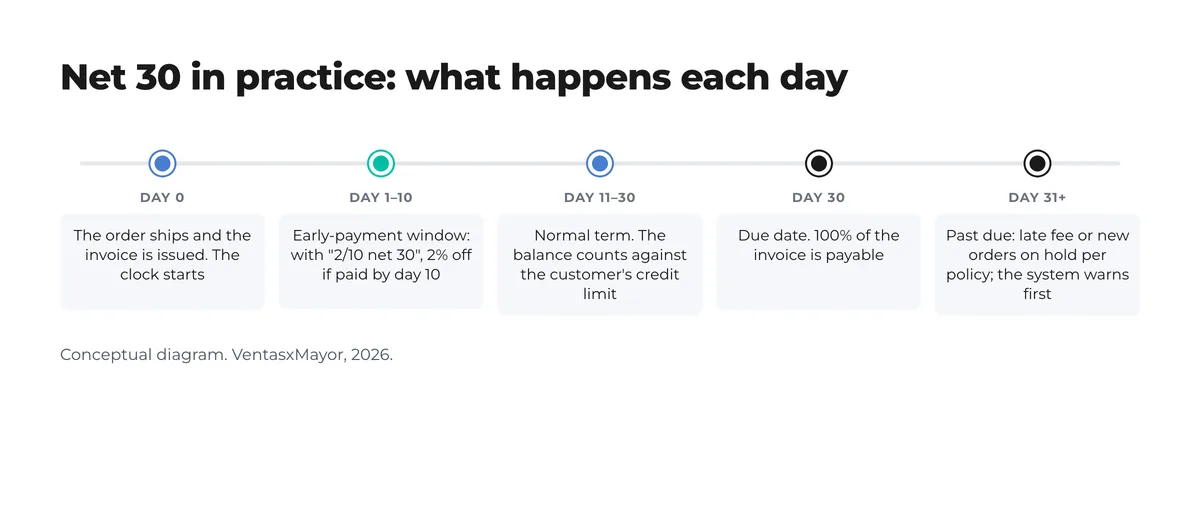
Net 30 means the invoice total is due 30 days after it is issued. Not 30 days after delivery or after month end, unless agreed that way: from the invoice date. Net 60 and net 90 are the same with more days; they are big-chain and import terms, not retail-store terms. 2/10 net 30 is the version with an incentive: 2% off if the customer pays within 10 days, and the full amount at 30. That 2% looks small and is not: annualized, paying on day 30 instead of day 10 costs the customer over 36% a year, so the customer with cash pays early and the one without shows they do not have it.
In Latin America the vocabulary changes ("cuenta corriente a 30 días", "30 días fecha factura", "prazo de 30 dias") but the mechanics are the same, and the real cycle is longer than the term: Atradius measures about two months from invoice to collection in North America.
Annual cost of skipping 2/10 net 30 = 2% ÷ 98% × 365 ÷ 20 days ≈ 37% a year. It is the interest the customer pays for 20 extra days of terms.
Who gets terms, and with what limit
The rule we see working is short: nobody starts on terms. The first three orders are prepaid or paid on delivery; after three orders paid on time, the customer moves to net 30 with a limit. And the limit is not invented: it is computed from what the customer buys.
Credit limit = average monthly purchases × (term in days ÷ 30) × 1.5. At $40,000 a month and net 30: $60,000. At net 60: $120,000.
The 1.5 leaves room for the customer to grow without asking permission every week; more than that is financing their expansion with your own cash. Three adjustments worth writing down: the limit is reviewed every quarter against real purchases; a delay of more than 15 days halves it until the account is current; and no rep can raise it alone, because the rep is paid for selling and the credit is the owner's money. On that basis, the price list and the payment terms go together on the customer record: distributor price on net 30 is not the same as distributor price prepaid.
What happens on day 31
Day 31 is where credit is lost or won, and where almost nobody has a rule. What works is a written, automatic ladder: a notice to the customer three days before the due date, with the balance and a link to pay; a notice on the due date; at 7 days past due, new orders go on hold until the account is current; at 30 days past due, the customer goes back to prepaid for three orders. None of it should be done by the rep over the phone: these are system messages with the balance visible in the portal, and the rep steps in only when there is something to negotiate.
Late fees can be charged, but in practice what disciplines collection is not the fee but the hold on the next order. A store that needs to restock pays the overdue invoice before the new order ships; a store that does not pay even then is a customer that should have stayed prepaid.
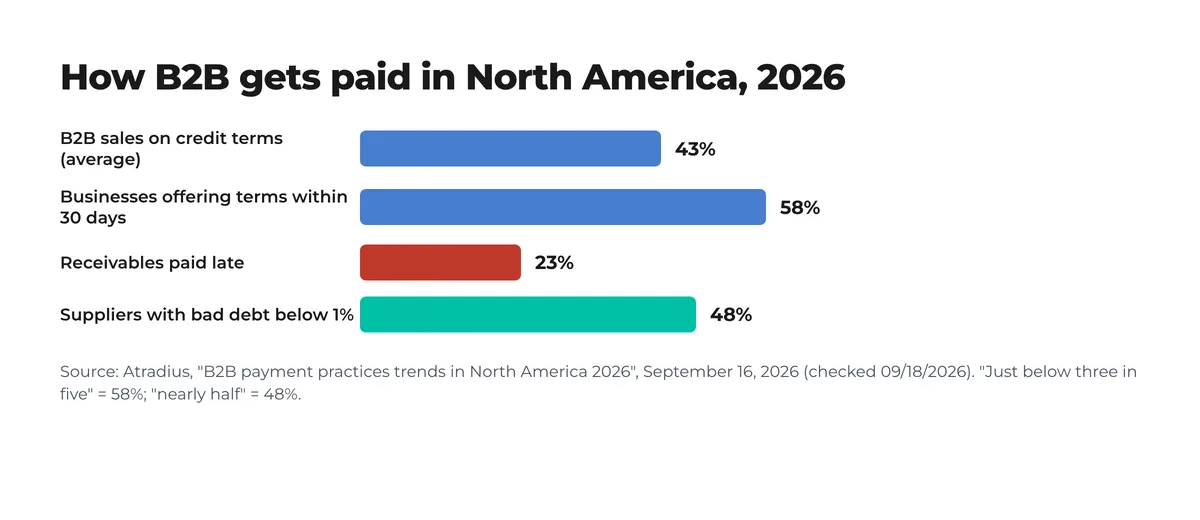
- 43%of B2B sales in North America are made on credit termsAtradius, sep 2026
- 23%of credit receivables are paid lateAtradius, sep 2026
- ≈ 37%a year is what skipping 2/10 net 30 costs the customerCalculation, VentasxMayor
How VentasxMayor handles it
Payment terms sit on each customer's record, next to their price list, minimum and discount: which methods are enabled (transfer, cash, net 30) and what they see at checkout. Every order syncs with the ERP so the account is reflected without double entry, and reps place orders under the customer's terms without changing them. The customer logs into the portal, sees their history and reorders; the credit policy in this post is written once and loaded per customer.
Checklist for writing the credit policy this week
- List the accounts on terms today and what each owes, by age.
- Set the entry rule: three prepaid orders before net 30.
- Compute the limit per customer: monthly purchases × (term ÷ 30) × 1.5, and load it.
- Decide whether to offer 2/10 net 30 and to which lists.
- Write the day-31 ladder: notice, notice, orders on hold at 7 days, prepaid at 30.
- Remove reps' power to raise limits; leave it with one person.
- Put the balance and invoices where the customer sees them without asking.
- Review the limits every quarter against real purchases.
Frequently asked questions
What does net 30 mean?+
That the invoice total is due 30 days after the issue date. It is the most common payment term in wholesale: the store buys, sells over the month and pays at the end. Net 60 and net 90 are the same with more days.
What does 2/10 net 30 mean?+
That the customer gets 2% off if they pay within 10 days, and otherwise pays the full amount at 30. Annualized, skipping the discount costs around 37% a year, so it is a way to get customers with cash to pay earlier.
How much credit limit should a customer get?+
A practical rule: average monthly purchases × (term in days ÷ 30) × 1.5. At $40,000 a month and net 30, $60,000. Reviewed every quarter against real purchases, halved after more than 15 days late, and never raised by a rep alone.
Should late fees be charged?+
They can be, but what disciplines collection is the hold on the next order, not the fee. A store that needs to restock pays the overdue invoice so the new order ships. The fee works as a signal; the orders-on-hold rule at 7 days past due is what actually collects.
Sources
- Atradius — B2B payment practices trends in North America 2026 (16 de septiembre de 2026; consultado el 18 de septiembre de 2026)
- Shopify Help Center — Shopify B2B features by plan: net terms y payment reminders en todos los planes (consultado el 17 de septiembre de 2026)
- Digital Commerce 360 — Gartner: two-thirds of B2B buyers prefer rep-free purchasing (17 de marzo de 2026)
- Portal del cliente — VentasxMayor, 2026
Next step
Payment terms, per customer and inside the same catalog
In VentasxMayor each customer has their payment methods enabled on their record (prepaid, transfer, net 30) and sees them at checkout; the account syncs with the ERP and the rep places orders under those terms, without changing them.
What is a wholesaler and what is a distributor: differences, margins and how they sell
What a wholesaler and a distributor are and how they differ: who they buy from and sell to, margins, minimums, terms and how they sell today. With 2026 data.

B2B customer portal: what it is, what it needs and how to roll it out
What a B2B customer portal is, what it needs for a wholesaler, how it differs from a rep portal and an online store, and how to launch it in five steps.

Wholesale price list by customer: how to stop emailing 5 different spreadsheets
One master list, three to five tiers, per-customer discounts and an effective-date policy. The method for ending the spreadsheet chase and invoicing the right price.