
What is a wholesaler and what is a distributor: differences, margins and how they sell
For whoever is starting a wholesale business, for the retailer thinking about selling to stores, and for the new rep who has to understand the trade. What each link does, which commercial rules it works under, and why a wholesaler is not "a store with lower prices".
"Wholesaler" is one of the most used and worst defined words in commerce. It gets used for the one who sells by the case from a warehouse on the outskirts, for the importer who brings in containers, for the one with a "wholesale prices" sign who sells one unit at a time, and for the distributor with twelve trucks delivering to supermarkets. They are different businesses, with different rules, and mixing them up costs money: whoever opens "a wholesale business" thinking it is a store with lower prices finds out in three months that there is no price list per customer, no minimums, no account terms, no reps, and that without those it is not wholesale, it is a store with a discount.
We have spent more than 8 years working only with manufacturers, importers, distributors and wholesalers, and this post is the definition we use: not the dictionary's, the trade's. What each link does, who it buys from, who it sells to and under which rules.
What a wholesaler is
A wholesaler buys in bulk from manufacturers or importers and sells, also in bulk, to businesses that resell. It does not sell to the end consumer: its customer is another business. That one sentence defines everything else. Because the customer resells, the wholesaler has to leave them margin, so its price is lower than the retailer's; because it sells in bulk, it works with minimums per product and per order, in cases rather than units; because the store buys every week, it extends payment terms and runs an account; and because it has hundreds of accounts with different volumes, it does not have a price: it has a list per customer type.
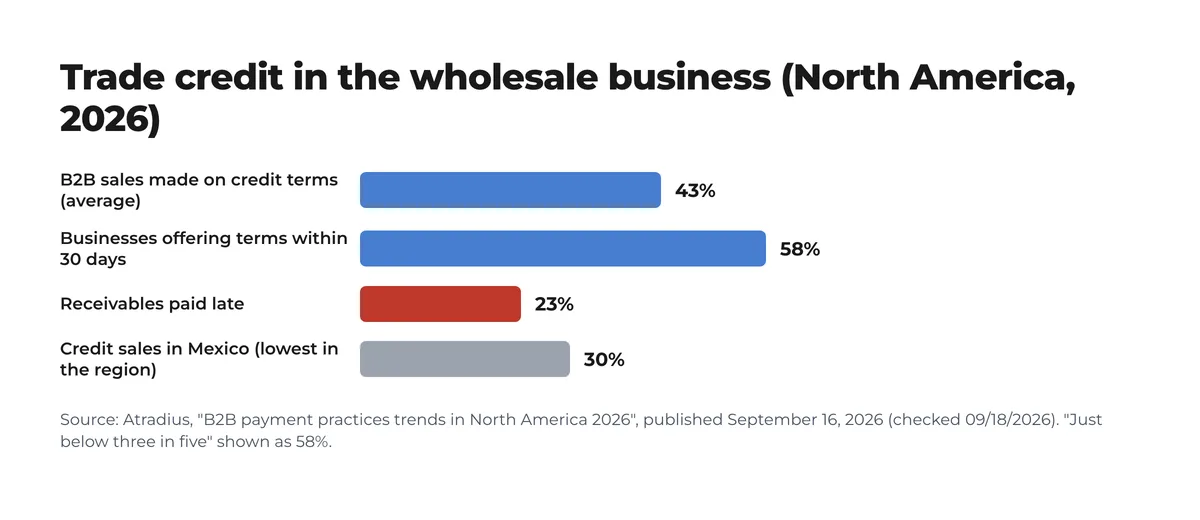
The other half of the definition is what the wholesaler puts in: capital to buy before selling, a warehouse to hold stock, logistics to deliver and credit to finance the retailer. In North America, per Atradius (September 2026), 43% of business-to-business sales are made on credit and 23% of those invoices are paid late. The wholesaler lives on the margin between what it finances and what it collects.
What a distributor is, and how it differs
A distributor is a wholesaler with a formal relationship with the manufacturer: it represents one or several brands in a territory, often exclusively, and in exchange commits to volumes, coverage and sometimes resale prices. The "pure" wholesaler buys from whoever suits it and builds its own assortment; the distributor builds its business around the brands it represents. In practice both do the same with the retailer: price list per customer, minimums, account terms, reps with portfolios. The difference is upstream, in the contract with the factory.
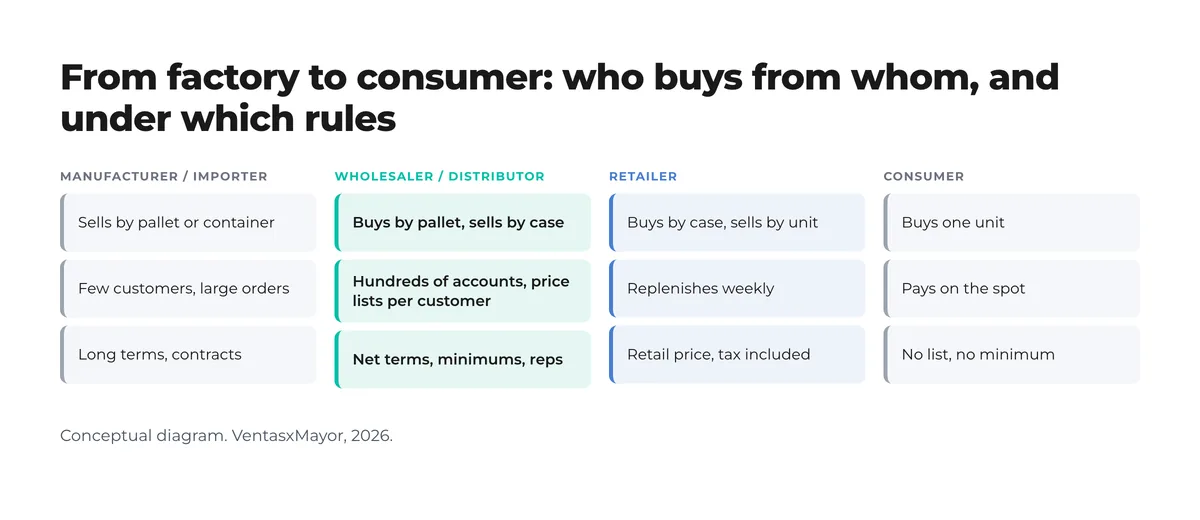
| Manufacturer / importer | Wholesaler | Distributor | Retailer | |
|---|---|---|---|---|
| Buys from | Raw materials / origin | Manufacturers and importers, by choice | The brands it represents | Wholesalers and distributors |
| Sells to | Wholesalers, distributors, key accounts | Businesses that resell | Businesses in its territory | End consumer |
| Selling unit | Pallet, container | Case, pallet | Case, pallet | Unit |
| Price | Contract | List per customer type | List per customer type, sometimes suggested by the brand | One, retail |
| Payment | Long terms | Net terms, 15–60 days | Net terms, 15–60 days | Cash |
| Sales force | Key accounts | Reps with portfolio and catalog | Reps with portfolio and route | Counter |
Margins, minimums and terms: the three rules of the trade
Margin. The wholesaler works on thinner margins than the retailer and makes up for it with volume. A product the retailer sells at 50% over cost, the wholesaler sells at 20 to 35% depending on the category and customer type. That is why a wholesaler cannot "make a price" per customer by eye: five points of discount on a pallet order are the order's entire profit. The price list per customer exists so that the discount is a rule and not a conversation.
Minimums. Selling by the case is not a preference: it is what makes the thin margin possible. Opening a case to sell three units costs the same in picking and freight as shipping the whole case. The minimum per product (the case) and the minimum per order (an amount or a number of cases) are the difference between a profitable order and one shipped at a loss.
Terms. The retailer buys today and sells over the month; paying in 30 days is what lets it restock. The wholesaler finances that cycle, which is why it keeps an account with a credit limit per customer. Per Atradius, just below three in five North American businesses offer terms within 30 days, and the full cycle from invoice to collection usually runs about two months. A wholesaler with no control over its receivables does not have a sales problem: it has a cash problem.
How a wholesaler sells today
For decades the wholesaler sold one way: the rep visited, took the order in a notebook and someone keyed it into the system. Then the notebook became WhatsApp and the system a spreadsheet, but the circuit stayed the same. What changed in recent years is not the channel but who builds the order. Per the Gartner survey published in March 2026, 67% of B2B buyers prefer to complete a purchase without talking to a sales rep; and per McKinsey, among B2B companies that sell online, e-commerce is now the top revenue channel.
For the wholesaler that means one concrete thing: the retailer wants to log into a catalog with their price, see their minimum and balance, and repeat last week's order in two minutes, at night if need be. The rep does not disappear: they stop copying orders and move to opening accounts and developing the ones they have. Digitizing orders does not mean removing the rep; it means no longer using them as a typist.
- 43%of B2B sales in North America are made on credit termsAtradius, sep 2026
- 67%of B2B buyers prefer to buy without talking to a sales repGartner, mar 2026
- USD 15.1 Tin U.S. manufacturer and distributor sales in 2025, +0.4%Digital Commerce 360, ene 2026
How VentasxMayor handles it
We work specifically with manufacturers, importers, distributors and wholesalers, and the platform is built on the three rules in this post: price lists per customer, minimums and volume discounts per product, and account terms with a credit limit. Reps have their own access with their portfolio and place orders at each customer's terms, and the retailer logs into the catalog, sees their price and reorders on their own. A flat monthly price, no per-user or per-rep fee.
Checklist for whoever starts selling wholesale
- Define in writing who counts as a wholesale customer: what they must show (tax ID, trade, storefront) to access the list.
- Build at least two lists (retailer and distributor) with margin on price, not markup on cost.
- Set the case as the minimum per product and a minimum per order that covers picking and freight.
- Decide the terms: prepaid for new accounts, net terms with a limit after the third order.
- Keep the retail price separate from wholesale: never both on the same sign or the same website.
- Assign each customer to a rep or to self-service, and measure orders per portfolio.
- Put the catalog where the retailer can order alone, with their price, minimum and balance.
- Review margins per list every quarter against real cost.
Frequently asked questions
What is the difference between a wholesaler and a distributor?+
Both buy in bulk and sell to businesses that resell, with price lists per customer, minimums and account terms. The difference is in the relationship with the manufacturer: the distributor represents brands in a territory, often with exclusivity and volume commitments; the wholesaler buys from whoever suits it and builds its own assortment.
Can a wholesaler sell to the public?+
It can, but it should be a separate channel, with another price and another list, because the retailer that resells will not buy from someone selling at the same price to its own customer. Many wholesalers run a retail counter at retail prices and a wholesale list with per-customer access.
What margin does a wholesaler work on?+
It depends on the category, but generally 20 to 35% on selling price, against 40 to 60% for the retailer. It is made up with volume and rotation. That is why discounting "by eye" is so expensive: five points on a pallet order can be the whole profit.
What is a pre-sell rep and how does it relate to the wholesaler?+
It is the wholesaler's or distributor's rep who visits stores and takes orders delivered later, with an assigned portfolio and commission. It is the trade's classic sales force; today it coexists with the catalog where the retailer orders alone. More on what a pre-sell rep is.
Sources
- Atradius — B2B payment practices trends in North America 2026 (16 de septiembre de 2026; consultado el 18 de septiembre de 2026)
- Digital Commerce 360 — Gartner: two-thirds of B2B buyers prefer rep-free purchasing (17 de marzo de 2026)
- Digital Commerce 360 — U.S. B2B sales top $15 trillion (26 de enero de 2026)
- McKinsey — B2B Pulse 2024 (12 de septiembre de 2024)
Next step
A catalog that runs on the wholesaler's rules
VentasxMayor works specifically with manufacturers, importers, distributors and wholesalers: price lists per customer, minimums per product, account terms and reps with portfolios, in a store where each retailer logs in and sees their own.
What is B2B? Meaning, how it works, types and examples
What B2B means, how it differs from B2C, the four types of business-to-business company, examples across Latin America and how B2B selling changed in 2026.
B2B vs B2C online store: key differences and how to choose the right one
Pricing, catalogs, credit and buying process: the operational differences between B2B and B2C models and when to combine them.
What is a pre-sell rep: the job, the pay and how online ordering changes it
The pre-sell rep visits stores on a fixed route and takes the order the delivery route ships later. The job, the pay, how it differs from van sales and how distributors run pre-sell.