
What is a pre-sell rep: the job, the pay and how online ordering changes it
For anyone who saw a "pre-sell rep" job ad and wants to know what it involves, and for the distributor with three reps on the road who wants more out of them. What the job is, how routes are built, how reps are paid and what happens to the role when customers start ordering on their own.
"Pre-sell sales rep for a food distributor, own vehicle required." The job ad repeats on every hiring site and almost never explains the role. On the other side of the counter something similar happens: distributors with three or four reps on the road who are not entirely sure how much of those people’s day is selling and how much is writing things down.
We have been running into this for more than eight years, watching how wholesalers and distributors of beverages, food, cosmetics, hardware and stationery sell. The pre-sell rep is the central figure in almost all of them, and also the one who loses the most time on tasks that are not selling. Here is what the role is, what a route day looks like, how reps are paid, how they differ from other sales roles and what happens to the job when customers start ordering on their own.
What is a pre-sell rep
A pre-sell rep is the salesperson of a distributor, wholesaler or manufacturer who drives a fixed route of stores, takes the order at each one and sends it back to the company; the goods are delivered later by the delivery route. They sell before the truck leaves, hence "pre-sell".
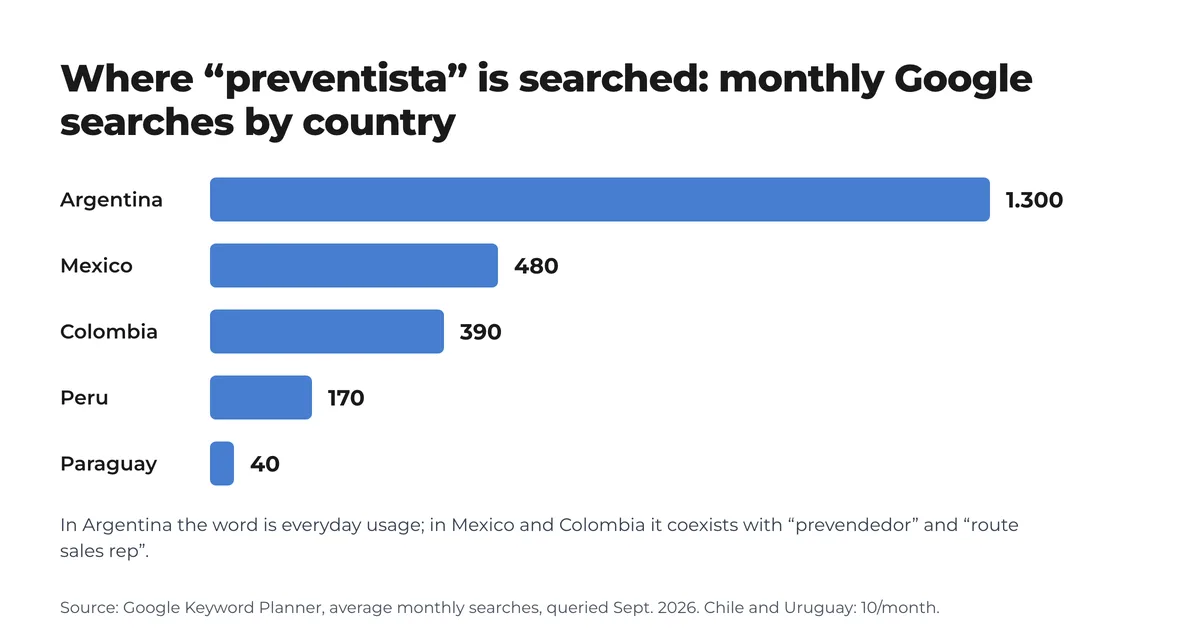
In Spanish-speaking Latin America the role has its own name, "preventista", and the chart below shows how regional the word is: Argentina searches for it ten times more than any other country. In Mexico and Colombia the same job shows up as "prevendedor" or "vendedor de ruta"; in Brazil it is the "pré-vendedor"; in US direct-store-delivery it is simply the pre-sell rep or route sales rep. The work is the same everywhere: the person who keeps the relationship with each store alive and who decides, week after week, how much the distributor sells.
It is a consumer-goods and distribution job: beverages, food, cleaning products, confectionery, cosmetics, hardware, stationery. Almost any product sold in hundreds of small stores gets there because a pre-sell rep stopped by to take the order.
What a pre-sell rep does on a route day
Job ads compress it into one line ("visit customers on preset routes, days and times; meet sales targets; follow up on collections"). In practice, a day looks like this:
- The day’s route. Between 15 and 25 stores, always the same ones for that weekday. Monday is the north side, Tuesday downtown. The store owner knows the rep comes on Thursday and holds the order for then.
- The visit. Check the shelf and the back room, see what is missing, suggest what moves, mention this week’s promotion and take the order. At many distributors the rep also collects on account or picks up the check.
- The order. Written in a notebook, on a route sheet, in the company’s own app or in a WhatsApp message to the warehouse. It has to reach the company before the cut-off time to ship the next day.
- The transmission. Someone keys it into the system: the rep at night, an admin in the morning or the warehouse. This is where time is lost and errors appear: codes written five different ways, prices from the wrong list, quantities in units when they were cases.
- The delivery. The next day, or two days later, the delivery truck arrives with the goods and the invoice. If something is missing, the complaint goes to the rep, not the driver.
Of the five steps, only two are selling. The third and fourth are writing and re-writing. At a distributor with three reps and 400 orders a week, that is hundreds of orders someone types twice.
Pre-sell rep, salesperson, driver and van sales: the differences
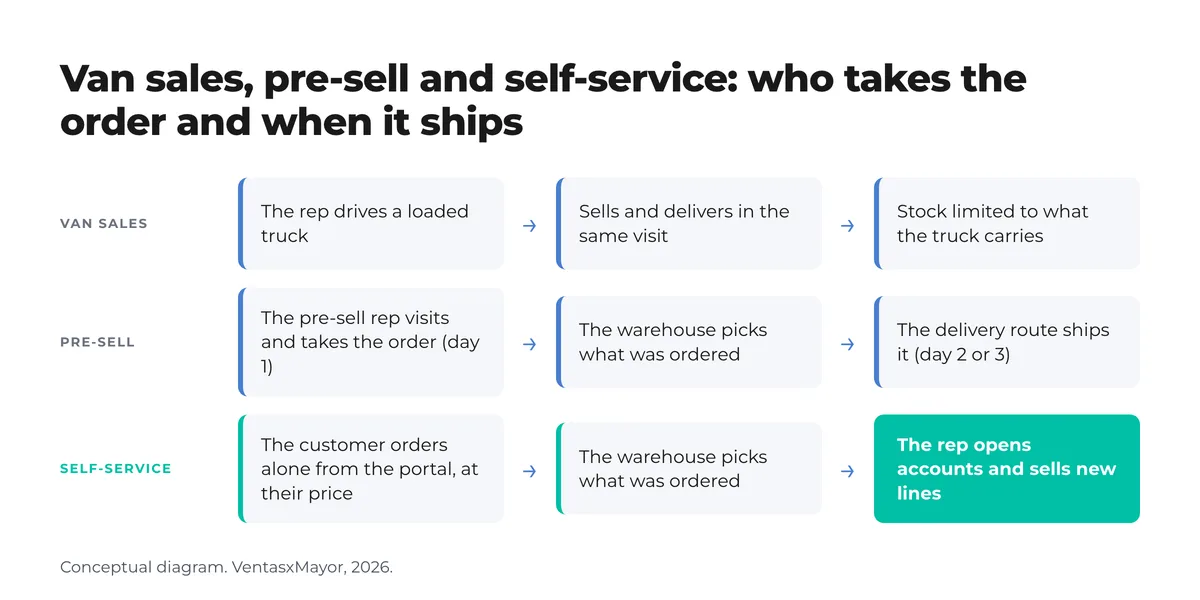
The most repeated question is "what is the difference between a salesperson and a pre-sell rep". Every pre-sell rep is a salesperson; not every salesperson is a pre-sell rep. The difference is where they sell, to whom and whether they deliver:
| Role | Where they sell | To whom | Delivers? | What defines the job |
|---|---|---|---|---|
| Pre-sell rep | On the road, fixed route | Stores (convenience, grocery, pharmacy) | No: the delivery route ships later | Frequency and portfolio: the same accounts every week |
| Van sales (driver-sell) | On the road, loaded truck | Stores | Yes, on the same visit | Sells what the truck carries; fits fast-moving, narrow assortments |
| Inside / counter sales | At the warehouse or showroom | Walk-in trade customers | Customer picks up | Waits for the customer; no route |
| Territory / outside sales | Travelling, wide territories | Distributors, chains, key accounts | No | Monthly or seasonal visits, large orders |
| Delivery driver | On the delivery route | The rep’s customers | Yes | Delivers, collects and brings back returns; does not sell |
How pre-sell reps are paid and what the job requires
There is no single pre-sell salary: there is a pay mix. Almost every job ad posted in September 2026 describes it the same way: a base, a commission on sales or on collections, and mileage or fuel when the rep drives their own vehicle. The proportion changes by company and category; in beverages and consumer goods commission weighs more, in high-ticket, low-frequency categories the base weighs more. Actual figures are best checked in current listings, because they vary a lot by market.
What they ask for: a vehicle or a licence, availability to be on the road the whole day, basic comfort with an app or a phone, and something no ad writes down but everyone evaluates: that the store owner wants to see the rep walk in every week. A rep whose customers hold the order for them is worth more than one who sells a lot one month and disappears.
The four types of salespeople people also ask about are, in wholesale, the ones in the table above: counter or inside sales, the route or pre-sell rep, the territory rep and, increasingly, the one who sells by phone or manages the orders that come in on their own through the online store.
How a distributor runs pre-sell
On the company side, pre-sell is a four-piece machine: portfolio, route, terms and measurement. When one is missing, the rep fills the gap with memory and goodwill, and that is where problems start.
- Assigned portfolio. Every store has one responsible rep, and only one. Without it you get "orphan" accounts nobody visits and accounts two reps fight over.
- Route and frequency. Which day each customer is visited and how often: weekly for the convenience store, biweekly for the large grocer who buys in volume. Frequency is a commercial decision, not a rep’s habit.
- Terms per customer. Which price list applies, the minimum order, whether they pay upfront or on account and up to what limit. If this lives in the rep’s head, it leaves with them when they quit.
- Measurement. Three numbers are enough to know how a route is doing: strike rate (of every 10 visits, how many end in an order), average order value and lines per order (how many different products each customer takes). A rep who raises lines per order is developing the account; one who only holds the ticket is taking dictation.
The rep should not be copying orders
Here is the opinion, because we have one. The problem with pre-sell is not WhatsApp or the notebook: it is that the order the rep already took gets keyed in again by someone else. Every time an order is typed twice there is an hour that was not spent selling and a chance for error. And every time a customer’s price, minimum or credit lives in the rep’s memory, the distributor depends on that person not getting sick, not quitting and not making a mistake.
Digitising pre-sell is not handing the rep a tablet to do the same thing on a screen. It is the order being entered once, at that customer’s correct price, and the rep seeing their portfolio: what each account ordered, who stopped ordering, how much they have sold this week. That is the point where the rep stops being a note-taker and goes back to being a salesperson.
What happens to the rep when the customer orders alone
- 2/3of B2B buyers prefer remote interactions or digital self-service over in-person visitsMcKinsey B2B Pulse, 2024
- 1.300monthly searches for "preventista" in Argentina: the role still exists and is still being hired forGoogle Keyword Planner, sept. 2026
The question every distributor asks when it opens a B2B store is whether the rep becomes redundant. What we see is the opposite: the job changes. The store owner who already knows what they want would rather enter the order at 10 pm from their phone, with their price and live stock in front of them, than wait for Thursday. That replenishment order, the one that repeats every week, is what moves to the portal. What is left for the rep is what no store does on its own: opening new accounts, winning back the one who stopped ordering, getting the new line onto the shelf, collecting from the one who is late.
For that to work, the rep needs to see what the customer does on their own. That is what a platform built for wholesalers solves: in VentasxMayor each rep logs in with their own user and sees only their portfolio, enters orders on behalf of their accounts with each one’s price list, discount and minimum, and gets notified when one of their customers orders alone from the store. WhatsApp orders do not disappear: they stop being the system.
Checklist to get pre-sell in order
- Every customer has one assigned rep, and none has two.
- Visit frequency is decided per customer (weekly, biweekly), not by habit.
- Each customer’s price list, minimum and credit are in the system, not in the notebook.
- The order is entered once, at the moment it is taken, at that customer’s price.
- The rep sees their portfolio: this week’s orders, customers who did not order, ticket and lines per order.
- There is a clear cut-off time for next-day shipping.
- Delivery complaints are logged, not left in a message to the rep.
- Customers who already order on their own are identified, and the rep knows who they are.
- Commission is calculated from system data, not from a spreadsheet the rep builds.
Frequently asked questions about pre-sell reps
What is the difference between a salesperson and a pre-sell rep?+
A pre-sell rep is one kind of salesperson: the one who drives a fixed route of stores, takes the order and does not deliver, because the delivery route comes later. A counter salesperson waits for the customer at the warehouse; a territory rep visits large accounts monthly; a van-sales rep sells and delivers on the same visit from the truck.
How much does a pre-sell rep earn?+
It depends on the company and the category, but the structure is almost always the same: a base, a commission on sales or collections, and mileage or fuel when the rep drives their own vehicle. In consumer goods commission weighs more. Actual amounts vary a lot by market: current job listings are a better guide than any average.
What is a pre-sell rep at a beverage or snack distributor?+
The same job at consumer-goods scale: large beverage and snack brands almost always work on a pre-sell model. The rep visits the stores on their route, takes the order, tidies the display and communicates promotions; the delivery truck ships the next day. That is why those companies and their distributors advertise for pre-sell reps with a vehicle and an assigned territory.
What does it take to be a pre-sell rep?+
A vehicle or a driving licence, availability to be on the road all day, basic comfort with a phone or the company app, and consistency: the value of the rep is that the store expects them every week. No degree is needed; knowing the products and being able to read a shelf is.
Does a B2B online store replace the pre-sell rep?+
No: it takes over the replenishment order, the one that repeats every week and that the customer would rather enter alone. The rep is left with what the store does not do: opening accounts, winning back inactive customers, selling new lines and collecting. For that they need to see their portfolio and be notified when one of their customers orders on their own.
Sources
Next step
Every rep with their own portfolio, every customer with their own price
In VentasxMayor each rep logs in with their own user, sees only their accounts and enters orders at each customer’s price, discount and minimum. When the customer orders alone from the store, the rep gets notified.
WhatsApp Business for wholesale sales: complete guide to automated messages
Set up automated messages, quick replies and connect WhatsApp with your B2B platform: the portal takes the order, WhatsApp notifies.
B2B customer portal: what it is, what it needs and how to roll it out
What a B2B customer portal is, what it needs for a wholesaler, how it differs from a rep portal and an online store, and how to launch it in five steps.
What is B2B? Meaning, how it works, types and examples
What B2B means, how it differs from B2C, the four types of business-to-business company, examples across Latin America and how B2B selling changed in 2026.