
Outside sales rep in wholesale: the job, the pay and how a portal changes it
For anyone who wants to understand the role before taking it, and for the wholesaler or manufacturer with reps on the road who wants them selling instead of transcribing. What an outside rep does, how they are paid, how the job differs from route sales and what changes when the order is entered once.
The outside sales rep is the oldest figure in wholesale trade and the one that has changed the least in fifty years. They cover a territory, know every customer by name, negotiate, take the order and earn a commission. What did change is everything around the order: the catalog that used to be a sample case is now a PDF sent over WhatsApp; the notebook became photos; and when the order reaches the company, someone keys it in again.
We have been watching that loop for more than eight years at wholesalers, importers and manufacturers across the Americas, and the pattern repeats: the outside rep sells well and loses a huge part of the day to tasks that are not selling. Here is what the job is, how reps are paid, how it differs from route and inside sales, and what changes when the order is entered once.
What is an outside sales rep
An outside sales rep sells a wholesaler’s, importer’s or manufacturer’s products by visiting customers across a territory, with an assigned portfolio, and is paid largely on commission over what they sell.
There are two ways to hire one, and it matters which. The employed rep earns a base plus commission and has the rights of any employee. The independent rep (manufacturer’s rep, agent, 1099 contractor in the US) invoices the company, usually carries several non-competing lines and lives entirely on commission.
In both cases the rep’s asset is the same: the portfolio. The customers who know them, hold the order for them and call when something runs out. That is why the relationship with the company always strains at the same point: who owns the account.
What an outside rep does in a day
- Prospect. Open new accounts in the territory: stores buying from a competitor, businesses that just opened, customers that were lost. This is what separates the rep from the route rep, who only maintains a route.
- Visit and present. Show the line, the new items and this month’s promotion. Once with a sample case; today with the catalog on a phone.
- Negotiate. Price by the customer’s list, volume discount, payment terms, minimum. The clearer the terms are inside the company, the less gets negotiated at the door.
- Take the order. Notebook, spreadsheet, WhatsApp or app. This step decides whether the order is entered once or twice.
- Follow up. That the delivery arrived complete, that the invoice is right, that the customer reorders. At many wholesalers the rep also collects or manages the account.
Outside rep, route rep, inside sales: the differences
| Role | Relationship | How they are paid | What they do with the portfolio |
|---|---|---|---|
| Outside sales rep | Employee or independent | Base + commission, or commission only | Opens and develops it: new accounts, new lines |
| Route / pre-sell rep | Almost always employee | Base + commission + mileage | Maintains it: fixed route, same stores every week |
| Inside / counter sales | Employee | Base + commission | No portfolio: serves whoever walks in |
| Manufacturer’s rep / agent | Own company, invoices | Commission only | Owns it: usually carries several lines |
The question "is a rep the same as a salesperson?" has a short answer: every rep sells, but the independent rep is a business in their own right, with their own portfolio and several lines; the salesperson is part of the company that hires them.
How outside reps are paid
There is no outside-rep salary: there is a commission and, depending on the relationship, a base. Commission is calculated on sales or, more often, on collections, and the company sets the rate by line, by account or by target. Actual figures depend on the category and the market; any average is stale within a month.
What is constant is where the arguments come from: the settlement. A commission calculated by hand on a spreadsheet the rep builds themselves is a guaranteed monthly argument.
What it takes to be an outside rep
Knowing the product and the category better than the customer, a territory with real presence, a vehicle or a way to move, and persistence: a portfolio is built through visits that sell nothing for months. If independent, also: a legal entity to invoice from, a clear contract on commission and territory, and written rules on who owns the account when the relationship ends.
On the company side: how to run an outside sales force
A wholesaler with four outside reps has four portfolios, four ways of writing things down and, without structure, four versions of the price list. What puts an outside sales force in order is the same across categories:
- Assigned, written-down portfolios. Every customer has a rep, and any customer with none shows up on an "orphans" list someone has to pick up.
- One price list per segment, with each customer’s discount and minimum set by the company, not renegotiated at every visit. The rep sells within those rules.
- Targets per rep beyond revenue: new accounts opened, customers won back, lines per order.
- Commission that calculates itself, on the orders in the system, with the rule visible to the rep before month end.
- Portfolio visibility: how much each customer ordered, who stopped ordering, which rep is behind each order, even when the customer entered it alone.
The rep’s order is entered once
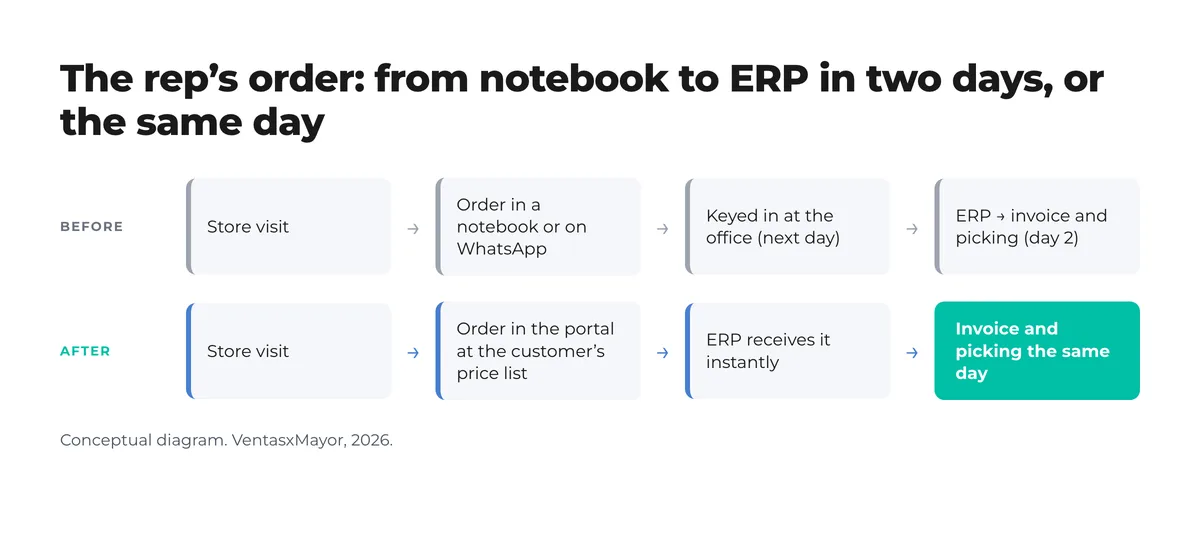
Our position is simple: the rep should sell and develop accounts, not copy orders from WhatsApp into an ERP. Every order typed twice is an hour of selling lost and an error waiting to happen. And a commission nobody can see until month end is a rep who does not know whether one more visit is worth it.
What changes with a portal built for wholesalers is that the order is born inside the system. In VentasxMayor each rep logs in with their own user and sees only their portfolio, enters orders on behalf of the customer at the price list, discount and minimum the company defined, the ERP receives it through the integration, and commission is calculated automatically on those orders. When one of their customers orders from the store without calling, the rep gets notified and the order still counts toward their portfolio. The rep does not disappear: they stop being the bottleneck.
Checklist for an outside sales force that sells
- Every customer has a rep assigned in writing; there is a list of customers with no rep.
- Price list, discount and minimum per customer set by the company and visible to the rep.
- The order is entered once, during the visit, at that customer’s price.
- The rep sees their portfolio: orders, customers who did not order, lines per order.
- Commission is calculated on system orders and the rep sees it before month end.
- Targets that include new and recovered accounts, not only revenue.
- Written rules on the portfolio when the relationship ends.
- Orders the customer enters alone stay attributed to the rep who owns the account.
Frequently asked questions
How much does an outside sales rep earn?+
It depends on the relationship and the category: base plus commission if employed, commission only if independent. Commission is usually calculated on collections, at rates the company sets by line or target. Amounts vary by market and month; current listings are a better reference than any average.
What is the difference between a rep and a salesperson?+
The independent rep is a business in their own right: they invoice, own their portfolio and usually carry several non-competing lines. The salesperson is an employee of the selling company, with a base, commission and employee rights. Both sell; what changes is who owns the portfolio and the risk.
What are an independent rep’s obligations?+
Those set in the contract: territory, exclusivity or not, targets, how orders are transmitted and how the customer is informed. Plus those of any business: invoicing and taxes. The contract should state in writing who owns the portfolio when the relationship ends.
What is a sales rep at a beverage or consumer-goods company?+
In consumer goods the role called "rep" is usually a route or pre-sell rep: they drive a fixed route of stores, take the order and the delivery route ships later. The difference from an outside rep is that they barely prospect: they maintain a route that already exists. We explain it in what is a pre-sell rep.
Does a B2B portal replace the outside rep?+
No: it takes over routine replenishment, which the customer would rather enter alone, and the double entry of the order. The rep is left to open accounts, win back customers and sell new lines, and still earns commission on their portfolio’s orders, whether they or the customer entered them.
Sources
- Lei nº 4.886, de 9 de dezembro de 1965 — Regula as atividades dos representantes comerciais autônomos. Presidência da República, Brasil
- Representante comercial: o que faz, quanto ganha e como se tornar um — Sólides Vagas, julho de 2026
- Google Keyword Planner — média mensal de buscas no Brasil, consulta de setembro de 2026
- B2B Pulse — McKinsey & Company, 2024
Next step
Every rep with their portfolio, every order entered once
In VentasxMayor each rep logs in with their own user, sees only their accounts, enters orders at each customer’s price list and minimum, and their commission is calculated automatically. When one of their customers orders from the store, they get notified.
What is a pre-sell rep: the job, the pay and how online ordering changes it
The pre-sell rep visits stores on a fixed route and takes the order the delivery route ships later. The job, the pay, how it differs from van sales and how distributors run pre-sell.
B2B customer portal: what it is, what it needs and how to roll it out
What a B2B customer portal is, what it needs for a wholesaler, how it differs from a rep portal and an online store, and how to launch it in five steps.

Wholesale price list by customer: how to stop emailing 5 different spreadsheets
One master list, three to five tiers, per-customer discounts and an effective-date policy. The method for ending the spreadsheet chase and invoicing the right price.