
What is B2B? Meaning, how it works, types and examples
For anyone selling to other businesses, or about to start, who wants the model explained without fluff. Definition, differences from B2C, the four types of B2B business, real examples and how companies sell to companies in 2026.
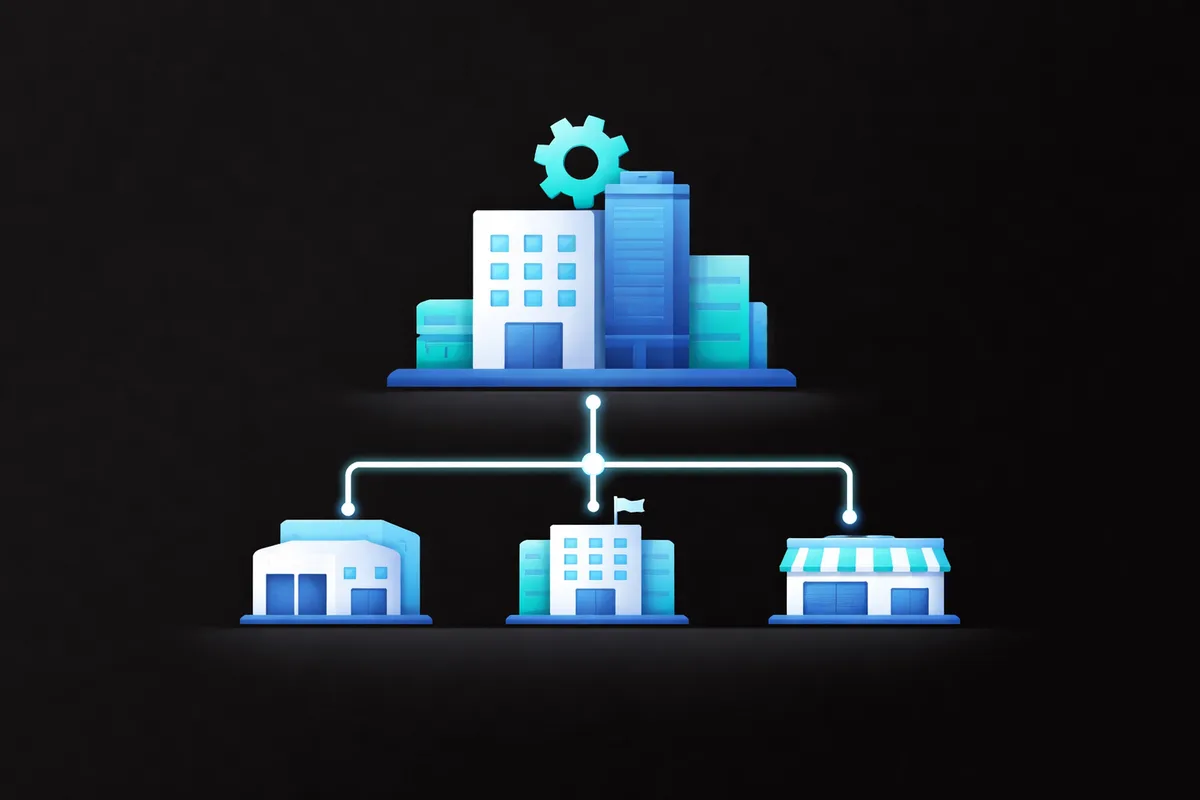
A cosmetics manufacturer selling to 40 perfume shops, a beverage distributor delivering to 300 convenience stores, a tool importer supplying hardware stores: all three are B2B businesses and none of them sells to the public. Yet when someone searches "what is B2B" they mostly find definitions written for software startups, examples from multinationals and very little about the business-to-business trade that carries the most weight in the real economy: wholesale.
This guide explains what B2B means, how a sale between companies works step by step, how it differs from B2C, what the four types of B2B business are and what changed in 2026, with examples from the Americas.
What is B2B
B2B (business-to-business) is the business model in which a company sells products or services to another company, not to the end consumer.
The acronym describes the customer, not the product. A cookie manufacturer selling to a distributor is doing B2B; the same manufacturer selling to walk-in shoppers at its factory outlet is doing B2C. That is why many companies are both at once, and why the useful question is not "what do I sell" but "who buys from me and what do they need in order to buy".
What makes B2B different is everything around the sale: the buyer is a company that resells the product or uses it to produce something, buys in volume, buys repeatedly and expects its own terms: price by quantity, payment terms, minimum order, scheduled delivery. That set of per-customer conditions is the heart of the model.
If every customer has their own price, payment terms and minimum order, the business is B2B even if it sells few units. That is exactly the point where the spreadsheet stops being enough.
How a B2B sale works
In B2C a sale is an event: someone walks in, pays and leaves. In B2B a sale is a process that repeats with the same customer for years. This is what it looks like, start to finish, at a typical wholesaler or distributor:
- Customer onboarding. The buyer provides a tax ID, line of business and references. The seller decides whether to approve the account and on what terms.
- Commercial terms. Which price list the customer sees, the minimum order, whether they pay upfront or on net-30 terms and up to what credit limit. None of this exists in a consumer store.
- Order. Historically by phone, through a field sales rep or over WhatsApp; today increasingly through a portal where the customer builds the order alone, with their own price and live stock.
- Picking, delivery and invoice. The order is picked in the warehouse, shipped on the delivery route and invoiced under the agreed terms, often on account.
- Reorder. The customer orders again every week or two. The relationship, not the transaction, is what carries the value.
B2B vs B2C: the differences that matter
B2C (business-to-consumer) is selling to the end consumer: supermarket, clothing store, delivery app. The differences from B2B are not about size but about nature, and each one has practical consequences for how the business is run:
| B2C | B2B | |
|---|---|---|
| Who buys | A person, to consume | A company, to resell or produce |
| Price | Single and public | Per customer, per quantity, negotiated |
| Payment | At checkout | On account, net terms, credit limit |
| Order | A few units, no minimum | Volume, minimum order, cases |
| Decision | One person, fast, emotional | Several people, rational, comparing |
| Frequency | Occasional | Recurring, weekly or biweekly |
| Relationship | Anonymous | Named account, assigned rep, history |
Other meanings of B2B that come up in search
- B2B in a job title or job ad: a "B2B sales rep" or "B2B account executive" sells to companies, with long cycles and a portfolio of accounts, as opposed to a retail salesperson.
- B2B in sales and marketing: the same idea applied to the discipline. B2B marketing speaks to professional buyers and is measured in accounts won, not carts.
- B2G and B2B2C: B2G is selling to government (tenders); B2B2C is selling to a company that resells to consumers with the supplier's brand visible, such as a brand selling through a marketplace.
- B2B in electronics, dating or music: nothing to do with business: a "back-to-back" adapter, two DJs playing a set together, or slang. If a search result is about that, it is a different B2B.
The four types of B2B business
Manufacturer to distributor
The manufacturer produces and sells to distributors who carry the product to the points of sale. It is the classic model in food, cosmetics, hardware and apparel: a cleaning-products manufacturer with 50 regional distributors, each with its own price list and territory.
Distributor or wholesaler to retailer
The wholesaler buys in volume and resells to stores, supermarkets, pharmacies, convenience stores and small businesses. Across Latin America it is the largest and most fragmented link in the chain: a single distributor can serve hundreds of neighborhood shops, each with its own frequency, credit and minimum. It is the type of B2B that appears least in definitions and employs the most people.
Services and software for companies
Consultancies, accounting firms, logistics, agencies and software-as-a-service (SaaS): companies that sell other companies a capability rather than a physical product. A B2B eCommerce platform like VentasxMayor belongs here: its customer is the wholesaler.
B2B marketplace
A platform that gathers many suppliers in front of many business buyers. It works like a digital shopping mall: useful for reaching volume fast, with the downside that the supplier controls neither the per-customer price nor the relationship. The difference from running your own store is covered in what is B2B eCommerce.
Examples of B2B businesses
The examples that usually circulate come from multinationals: a chip maker selling to phone brands, a cloud provider renting servers to other companies, a brewer supplying bars. They are correct, but everyday B2B in the Americas looks more like this:
- Food and beverage: a distributor in Colombia supplying 300 neighborhood stores, restaurants and hotels, with a different price list per channel.
- Cosmetics and fragrances: an importer in Argentina selling to perfume shops and pharmacies with a minimum order and volume discounts.
- Hardware and construction: a building-materials distributor in Mexico serving contractors and hardware stores with thousands of SKUs and per-project pricing.
- Apparel: a manufacturer in Peru selling to chains and boutiques by season, with scheduled orders.
- Technology: a components distributor in Chile supplying assemblers and repair shops.
Advantages and disadvantages of the B2B model
Advantages. Predictable revenue, because the customer comes back every week. High order value, because they buy by the case. Fewer customers to serve for the same revenue. And a relationship that, well tended, lasts for years and allows selling more lines to the same account.
Disadvantages. Long sales cycles and multi-person decisions. Dependence: if three customers account for half the revenue, losing one hurts. Operational complexity: every customer has their own price, terms and minimum, and holding that together by hand (spreadsheets, messages, the rep's memory) is the wholesaler's main source of errors. And collection risk: selling on net-30 means financing the customer.
How B2B is sold in 2026: B2B eCommerce
- 18,7trillion USD in global B2B eCommerce in 2023, with an expected 18.2% annual growth through 2030Grand View Research, 2024
- 2/3of B2B buyers prefer remote interactions or digital self-service over in-person visitsMcKinsey B2B Pulse, 2024
- 80%of B2B sales interactions between suppliers and buyers happen in digital channels from 2025, according to Gartner’s projectionGartner, 2020
The B2B buyer changed before the seller did. Today the owner of a corner store or the purchasing manager of a hardware shop wants to see the catalog with their price, know whether there is stock and load the order after closing time, without waiting for the rep who comes on Thursdays. The three things defining business-to-business selling right now:
- Self-service with the customer’s own terms. A portal where each customer logs in and sees their price list, available credit and order history. Not a consumer store behind a password: it is B2B brought to the web.
- WhatsApp as the door, not the system. Chat orders still exist, but the operation that scales is the one where the order is built in the portal and WhatsApp is used to notify, confirm and collect.
- The rep stays, but the job changes. With routine reorders handled by the customer, the field or pre-sales rep focuses on opening accounts, winning back inactive customers and selling new lines.
That is where a platform built for wholesalers comes in. VentasxMayor manages price lists per customer, volume discounts, minimum orders and account terms, and integrates with the ERP so stock and prices are never entered twice. The customer orders alone, 24/7, from their phone; the wholesaler stops transcribing orders and starts deciding with data.
Checklist: what a B2B business needs to sell well
- One price list per customer segment, and clarity on who sees which.
- A minimum order defined per customer or per product, not "case by case".
- Payment terms and credit limits written down, not in the rep’s head.
- A catalog with real stock the customer can check without calling.
- A channel for the customer to order alone outside business hours.
- Purchase history per customer to spot the one who stopped ordering.
- Quantity discounts set by rule, not renegotiated order by order.
- A rep with an assigned portfolio and goals other than "keying in orders".
Frequently asked questions about B2B
What are B2B and B2C?+
B2B is a company selling to another company; B2C is a company selling to the end consumer. The core difference is not the product but the buyer: in B2B they buy in volume, repeatedly, with negotiated price, terms and minimum; in B2C they buy a few units at list price and pay on the spot.
What does B2B mean in a job?+
That the role works with business customers. A B2B salesperson manages a portfolio of accounts, negotiates terms and follows long sales cycles; a B2C salesperson serves the public. In wholesale, the pre-sales rep and the route rep are typical B2B roles.
What are the four types of B2B business?+
Manufacturer to distributor, distributor or wholesaler to retailer, services and software for companies, and B2B marketplace. The first two move physical goods and make up the bulk of business-to-business trade in the Americas.
Is a wholesaler or distributor a B2B business?+
Yes, it is the clearest example. It buys in volume from the manufacturer or importer and resells to stores, with per-customer pricing, a minimum order and often account terms. If it also sells to the public at a counter, it is a mixed business (B2B and B2C), but the wholesale side is still B2B.
Is Amazon B2B or B2C?+
Both. For the shopper receiving a package at home it is B2C; for the thousands of companies selling through the marketplace, renting its cloud infrastructure or buying supplies with a business account, it is B2B. It is the textbook example of a mixed business.
What are B2G and B2B2C?+
B2G (business-to-government) is selling to the public sector, usually through tenders. B2B2C is selling to a company that resells to the end consumer with the supplier’s brand visible, such as a cosmetics brand selling through a chain or a marketplace. Both are variants of the same principle: the one paying is a company.
Sources
- B2B E-commerce Market Size, Share & Trends Analysis Report — Grand View Research, 2024
- B2B Pulse — McKinsey & Company, 2024
- Gartner Says 80% of B2B Sales Interactions Between Suppliers and Buyers Will Occur in Digital Channels by 2025 — Gartner, Sept. 2020
- Understanding Business-to-Business (B2B) Commerce — Investopedia, May 2026
Next step
One price list per customer, no spreadsheets
What defines B2B (different prices, credit and terms for every customer) is exactly what VentasxMayor manages in a store where customers order on their own, 24/7, from their phone.
What is B2B eCommerce: Complete Guide for Wholesalers in 2026
Definition, differences from B2C, platform types, key features and high-impact sectors in Latin America.
B2B vs B2C online store: key differences and how to choose the right one
Pricing, catalogs, credit and buying process: the operational differences between B2B and B2C models and when to combine them.
B2B Customer Portal: What It Is, Benefits and How to Implement It
24/7 orders, personalized pricing, credit management and error reduction: everything a B2B portal solves for your operation.