
Black Friday for wholesalers: clearing slow stock without giving away margin
For the wholesaler, distributor or manufacturer who every November hears retail customers ask for a "Black Friday price" and ends up discounting what should not have been discounted. How to pick what to clear with rotation figures in hand, how to build a discount that moves the pallet without giving away margin, and a six-week calendar that starts in October.
Every year it is the same. In the second week of November the messages from retail customers start coming in: "what price can you do for Black Friday?". The rep, who wants to close the month, answers with a percentage taken from retail: 30, 35, 40. And the wholesaler, who works on 24 points of margin at the pallet, ends up selling below cost what was rotating best, while the slow stock stays in the warehouse.
Black Friday was not designed for the wholesaler: it is a consumer event. Per CACE, Argentina's CyberMonday 2025 billed 639 billion pesos with an average discount of 31%. That 31% is a retail number, on retail margins. Copying it into a wholesale list is the fastest way to give away the year's work. This post is the wholesale version of the event: what to clear, how much to discount and when to announce it, with rotation and the margin floor as the limits.
What to clear: rotation decides, not the rep
In wholesale the event is good for one thing: moving what does not move. Before thinking about percentages, split the catalog in three using rotation data from the last six months:
- Slow or dead stock (rotation below half the category average, or zero in six months): this is what gets cleared. Every month it stays in the warehouse costs capital and space.
- Stars (high rotation, good margin): leave them alone, or use them as the hook in bundles. Discounting them gives away margin on what would have sold anyway.
- Middle: push them with volume tiers, not a flat discount.
The rule is simple and almost nobody follows it: the big discount goes on the product that does not rotate, and the product that rotates sells at list with a quantity tier. The opposite is what a rushed rep does.
How much to discount: the slow-stock math
A slow product has two prices that matter and neither is the list price: what it costs to hold it and the floor below which it is better not to sell it. With cost of capital and storage, six more months on the shelf can cost more than the discount. In the chart's fictional case, 500 units at $6.20 cost and $10 list:
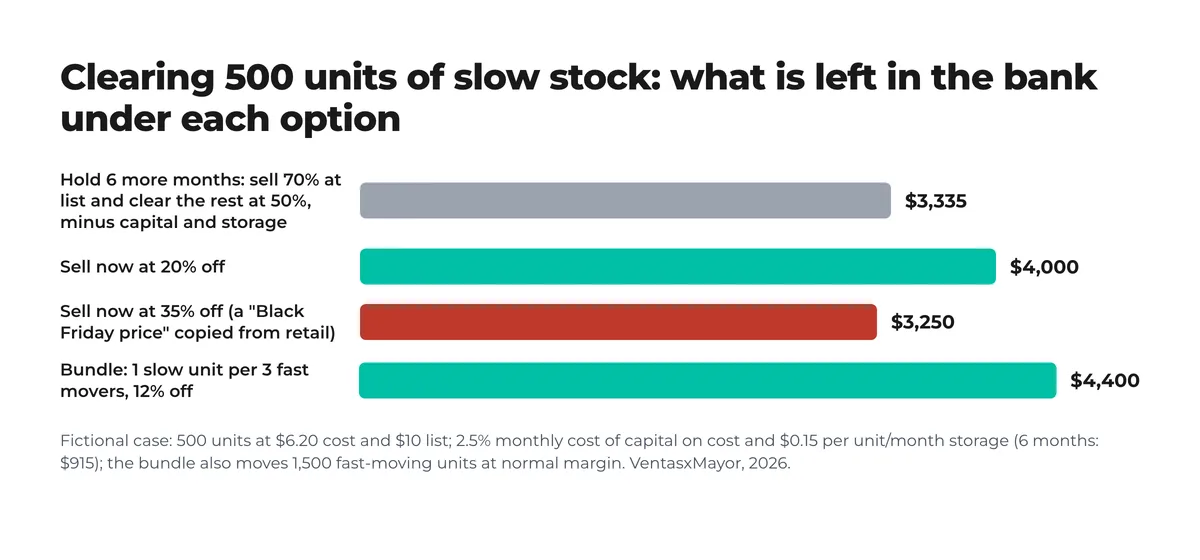
Maximum discount = 1 − (cost ÷ (1 − margin floor)) ÷ list price. At $6.20 cost, 15% floor and $10 list: minimum price $7.29, maximum discount 27%.
The clearance floor can be lower than the normal floor (15% instead of 20%) because the goal is recovering the capital, but it cannot be zero: freight, the rep's commission and the cost of shipping exist regardless. And the discount is set per SKU, with the formula, not for the whole catalog with a round percentage. Volume tiers do the rest: 20% from a case, 27% from a pallet, and the customer completes the pallet on their own.
Bundles: how to move the slow without touching what rotates
The bundle is the most profitable tool of the event and the least used by wholesalers. Three units of a star product plus one of the slow product, at 12% off the bundle total: the customer sees a real discount, the star leaves at a price barely below list, and the slow one goes out with the load. In the chart's case it is the option that leaves the most cash, and it also moves 1,500 fast-moving units that would have sold slowly.
Two conditions for it to work: the bundle has to be built in the catalog, with its price and minimum, so the buyer adds it with one click and the rep does not have to explain it; and it has to have an end date. A bundle with no end date becomes the new list.
The calendar: six weeks, not six days
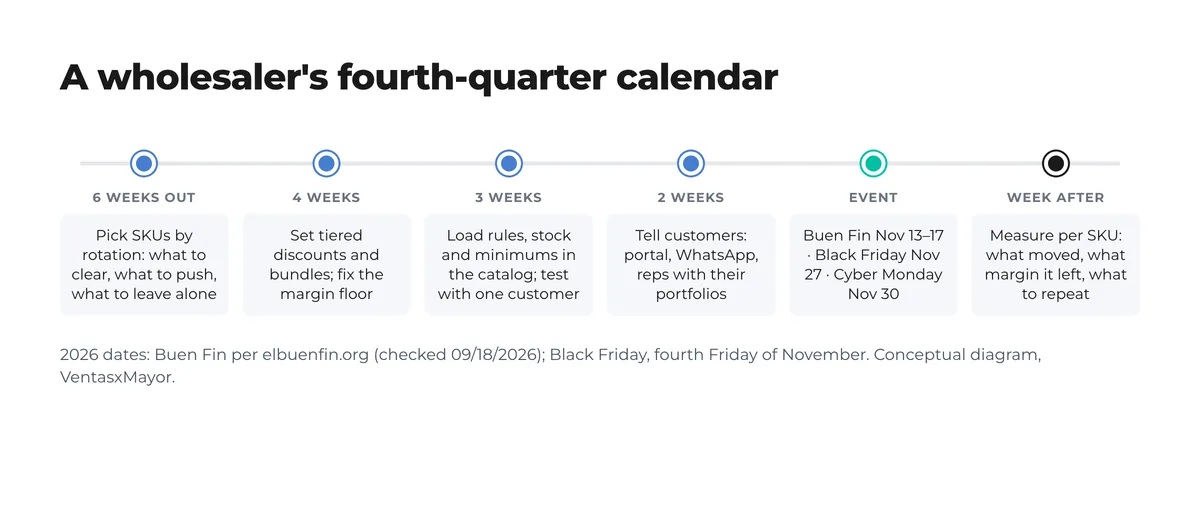
The 2026 dates, checked on September 18: Buen Fin in Mexico from November 13 to 17 per elbuenfin.org; Black Friday on November 27 everywhere; CACE's CyberMonday in Argentina in the first week of November (in 2025 it ran November 3–5). The wholesaler has to arrive with the rules loaded and customers informed before the retailer starts buying for its own event, which is about two weeks earlier.
- 31%average discount at Argentina's CyberMonday 2025: a retail numberCACE, nov 2025
- 27%maximum discount in the fictional case with a 15% floor; above it, sales fall below the floorFictional case, VentasxMayor
- 67%of B2B buyers prefer to buy without talking to a rep: the rules have to be in the catalogGartner, mar 2026
How VentasxMayor handles it
The discount engine takes tiers per product or category, bundles, and start and end dates; each customer sees them at their own price list and the rep has nothing to negotiate by chat. Rotation reports per product say what to clear before starting, and minimums per product keep the discount from moving one unit instead of a case. How promotions, bundles and cascades are set up is in the post on automatic discounts.
Checklist to start the first week of October
- Pull six-month rotation per SKU and tag slow, middle and star.
- Compute the maximum discount per slow SKU with the formula and the clearance floor.
- Decide the stars' volume tier: list up to a case, discount from a pallet.
- Build the bundles: three stars plus one slow item, 10 to 15% off the total.
- Load everything in the catalog with a start and end date; no date, no loading.
- Test with one real customer that the price, minimum and bundle display correctly.
- Tell the portfolio two weeks ahead: portal, WhatsApp with the link, reps.
- Tell reps in writing there is no discount beyond what is loaded.
- The week after: measure per SKU what moved and at what margin, and keep the list for 2027.
Frequently asked questions
Should a wholesaler take part in Black Friday?+
Use the date, do not copy the discount. The retailer buys for its own event two weeks earlier: that is the moment to clear slow stock at a formula discount and push the stars with pallet tiers. A 30% across the whole catalog is a retail number that in wholesale sells below the floor.
How much discount can be given without losing money?+
It depends on each SKU's cost and margin floor: maximum discount = 1 − (cost ÷ (1 − floor)) ÷ list. At $6.20 cost, 15% floor and $10 list, the maximum is 27%. That is why the discount is computed per product and not picked as a round number for everything.
When are Buen Fin and Black Friday 2026?+
Buen Fin in Mexico: November 13 to 17, 2026 per elbuenfin.org (checked September 18). Black Friday: Friday, November 27. CACE's CyberMonday in Argentina: first week of November (in 2025 it ran November 3–5).
What about customers who ask for a discount anyway?+
Show them what there is: the bundles and pallet tiers, loaded in the catalog with a date. If the discount exists only when a customer asks for it, it is not a promotion: it is a lower list negotiated one by one. The rule that works is that there is no discount beyond what is loaded, and what is loaded is visible without asking.
Sources
- CACE — CyberMonday 2025 cerró con resultados positivos (7 de noviembre de 2025; consultado el 18 de septiembre de 2026)
- El Buen Fin — sitio oficial: edición 2026 del 13 al 17 de noviembre (consultado el 18 de septiembre de 2026)
- Digital Commerce 360 — Gartner: two-thirds of B2B buyers prefer rep-free purchasing (17 de marzo de 2026)
- Motor de descuentos — VentasxMayor, 2026
Next step
November's rules loaded in October
In VentasxMayor tiered discounts, bundles and minimums are set once with a start and end date, and each customer sees them at their own list. When the event arrives, there is nothing to send by WhatsApp.
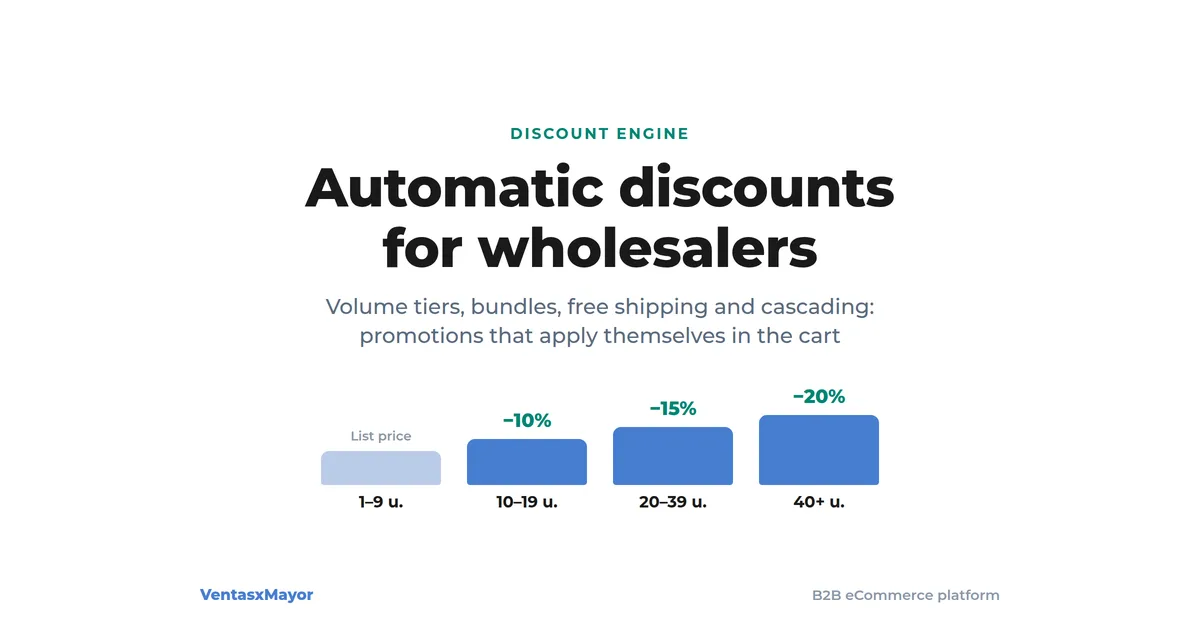
Automatic discounts for wholesalers: how to build promotions that apply themselves
Volume tiers, BOGO, bundles, free shipping and cascading rules: how automatic discounts work, how they combine, and why order changes the outcome.

How to Measure Stock Rotation and Stop Losing Money on Your Wholesale Inventory
Learn how to calculate stock rotation index, identify dead products and apply strategies to optimize your wholesale inventory.
Tiered pricing for wholesale: how to set volume breaks without giving away margin
Volume pricing vs. graduated tiers, five rules for setting the breaks, how tiers combine with per-customer price lists, and where the margin leaks. With a fictional case and chart.