
Tiered pricing for wholesale: how to set volume breaks without giving away margin
For the wholesaler, distributor or manufacturer with "10% off from 50 units" written in a text message and renegotiated on every order. The difference between volume pricing and graduated tiers, five rules for setting the breaks, how tiers combine with each customer's price list, and where the margin leaks.
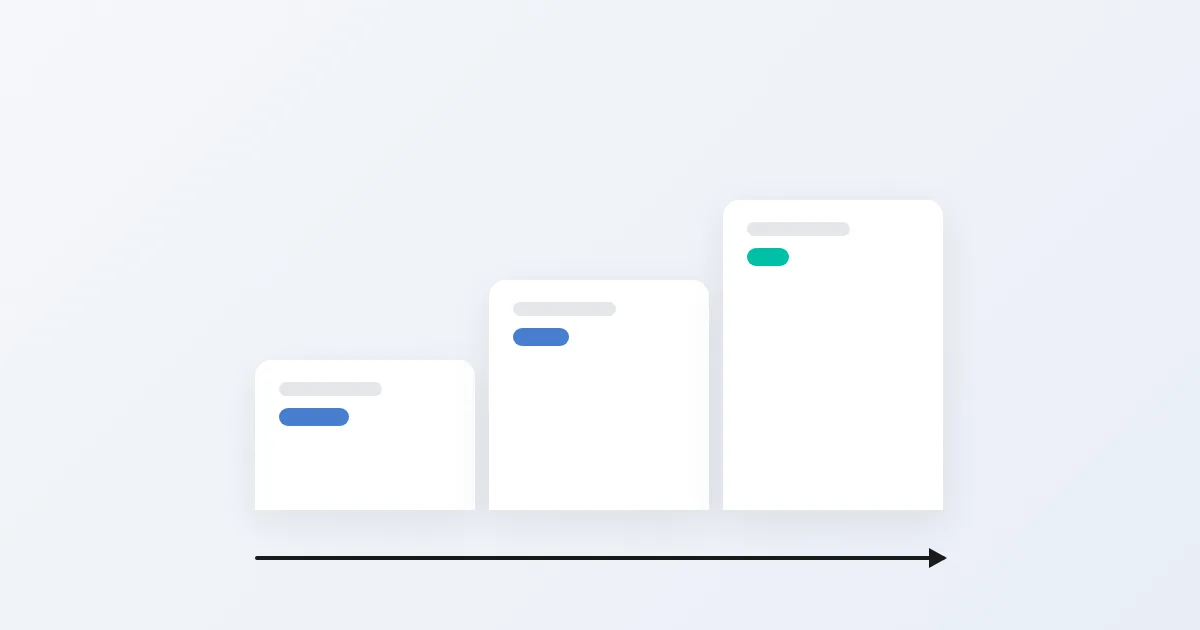
Almost every wholesaler we know has volume pricing. Almost none has it written down in one place. It lives in the owner's head, in a text to a rep ("from 50 give them 10%"), in a spreadsheet from 2023 and in the customers' memory, who recall last year's discount with admirable precision. The result is that every large order gets negotiated again, and in that negotiation the same party always loses: the margin.
After more than 8 years watching wholesalers operate, the mistakes with tiers repeat so often they can be listed: copying a competitor's breaks without looking at your own cost; putting the discount on the order total instead of the product; breaks that do not match the case size; tiers stacked on top of the customer's list without deciding whether they add up; and a rep who "rounds" another 5% because the customer asked. None of these mistakes shows on the order. They show at month end, in the margin.
Volume pricing or graduated tiers: the difference that changes the invoice
There are two ways to apply a tiered price, and it is worth being clear which one is in play before arguing about numbers. The definitions are the ones Salesforce uses in the documentation for its pricing engine, checked on September 17, 2026:
- Volume pricing: once the tier quantity is reached, every unit on the order is charged at that tier's price. 60 units with a break at 40 means all 60 at the lower price.
- Graduated tiers: each tier charges only the units that fall inside it. The first 39 at list, unit 40 onward at the tier price.
In physical wholesale almost everything is volume pricing, per product, with breaks that match the case and the pallet: it is what a buyer understands without explanation. Graduated tiers are common in software and usage-based services, and show up in wholesale when the discount is applied to the order total. The difference is not theoretical: in the diagram's example it is $39 on the invoice.
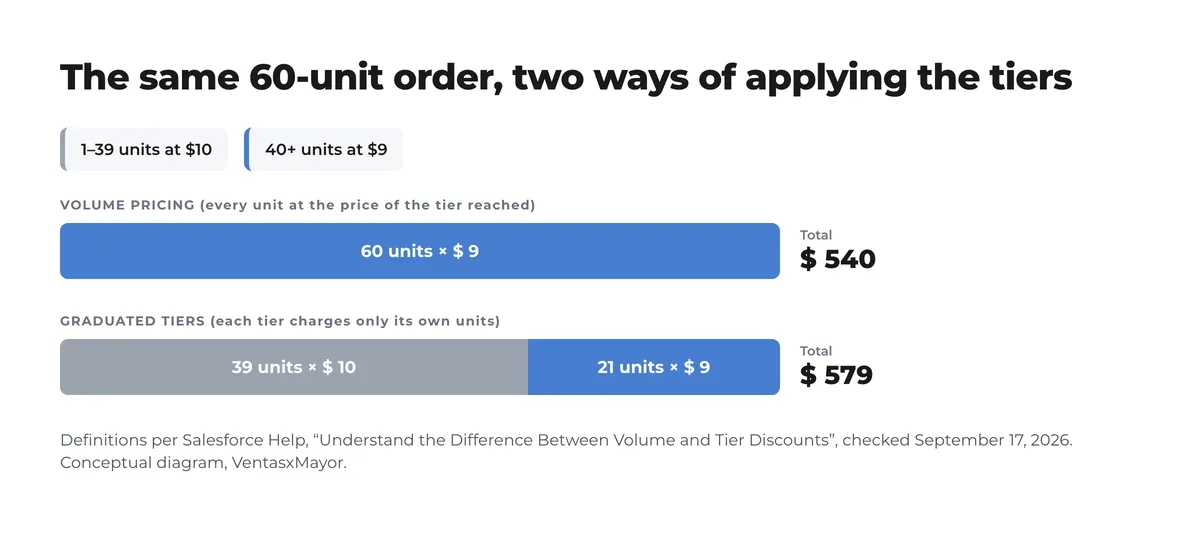
Under volume pricing, 40 units can cost less than 38. That is not a bug: it is the incentive for the customer to complete the case. The bug is putting the break at 40 when the case holds 36 or 48.
Five rules for setting the breaks
- From cost upward, not from the competitor downward. Every product or family has a margin floor. The last tier's price is computed from there: cost ÷ (1 − minimum margin). Everything above it is negotiable; nothing below it is.
- Breaks are multiples of the case. Unit, case, pallet. If the case holds 12, the second tier starts at 12, not 10. The buyer completes cases and the warehouse does not break them open.
- Three tiers per product, not seven. List, case and pallet cover 95% of cases. More tiers do not sell more: they confuse the buyer and the rep, and multiply data-entry errors.
- Per product, not per order total. A discount on the order total is a different thing (a cascade) and gets decided separately. Mixing the two is the fastest way to end up with a 10% + 8% nobody approved.
- Customer list first, tier second. Decide in writing whether the tier adds to the customer's list price or replaces it, and cap it. Without that decision, the best account with the largest order ends up buying below the floor.
Minimum price of any tier = cost ÷ (1 − margin floor). With a $6.20 cost and a 20% floor: $7.75. No tier, list or rep goes below it.
Tiers and customer price lists: what stacks and what does not
This is where the real margin gets decided. A wholesaler has price lists per customer (walk-in, retailer, distributor) and volume tiers. Both are right; the problem is never having written down how they combine. There are three ways, and each gives a different number for the same order:
| Combination rule | How it is computed | Distributor, 480 units | Margin | Who it is for |
|---|---|---|---|---|
| Replaces | The lower of the customer's list price and the tier price applies | $8.20 | 24.4% | Most wholesalers: simple, no surprises |
| Stacks with a cap | Customer's list price, minus the tier %, never below the floor | $7.75 (cap) | 20.0% | Large distributors that already have their own list |
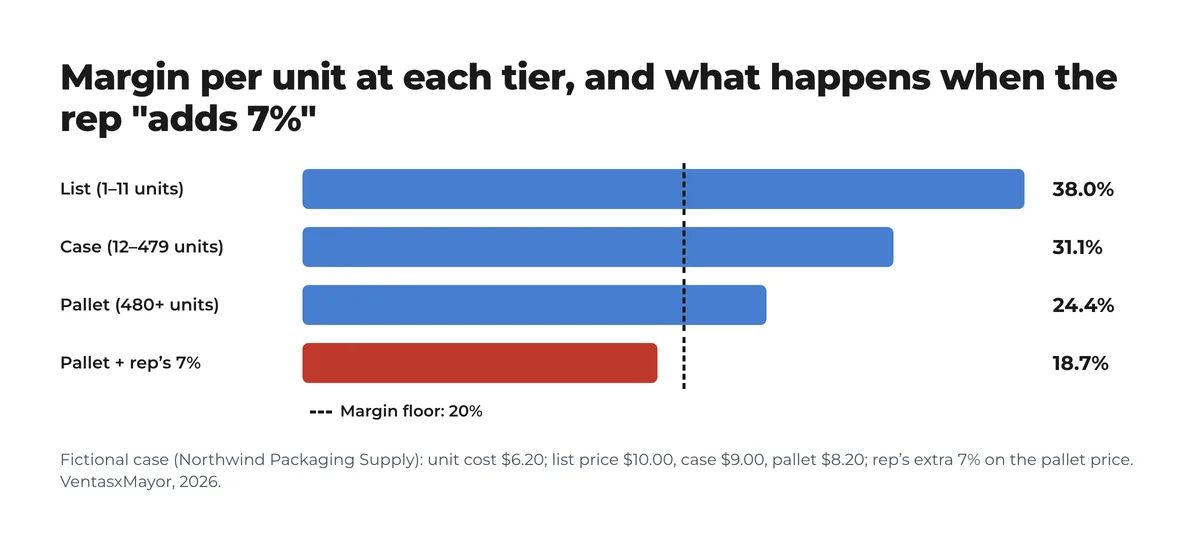
| Stacks with no cap | Customer's list price, minus the tier %, minus whatever the rep adds | $7.63 | 18.7% | Nobody. It is what happens when nothing was decided |
Showing every customer the same price ignores how a wholesaler works; stacking every discount with no cap ignores how margin works. The rule we recommend to most is the first one: the tier replaces, it does not stack. It is the easiest to explain to a buyer ("from a pallet, this price") and the only one a rep cannot make worse without asking.
Where the margin leaks
The pallet tier is already the lowest price the company decided to accept. Everything added after it comes out of what margin was left. In the fictional case in the chart, the pallet leaves 24.4%: four points above the floor. A rep's "7% more" takes it to 18.7%, below the floor, and on a 480-unit order that is $275 nobody approved. Multiplied across a month of large orders, it is someone's salary.
The other leaks are less visible but just as expensive:
- The tier that was never updated. Cost went up, the list was updated, and the pallet price stayed where it was six months ago. It is the most common leak wherever costs move fast.
- The break below the case. "From 10" with cases of 12: the customer orders 10, the warehouse opens a case, and freight costs the same.
- The order-total discount plus the per-product discount. Each was approved on its own; together, never.
- The negotiated price that became permanent. A pallet price given once "just this time" that the customer repeats every month, and so does the rep.
Tiers belong in the catalog, not in a PDF
A well-built tier the buyer cannot see while ordering changes nobody's behavior. The rule "from 480 units, $8.20" has to appear on the product page and in the cart, at the moment the customer is deciding between 400 and 480. That is where the tier does its job: the buyer completes the pallet on their own, without a call from the rep.
The data points the same way. In McKinsey's B2B Pulse 2024, e-commerce is now the top revenue channel among companies that offer it, with more than one-third of revenue, and buyers' comfort with self-serve spending "has jumped" even on large orders. And in the Gartner survey published in March 2026, 67% of B2B buyers prefer to complete a purchase without talking to a sales rep. A tier hidden in a PDF or in the rep's memory is a tier that does not exist for that 67%.
- > 1/3of revenue comes through e-commerce at B2B companies that offer it; now the top channelMcKinsey B2B Pulse, 2024
- 67%of B2B buyers prefer to buy without talking to a sales repGartner, mar 2026
- 3tiers per product are enough: list, case and palletRule of thumb, VentasxMayor
How VentasxMayor handles it
The discount engine takes tiers per product or per category, with whatever break quantities the company decides, and combines them with per-customer price lists according to the rule you configure. The buyer sees each tier's price on the product page and in the cart while building the order, and minimums and case sizes per product keep the breaks aligned with what the warehouse ships. Reps place orders at their customer's list under the same rules; the AI sales assistant quotes while respecting each customer's list. How promotions, bundles and cascade scales are set up is covered in the post on automatic discounts.
Checklist for building the tiers this week
- Write down the margin floor per product family, with the owner in the room.
- Compute the minimum price per family: cost ÷ (1 − floor).
- List the case and pallet size of every product and use them as breaks.
- Cut to three tiers: list, case, pallet.
- Decide in writing whether the tier replaces or stacks with the customer's list, and the cap.
- Separate the order-total discount (cascade) from per-product tiers.
- Review the "just this time" negotiated prices that have repeated for more than three months.
- Load the tiers where the buyer sees them: product page and cart, not a PDF.
- Set a tier review date every time the price list is updated.
Frequently asked questions
What is tiered pricing?+
It is a price that drops per unit as the quantity bought crosses set breaks: one price up to 11 units, another from a case, another from a pallet. In wholesale it is almost always applied as volume pricing (every unit at the price of the tier reached) and per product, not per order total.
What is the difference between tiered and volume pricing?+
Under volume pricing, once the break is reached every unit on the order is charged at that tier's price. Under graduated tiers, each tier charges only the units that fall inside it, like a tax bracket. For 60 units with a break at 40 and prices of 10 and 9, the first invoices 540 and the second 579.
How many pricing tiers should a wholesaler have?+
Three per product: list, case and pallet. They cover the vast majority of orders and match what the warehouse ships. More tiers do not sell more; they add data-entry errors and arguments with the buyer.
Do volume tiers stack with customer-specific pricing?+
Only if the company decided so in writing and set a cap. The safest rule is that the tier replaces: the lower of the customer's list price and the tier price applies. Stacking with no cap is what happens when nobody decided, and it ends with orders below the margin floor.
Sources
- Salesforce Help — Understand the Difference Between Volume and Tier Discounts (consultado el 17 de septiembre de 2026)
- McKinsey — B2B Pulse 2024: Five fundamental truths (12 de septiembre de 2024; consultado el 17 de septiembre de 2026)
- Digital Commerce 360 — Gartner: two-thirds of B2B buyers prefer rep-free purchasing (17 de marzo de 2026)
- Motor de descuentos — VentasxMayor, 2026
Next step
Tiers configured once, applied on every order
In VentasxMayor volume discounts are set per product or category, combine with each customer's price list, and the buyer sees them while building the order. No side spreadsheets, no haggling by chat.
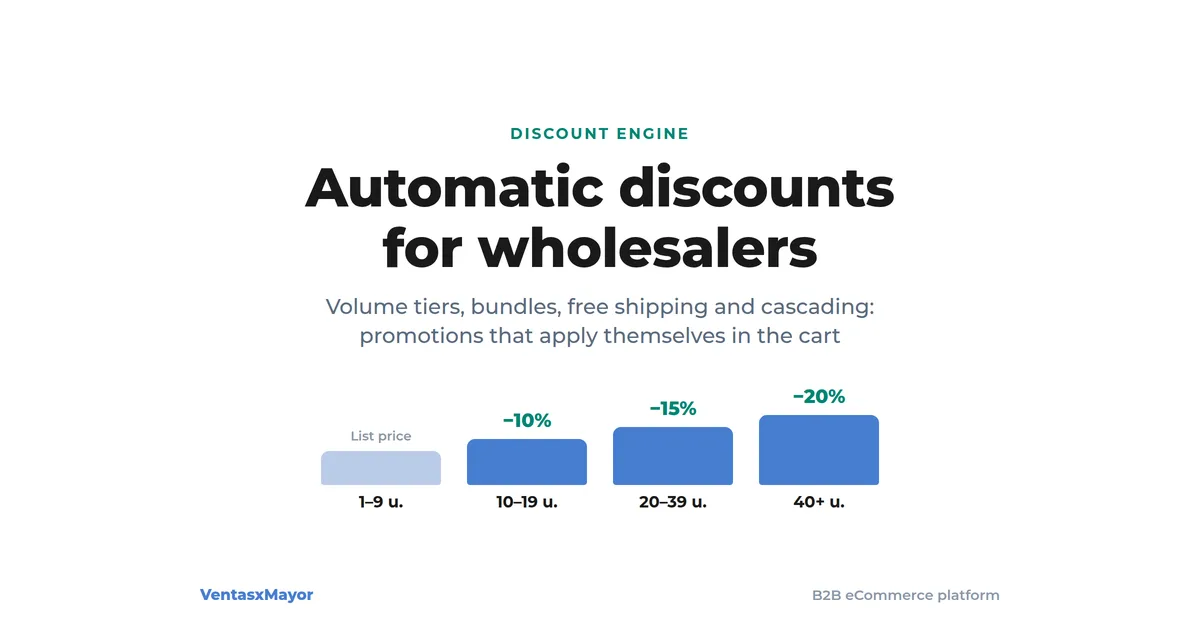
Automatic discounts for wholesalers: how to build promotions that apply themselves
Volume tiers, BOGO, bundles, free shipping and cascading rules: how automatic discounts work, how they combine, and why order changes the outcome.

Wholesale price list by customer: how to stop emailing 5 different spreadsheets
One master list, three to five tiers, per-customer discounts and an effective-date policy. The method for ending the spreadsheet chase and invoicing the right price.
How to choose a B2B ecommerce platform: 12 questions before signing
The three routes to selling B2B online, the rule sheet that comes before any demo, the 12 questions to ask before signing and the costs the plan price hides.