
Break-even point: what it is, the formula and how to calculate it for a wholesaler
For the owner of a distributor who knows what last month’s revenue was but not what it needed to be to avoid a loss. The formula in units and in dollars, a step-by-step calculation with a case, and the three things that move a wholesaler’s break-even point more than anything else.
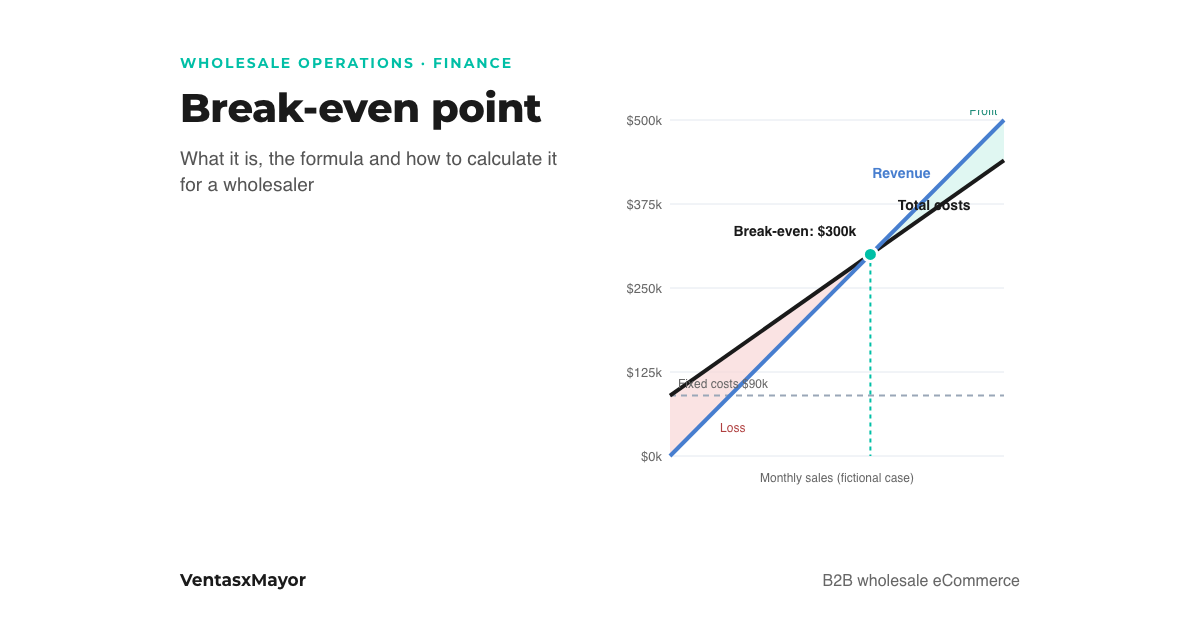
"We sold 15% more this month." It sounds good in the meeting and says nothing: more than what, and enough for what. We keep running into distributors that bill large numbers, pay salaries, rent, vans and sales reps, and at month-end do not know whether they made or lost money until the accountant sends the statements three months later. The break-even point is the number that answers that before, not after: how much the business has to sell each month to cover its costs and, from there, start earning.
The calculation is simple. What is hard, at a wholesaler, is that no product sells at a single price: there are price lists per customer, volume discounts, rep commissions and minimum orders, and each of those moves the break-even point. This article explains the formula, how to apply it to a real distributor step by step, and which levers move the number.
What is the break-even point
The break-even point is the level of sales at which revenue equals total costs: the company neither makes nor loses money. Below that level, every month loses money; above it, every additional sale leaves a profit.
It can be expressed two ways and both are useful: in units (how many cases, boxes or kilos have to be sold) and in dollars (how much revenue is needed). For a manufacturer with a few products the first works; for a distributor with 3,000 SKUs the second does, because nobody knows "how many units" a housewares wholesaler sells.
Three numbers are needed, and the real work is separating them properly:
- Fixed costs: the ones paid whether sales are high or low. Warehouse rent, admin and warehouse salaries, the reps’ base pay, insurance, software, the truck payment.
- Variable costs: the ones that grow with every sale. Cost of goods sold (what the supplier is paid), the rep’s commission, freight per delivery, packaging, card or payment-platform fees.
- Selling price: at a wholesaler, the real average price, after discounts. This is where most people get it wrong, and it is covered below.
The break-even formula
Break-even in units = Fixed costs ÷ (Unit selling price − Unit variable cost)
Break-even in dollars = Fixed costs ÷ Contribution margin (as a %)
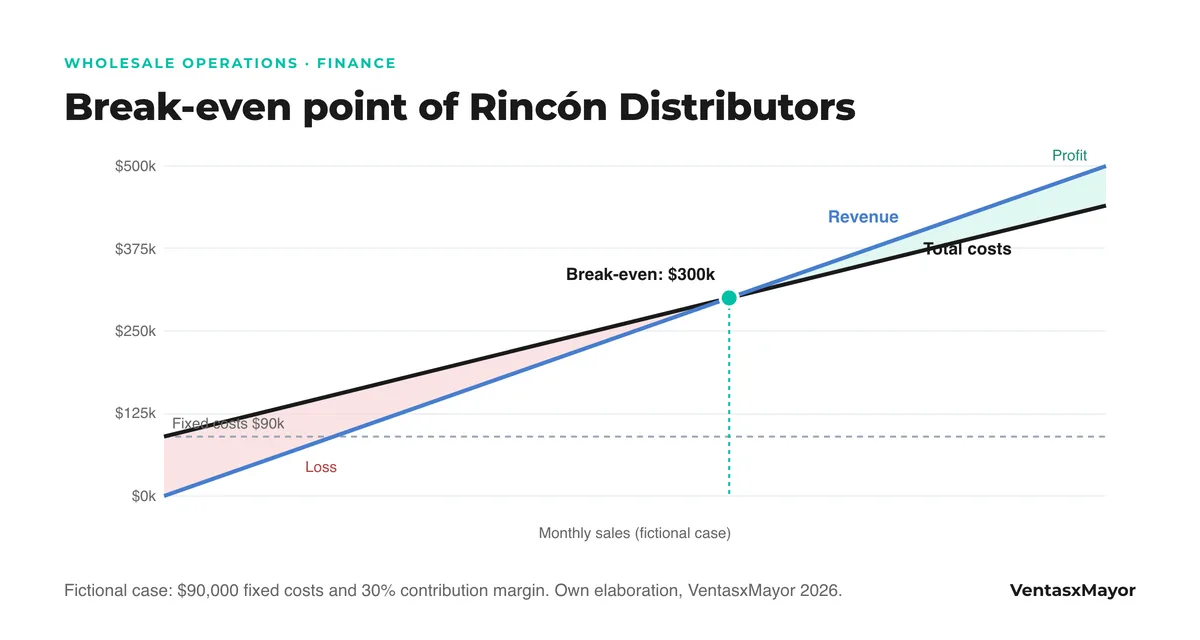
The difference between price and variable cost is called the contribution margin: what every sale "contributes" towards paying fixed costs. If a case sells for $15 and costs $10.50 between goods, commission and freight, it contributes $4.50, or 30%. With fixed costs of $90,000 a month, it takes 20,000 cases or $300,000 in revenue to break even. Everything sold above that leaves 30% profit; everything short of it, the same in losses.
Two things worth keeping clear. First: contribution margin is not markup or gross margin. Markup is calculated on cost; contribution margin on price, and it also deducts commission and freight. Second: the break-even point is monthly, because fixed costs are monthly. A seasonal wholesaler (toys, back-to-school stationery, apparel by collection) has months above and months below, and what matters is the year’s running total.
How to calculate the break-even point for a wholesaler, step by step
The wholesaler’s problem is the third number. The same product sells at $16 on the reseller list, $14.50 to the regional distributor and $13 to the large account that takes a pallet. On top of that, whoever buys 50 cases gets 5% extra. Calculating the break-even point with the list price inflates the margin and hides the problem. The right path is to work with percentages of real sales:
- Add up the month’s fixed costs. Everything paid even if no order comes in. If the owner draws no salary, put one in: otherwise the break-even point lies.
- Take real revenue for the last three months and the cost of goods sold for those same months. The ratio gives cost of goods as a percentage of real sales, with every discount already inside.
- Add the other variable costs as percentages: commissions (3%, 5%), own or outsourced freight per order, payment fees, packaging. What is left is the real contribution margin.
- Divide fixed costs by that margin. The result is the monthly break-even revenue. Comparing it with the last months’ average says immediately which side of the line the business is on.
- Repeat by channel or by price list if margins differ a lot. A distributor selling to resellers at 35% contribution and to chains at 12% does not have one break-even point: it has two, and the mix between them is the most important decision of the year.
What moves a wholesaler’s break-even point
Generic guides say "cut fixed costs or raise prices". At a distributor the real levers are three others, and all three sit in commercial policy, not in accounting:
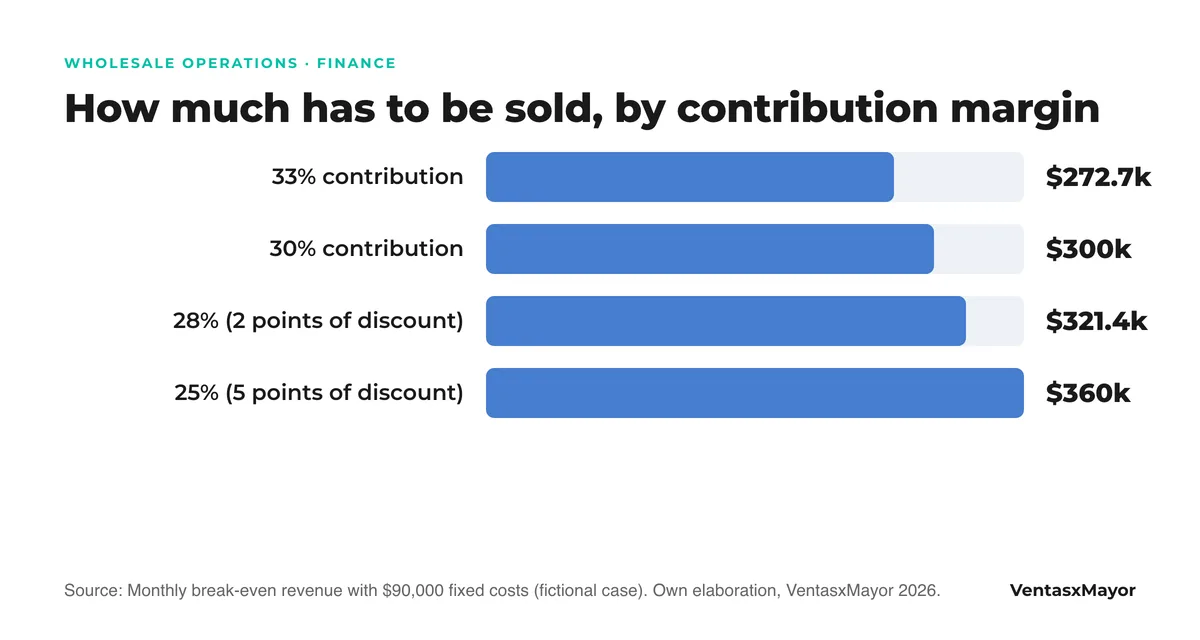
- Discounts. Every point of discount comes straight out of the contribution margin. Going from 30% to 28% contribution, in the case above, raises the break-even point from $300,000 to $321,400: 7% more sales to break even, for 2 points of discount. A volume discount is only justified if it brings the volume that pays for it; the discount the rep "gets" to close a small order, never.
- Minimum order and freight. A $400 order that rides in the van costs the same to deliver as a $4,000 one. If freight averages 2%, on the small order it is 20%, and that order is sold at a loss. The minimum order is not a nuisance for the customer: it is the tool that keeps freight inside the percentage the break-even was calculated with.
- The cost of the rep. Base pay is fixed; commission is variable. A distributor paying a high base and low commission has a high break-even point and a high margin afterwards; one paying almost everything in commission, the opposite. Neither is better, but it has to be a known choice. And every hour the rep spends keying in orders instead of selling is fixed cost that contributes nothing.
The mistakes we see when it gets calculated
- Using the list price. The margin that exists on the list is not the one that exists in the sale. With three price lists and volume discounts the gap can be 5 to 10 points.
- Forgetting the owner. If the owner works 10 hours a day and draws no salary, the business "breaks even" but the family does not.
- Treating freight as fixed. The van payment is fixed; fuel, the hourly driver and outsourced shipping grow with orders. Mixing them hides the cost of small orders.
- Calculating it once. With inflation or supplier changes, cost of goods as a percentage of sales moves every month. The number has to be looked at monthly, not per financial statement.
- Not having the data. The most common mistake: not knowing how much was sold at each price because orders came in over WhatsApp and were keyed in by hand. Without real sales by customer and by product, the break-even point is a guess.
How VentasxMayor solves it
The break-even point is not a software feature: it is arithmetic. What a wholesale platform solves is that the three numbers exist. In VentasxMayor every order comes in with that customer’s price list and the discount they get by rule, not by the day’s negotiation; the minimum order applies on its own, and an order below the minimum does not go through. Rep commissions are calculated automatically on what was sold.
With that, the reports show how much was sold, to which customer, of which product and at what real price: step 2 of the calculation comes off a screen instead of a hand-built spreadsheet. And since the customer orders alone from their portal and the rep does not transcribe, the rep’s hour goes back to being a variable that contributes, not a fixed cost paid regardless.
Checklist to calculate it this month
- List of the month’s fixed costs, owner’s salary included.
- Real revenue for the last three months, net of discounts and returns.
- Cost of goods sold for those three months, as a percentage of sales.
- Commissions, freight per order, packaging and payment fees, each as a percentage.
- Real contribution margin = 100% minus all of the above.
- Break-even = fixed costs ÷ contribution margin. Compared with the monthly average.
- The same calculation per price list or channel, if margins differ by more than 5 points.
- Minimum order reviewed against the real cost of delivering one order.
- A date on the calendar to repeat the calculation next month.
Frequently asked questions about the break-even point
What is the break-even formula?+
In units: fixed costs ÷ (unit price − unit variable cost). In dollars: fixed costs ÷ contribution margin as a percentage. Both give the same point; the second is the useful one for a wholesaler with many products.
What is contribution margin and how does it differ from gross margin?+
Gross margin is price minus cost of goods. Contribution margin also deducts every other variable cost: rep commission, freight per order, packaging, payment fees. It is what pays fixed costs, which is why it goes in the formula.
How is the break-even point calculated with many products or several price lists?+
By working in dollars with percentages of real sales: cost of goods sold divided by real revenue for the last months already incorporates the mix of products, price lists and discounts. If one channel has a very different margin from another, calculate a break-even point per channel and decide the mix.
How often should it be recalculated?+
Every month, or whenever something big changes: a supplier price increase, a new rep, a lease, a price list. In high-inflation markets the cost-of-goods percentage moves monthly, and a six-month-old break-even point no longer describes the business.
Sources
Next step
Sales by customer and by product, without building the spreadsheet
In VentasxMayor every order comes in with that customer’s price list, discount and minimum, and the reports show how much was sold, to whom and of what. The numbers that feed the break-even point come out of the system, not out of memory.

Wholesale stock control: how to measure turnover and stop losing money on your inventory
Learn how to calculate stock rotation index, identify dead products and apply strategies to optimize your wholesale inventory.

Tiered pricing for wholesale: how to set volume breaks without giving away margin
Volume pricing vs. graduated tiers, five rules for setting the breaks, how tiers combine with per-customer price lists, and where the margin leaks. With a fictional case and chart.

Wholesale price list by customer: how to stop emailing 5 different spreadsheets
One master list, three to five tiers, per-customer discounts and an effective-date policy. The method for ending the spreadsheet chase and invoicing the right price.