
FOB vs CIF: what they mean, who pays and which to use in wholesale
For the wholesaler who imports and signs a proforma marked "FOB Shanghai", and for the distributor arguing with a customer about who pays the truck. What each term means, where the risk transfers, what Incoterms 2020 say and how to put freight terms in writing on every sale.
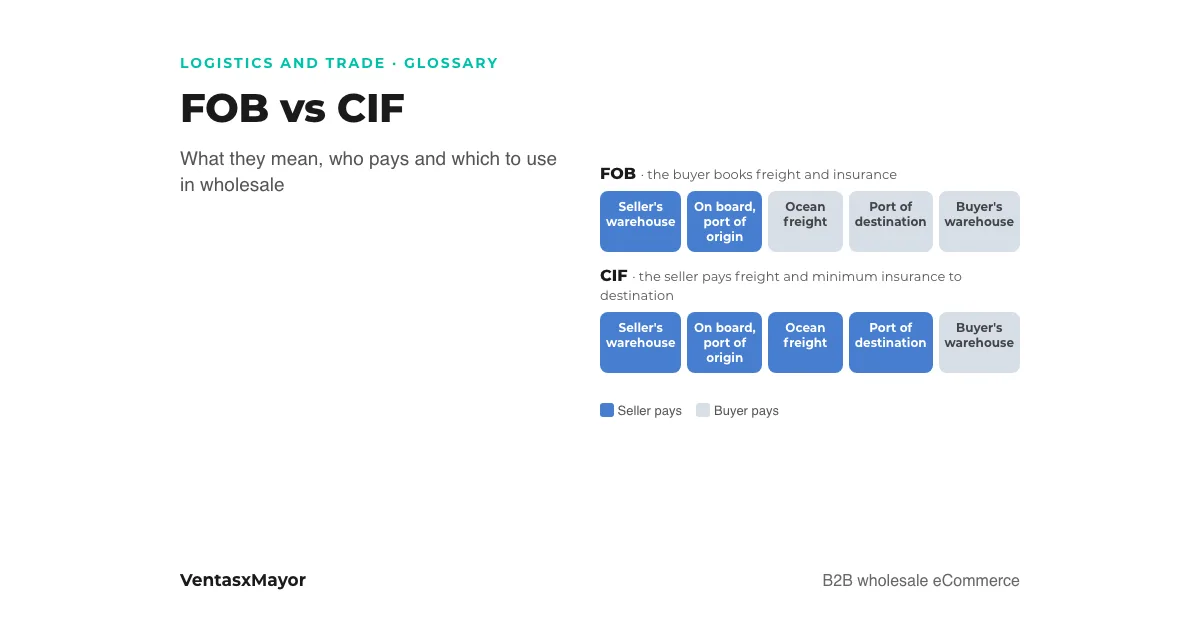
The first proforma an importer receives says "FOB Ningbo, USD 18,400" and the second says "CIF Los Angeles, USD 21,900", and the obvious question is which one is cheaper. The answer is that they cannot be compared without knowing what each includes. The same thing happens in everyday domestic sales with other words: the distributor ships the order "freight included" or "freight collect", the customer understood something else, and the difference gets argued when the truck is already at the door.
FOB and CIF are two of the eleven Incoterms rules published by the International Chamber of Commerce (ICC) to say, in three letters, who pays transport, who pays insurance and at which exact point risk transfers from seller to buyer. They were born for international trade, but in Brazil they are used daily for any domestic sale, and across Latin America they are the language of everyone who imports. This article explains what each one means, how they differ, what Incoterms 2020 say and how to apply the same logic to local wholesale sales.
What is FOB
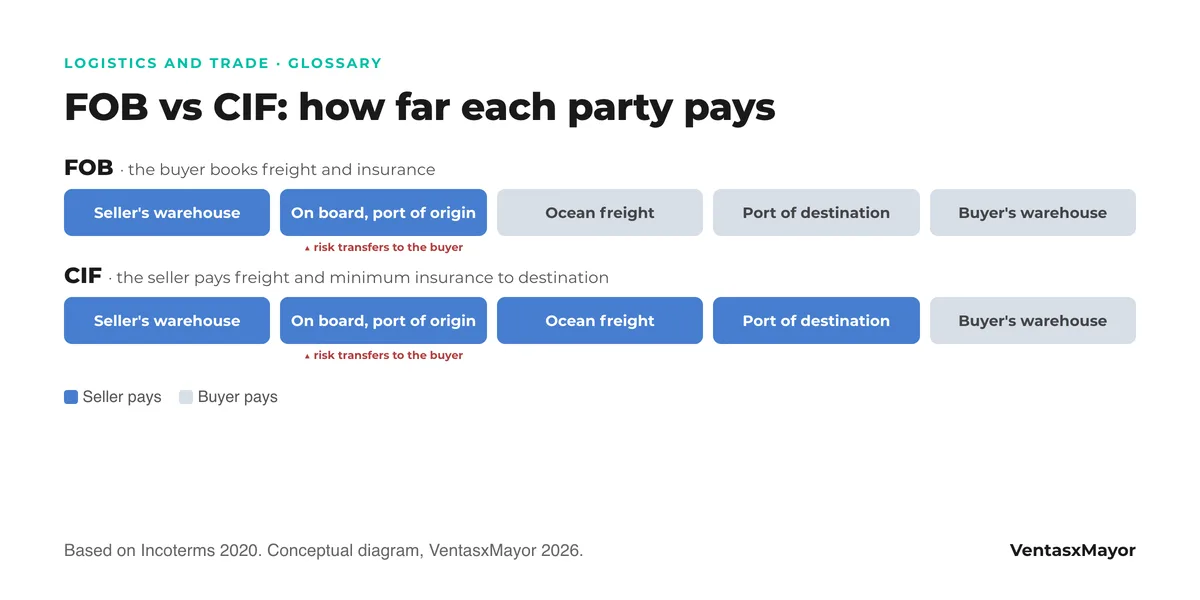
FOB (Free On Board) means the seller has delivered once the goods are loaded on board the vessel at the port of origin. From that moment on, freight, insurance and risk are the buyer’s.
In day-to-day wholesale, "FOB" means freight collect, paid by the buyer: the price covers the goods at the seller’s dock or port, and the buyer arranges the haul. For an importer, an FOB price is the easiest to compare across suppliers, because every quote includes the same thing: the product and loading. Ocean freight, insurance, port charges and customs then have to be added to reach the real landed cost at the warehouse.
What the three letters do not say, and is worth knowing: under FOB the buyer chooses and books the transport, which gives control over the carrier, the timing and the rate, but requires a trusted freight forwarder. For a first-time importer, FOB is usually cheaper on paper and more expensive in surprises. (In US domestic trade "FOB origin" and "FOB destination" are used loosely for any mode of transport; the ICC rule is strictly for sea freight.)
What is CIF
CIF (Cost, Insurance and Freight) means the seller pays freight and a minimum insurance cover up to the port of destination. Risk, however, transfers to the buyer at the same point as under FOB: when the goods are on board at origin.
That detail is the one almost nobody reads: CIF does not mean "the seller takes care of everything". The seller pays for transport to destination, but if the container goes overboard halfway, the one claiming on the insurance is the buyer. And the cover the rule requires is the minimum (Institute Cargo Clauses "C"), which covers little; whoever wants real cover has to ask for it in the contract or buy it separately.
In everyday wholesale, "CIF" or "prepaid freight" means freight paid by the seller: the price includes delivery to the customer’s door. It is what most buyers prefer and what causes the most confusion, because the "included" freight comes from somewhere: from margin or from price. A distributor that sells freight-prepaid without a minimum order ends up financing deliveries of small orders that do not pay for the trip.
FOB vs CIF: who pays what
| Item | FOB | CIF |
|---|---|---|
| Loading on board at origin | Seller | Seller |
| Main carriage (ocean freight) | Buyer | Seller |
| Cargo insurance | Buyer (optional) | Seller (minimum cover) |
| Risk during the voyage | Buyer | Buyer |
| Unloading, port and customs at destination | Buyer | Buyer |
| Who chooses the carrier | Buyer | Seller |
| Price on the proforma | Lower, includes less | Higher, includes freight and insurance |
| Mode of transport (Incoterms 2020) | Sea and inland waterway only | Sea and inland waterway only |
What Incoterms 2020 say and what is used on the street
There are eleven Incoterms rules, revised every ten years (the current version is 2020), and they come with a frequent trap: FOB and CIF are sea-freight-only rules. For containerized cargo, which is almost always handed over at a terminal rather than "on board", the ICC recommends FCA instead of FOB and CIP instead of CIF, because the point where risk transfers then matches where the seller actually delivers. In practice, proformas from Asia keep saying FOB out of habit, and it works, but it pays to know that risk transfers earlier than the paper suggests.
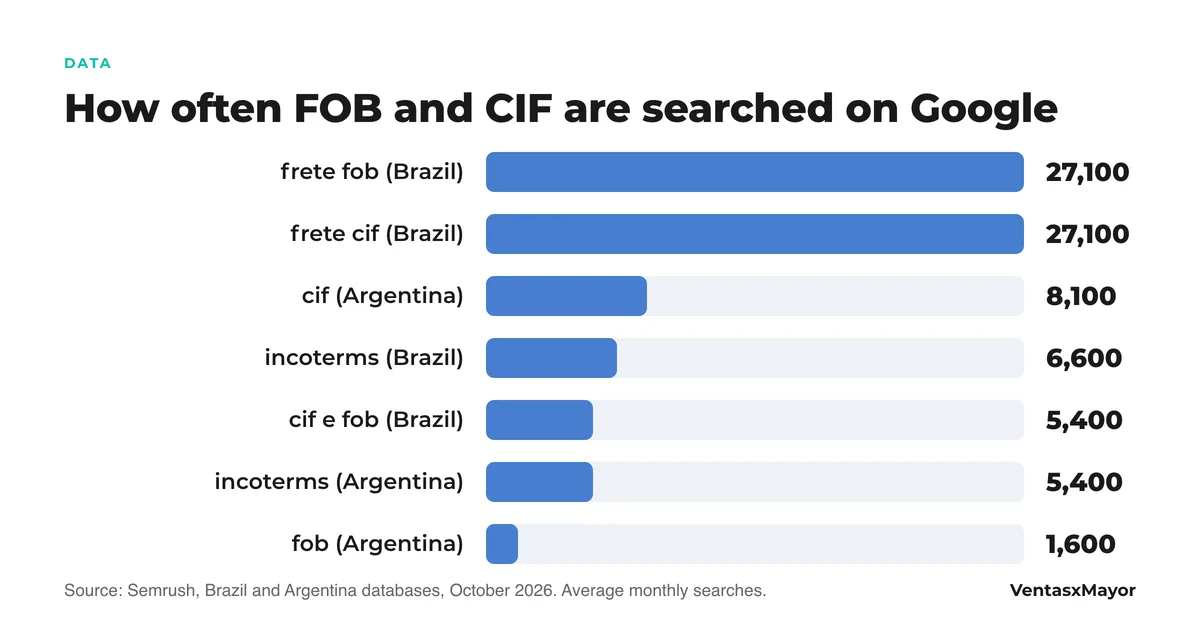
For domestic sales, the US uses "FOB origin" (buyer pays and bears risk from the dock) and "FOB destination" (seller pays and bears risk to the door), plus "prepaid" and "collect" for who is billed, regardless of mode. In Brazil the electronic invoice has a mandatory freight-mode field where FOB and CIF are ticked on every sale, which is why "frete FOB" is searched on Google more than any other logistics term there. The logic is identical everywhere: how far transport is included in the price.
Which one suits the wholesaler: how to set freight on every sale
For the importer, the practical rule is: FOB when there is volume and a forwarder of your own, because control over transport is worth money; CIF (or better, CIP) when importing little or for the first time, accepting a slightly higher price in exchange for not coordinating the carrier. In both cases, ask for "A" clauses cover, not the minimum.
For the distributor selling to stores, the question is not FOB or CIF: it is when each one applies. What we see working at distributors in every category is a written policy, the same for every customer, with three pieces:
- A rate per zone. Metro, suburbs, out of state, pickup at the warehouse. Each zone has its freight price and its notes (delivery days, time windows, liftgate). The customer sees it before confirming.
- A free-freight threshold. Above a certain amount or number of cases, shipping is free: that is prepaid freight earned by volume. Below it, freight is charged: that is the small order’s collect freight. This turns freight into an incentive to fill the order, not a fight.
- The minimum order. Below the minimum the order does not ship, with or without freight. It is what protects the break-even point from trips that do not pay for themselves.
How VentasxMayor solves it
A freight policy only works if the customer sees it before confirming and if it applies on its own, without a rep renegotiating it order by order. In VentasxMayor shipping is defined by zone, each with its rate and notes, and the buyer picks theirs at checkout seeing the cost; shipping becomes free when the order reaches the level the wholesaler set, and the minimum order stops the order that falls short. The freight term travels with the order through the packing slip and the invoice, so what gets argued at the door was already written in the cart.
Checklist: freight in writing
- Every import proforma states the Incoterm and the place: "FOB Ningbo", not just "FOB".
- FOB and CIF quotes are compared by adding freight, insurance and destination charges, never by the proforma number.
- Insurance is requested with "A" clauses cover even though CIF only requires the minimum.
- For containers, FCA/CIP are considered instead of FOB/CIF, as the ICC recommends.
- The domestic freight policy is written down and the same for every customer.
- Every delivery zone has a published rate and the customer sees it before confirming.
- There is a free-shipping threshold that justifies the trip, and a minimum order below which nothing ships.
- The freight term appears on the order, the packing slip and the invoice.
- The real delivery cost of small orders is measured at least once a quarter.
Frequently asked questions about FOB and CIF
What does FOB freight mean?+
Free On Board: the seller delivers the goods loaded on board at the port of origin, and from there the buyer pays freight and insurance and bears the risk. In domestic trade it is the equivalent of "freight collect".
What does CIF freight mean?+
Cost, Insurance and Freight: the seller pays freight and minimum insurance to the port of destination, but risk transfers to the buyer on loading, just as under FOB. In domestic trade it is the equivalent of "freight prepaid".
What is the difference between FOB and CIF?+
Who pays the main carriage and the insurance: under FOB the buyer, under CIF the seller. Risk transfers at the same point under both. That is why a CIF price is higher than an FOB one: it includes transport and insurance to destination.
Can FOB and CIF be used for road or air transport?+
According to Incoterms 2020, no: they are rules for sea and inland waterway transport only. For truck, air or multimodal containers the equivalents are FCA and CIP. In US domestic trade "FOB origin/destination" is used for any mode anyway, which is valid between the parties but is not the ICC usage.
Sources
Next step
Freight, settled before the customer confirms
In VentasxMayor every delivery zone has its own rate and notes, shipping becomes free when the order reaches the level the wholesaler sets, and the buyer sees the cost at checkout before confirming. The argument about the truck goes away.
Wholesalers: How to Import and Export from Argentina — What Nobody Tells You
Practical guide for wholesalers looking to start importing or exporting. Regulations, logistics, common mistakes and how to digitalize the process.
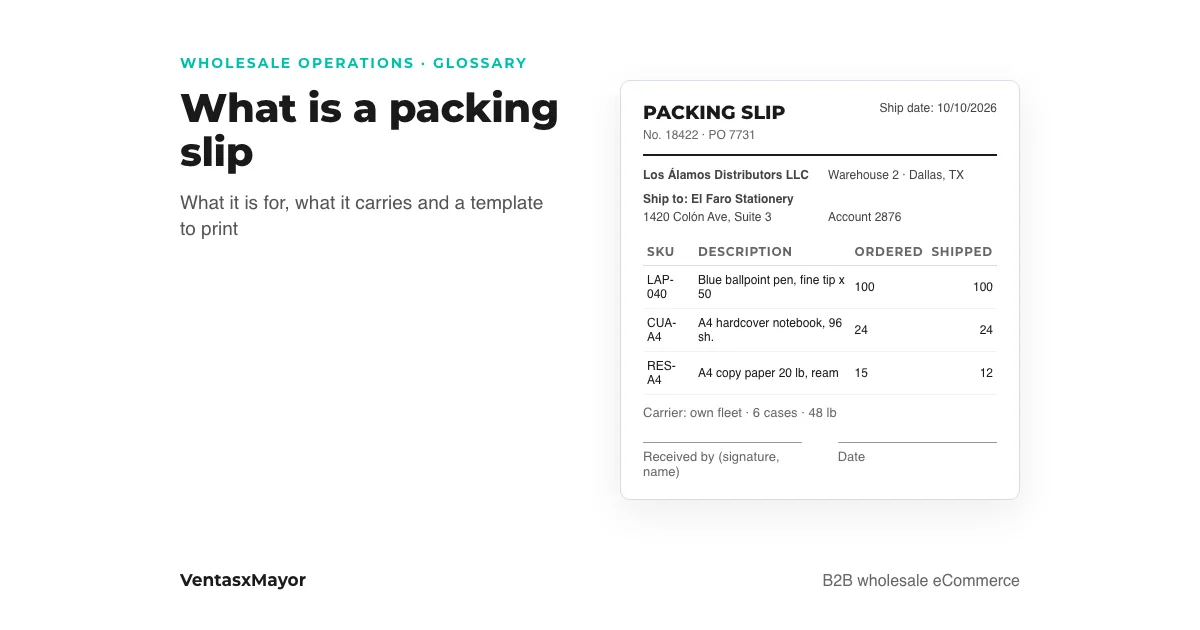
What is a packing slip: what it is for, what it carries and a template to print
The packing slip travels with the goods and proves delivery; it is not an invoice. What it carries, the digital version and a template to print.

B2B eCommerce glossary: 50 essential terms for wholesalers
From API to delivery zone: the 50 terms every wholesaler needs to know to digitalize their operation, grouped by topic.