
How to set a minimum order in a wholesale store (and which kind)
For the distributor delivering two-case orders that do not pay for the trip, and for the manufacturer unsure whether to set the minimum in dollars or in units. The five kinds of minimum, how to calculate the number from the real cost of delivering and how to state it before sign-up without losing customers.
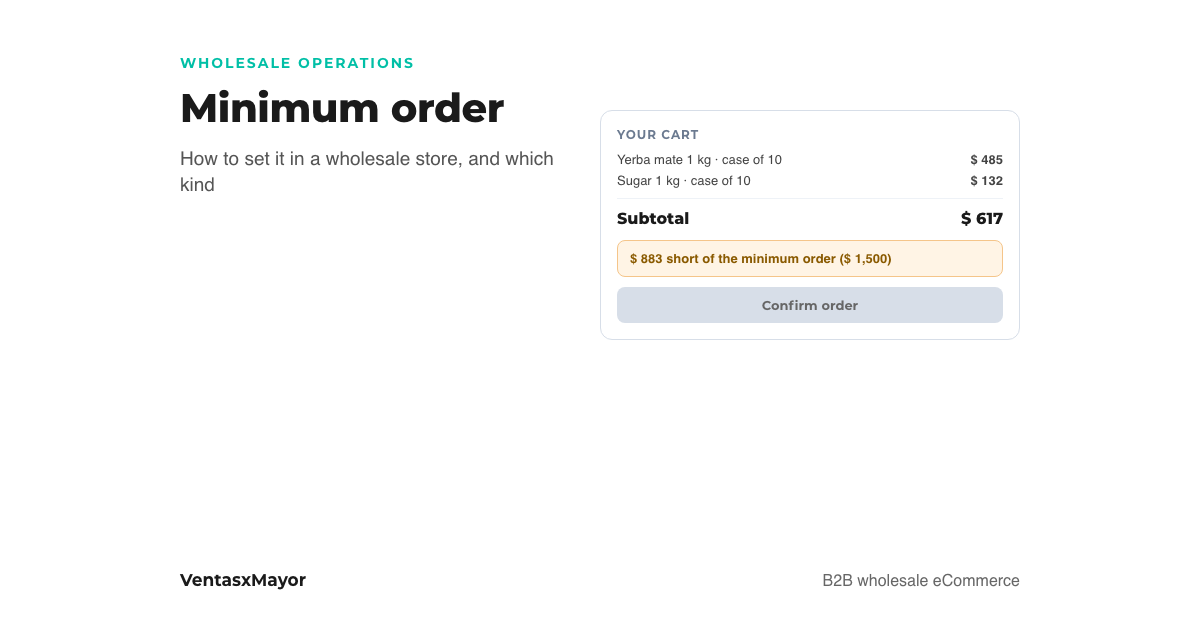
A food distributor told us recently that 35% of its deliveries were orders under six cases going forty kilometers. Each one cost more in freight than it left in margin, and nobody stopped them because "they're a customer". When the store opened, the problem became visible at once: the minimum order existed in the owner's head, but not in the cart.
The minimum order is not a punishment for the small customer. It is the rule that keeps freight, picking and admin inside the percentage the break-even point was calculated with. This article explains the five kinds of minimum, how to pick the number, how to configure it in a wholesale store and how to communicate it so it does not scare off sign-ups.
The five kinds of minimum order
| Kind | Example | When it suits | Watch out for |
|---|---|---|---|
| By amount | Minimum order $1,500 | Wide catalogs with very different prices between products | With inflation it needs frequent updating |
| By units or cases | Minimum 10 cases | Categories where freight depends on volume, not value | A $20 case and an $800 case count the same |
| By full case | Sold in 12s, 24s or 48s | Manufacturers and importers that do not break cases | The small customer needs to know before building the cart |
| Per product | This item, minimum 6 units | Low-value items or items sold in packs | Mixing it with the global minimum without explaining |
| Per customer | First order $3,000; reorders $1,200 | Telling onboarding from reorders, or distributors from small stores | Living in someone's memory instead of the customer record |
How to calculate the minimum
The right minimum does not come from what competitors do: it comes from what it costs to deliver an order. The calculation has three steps.
- Fixed cost of one order. What any order costs regardless of size: picking (warehouse minutes), admin (entering, invoicing, collecting) and delivery (the truck stop or the shipment). At a distributor with its own van, a suburban stop usually runs 1 to 3% of a mid-sized order; on a small order, 15 or 20%.
- Contribution margin of the order. The percentage left after goods, commissions and variable freight. At 30%, a $1,000 order contributes $300.
- The minimum is the order where contribution covers the fixed cost with room to spare. If delivering costs $90 and contribution is 30%, a $300 order breaks even and a $600 order leaves $90 clean. That is where the minimum goes: at the point where the order stops merely paying for its own trip.
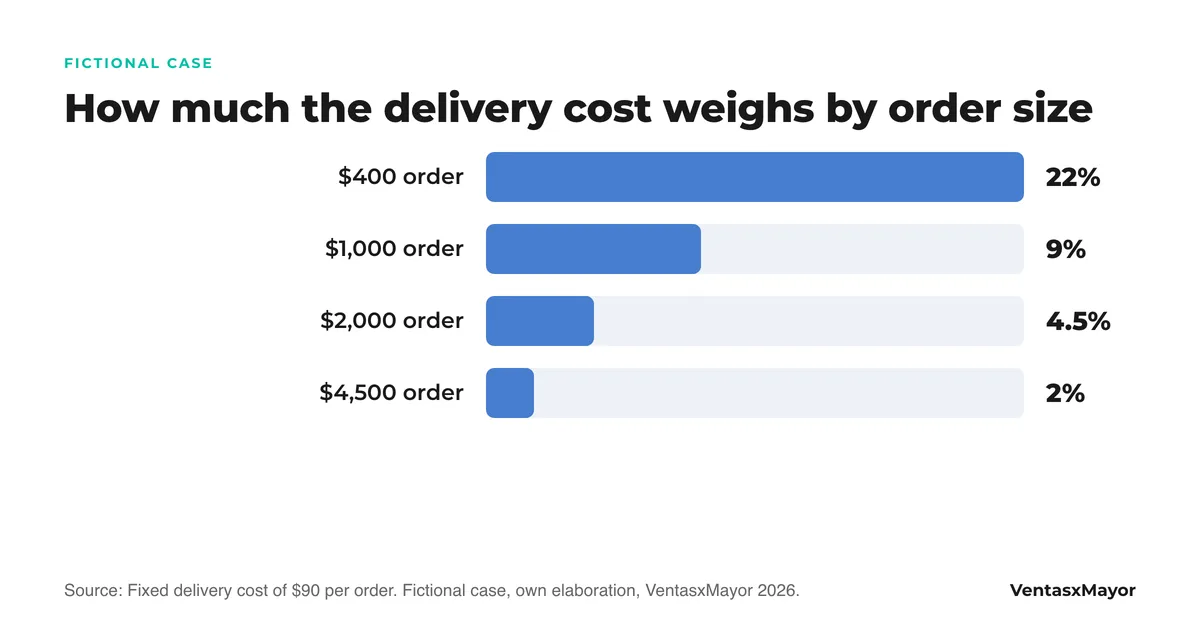
A low minimum with free shipping from a certain level works better than a high minimum on its own: the small customer can get in, and the cart shows them how much is missing to avoid paying freight. The minimum stops the order that does not pay; the free-shipping level pushes toward the order that does.
How to configure it in the store
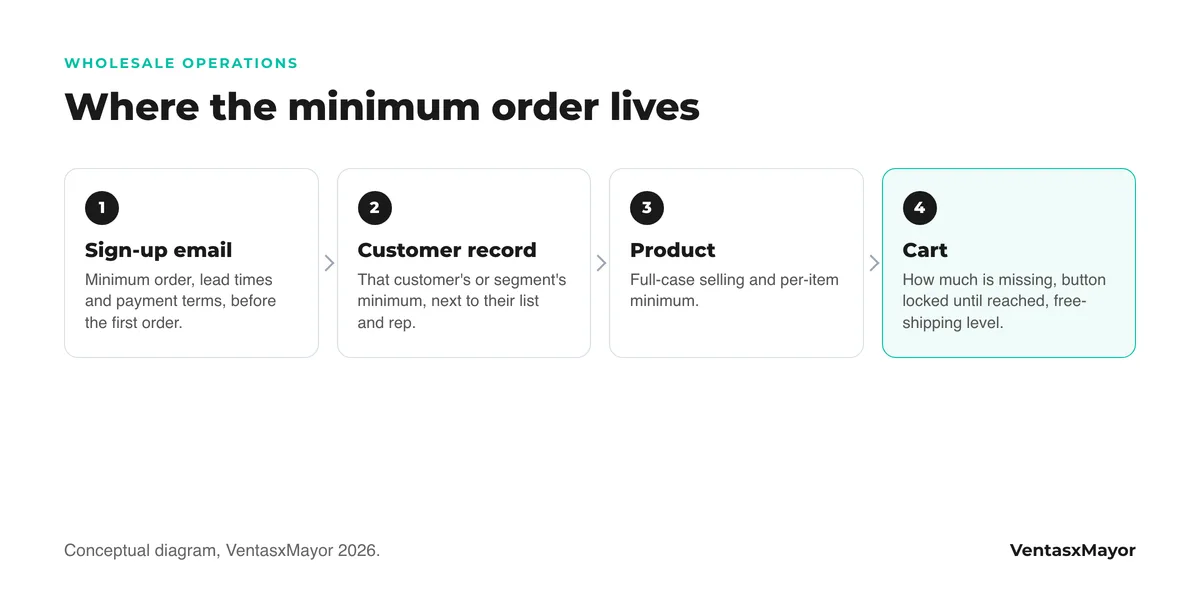
In a wholesale store the minimum has to live in three places, because it is decided at three different levels:
- On the customer record: that customer's or segment's minimum order, next to their price list, rep and payment method. A distributor can have $3,000 and a small store $800 in the same store.
- On the product: case-based selling (in 12s, in 24s) and the per-item minimum, for whatever is not broken down.
- In the cart: the notice of how much is missing, the confirm button disabled until it is reached, and the free-shipping level as an incentive. The customer has to find out before loading ten products, not at the end.
And in a fourth place that is not the store: the sign-up email. The minimum order, lead times and payment terms are written there, before the first order. Whoever reads "first order from $3,000" and cannot use it does not sign up; whoever can, arrives knowing.
How VentasxMayor solves it
In VentasxMayor the minimum order is on each customer's record, next to their price list, rep and payment method, and every product can be sold by full case or with its own minimum. The cart applies all of it on its own: it shows how much is missing and does not allow confirming until it is reached. The discount engine builds the tiers by quantity or by amount, and in payments and shipping every zone has its rate and shipping becomes free when the order reaches the level you set. Sign-up and approval emails go out under the business's brand with the text you write: that is where the minimum order goes, before the first order.
Checklist to set the minimum
- Fixed cost of one order measured: picking + admin + stop or shipment.
- Real contribution margin calculated on the last three months of sales.
- Minimum set where the order leaves money after paying for its trip, not where it breaks even.
- One main kind of minimum (amount or cases) and full-case selling where nothing is broken down.
- A different minimum for first order and reorders, written on the customer record.
- A free-shipping level above the minimum, as an incentive.
- The cart says how much is missing before ten products are loaded.
- The minimum appears in the sign-up and approval emails.
- Reviewed every quarter, or whenever freight changes or inflation makes it stale.
Frequently asked questions
Should the minimum order be in dollars or in units?+
In units or cases when the cost of delivering depends on volume (beverages, food, cleaning products); in amount when the catalog is wide and prices vary a lot between products (housewares, hardware). With inflation, an amount-based minimum needs frequent updating; a case-based one does not.
Does a minimum order scare customers away?+
It scares away the ones who are not wholesale buyers, and that is what it should do. For the real buyer it saves a conversation: they read it at sign-up, see it in the cart and build the order knowing. What does scare them is discovering it at the end, after loading everything.
Can each customer have a different minimum?+
Yes, and it is normal in wholesale: the regional distributor has one minimum and the small store another, and the first order is usually higher than reorders. What matters is that it lives on the customer record inside the store, not in the memory of whoever approves orders.
Minimum order or free shipping above an amount?+
Both, in different roles: the minimum stops the order that does not pay for its own trip; free shipping from a higher level pushes the customer to fill the order that does. A low minimum plus a free-shipping level usually performs better than a high minimum alone.
Sources
Next step
The minimum applies on its own, in the cart
In VentasxMayor the minimum order lives on each customer's record, case-based selling on each product and free shipping by tier in the discount engine: an order below the minimum cannot be confirmed, and one that reaches it goes through without anyone checking.
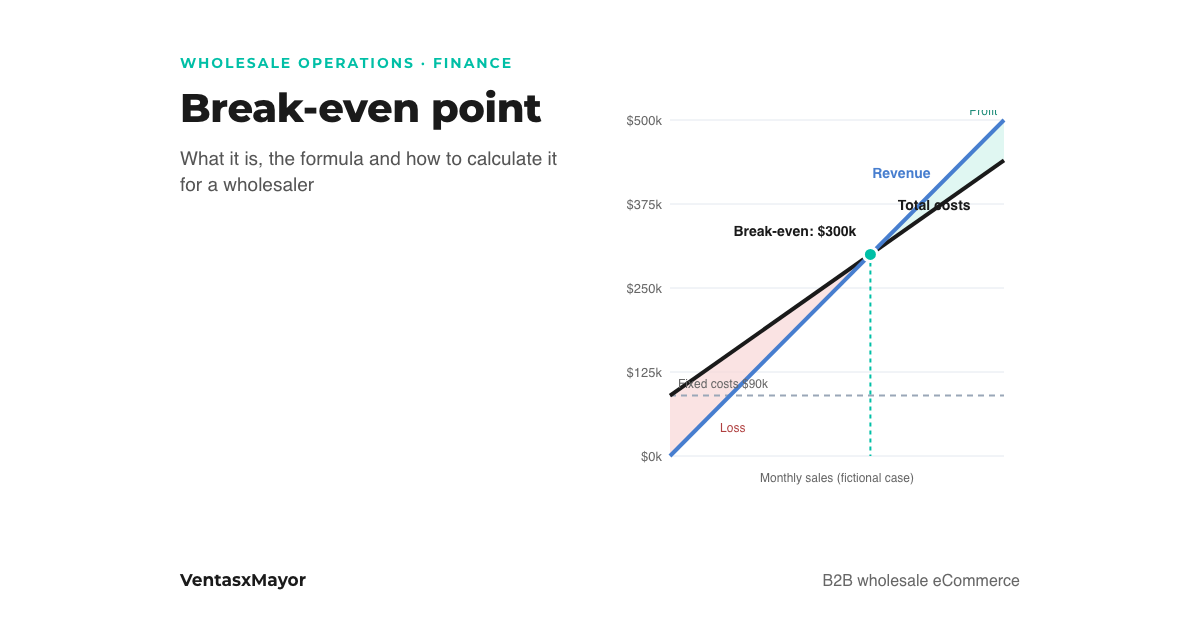
Break-even point: what it is, the formula and how to calculate it for a wholesaler
How much you need to sell each month to stop losing money: formula in units and dollars, a step-by-step distributor case and what moves it.
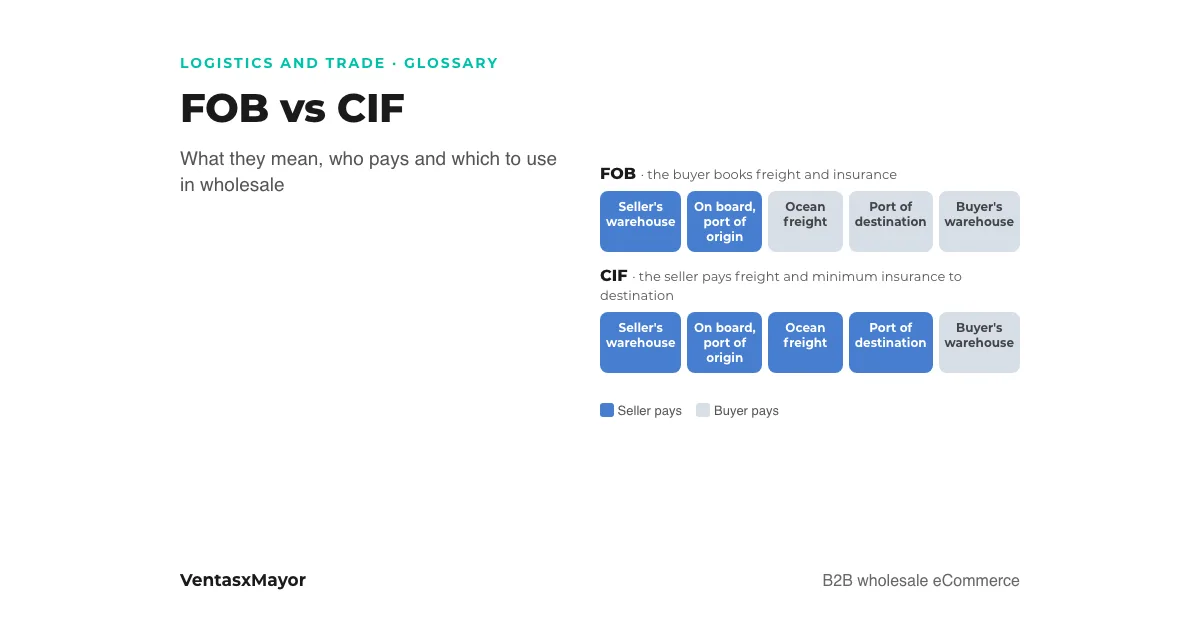
FOB vs CIF: what they mean, who pays and which to use in wholesale
FOB: the buyer pays freight from the moment the goods ship. CIF: the seller pays freight and insurance to destination. Who bears what, and how to set it in wholesale.
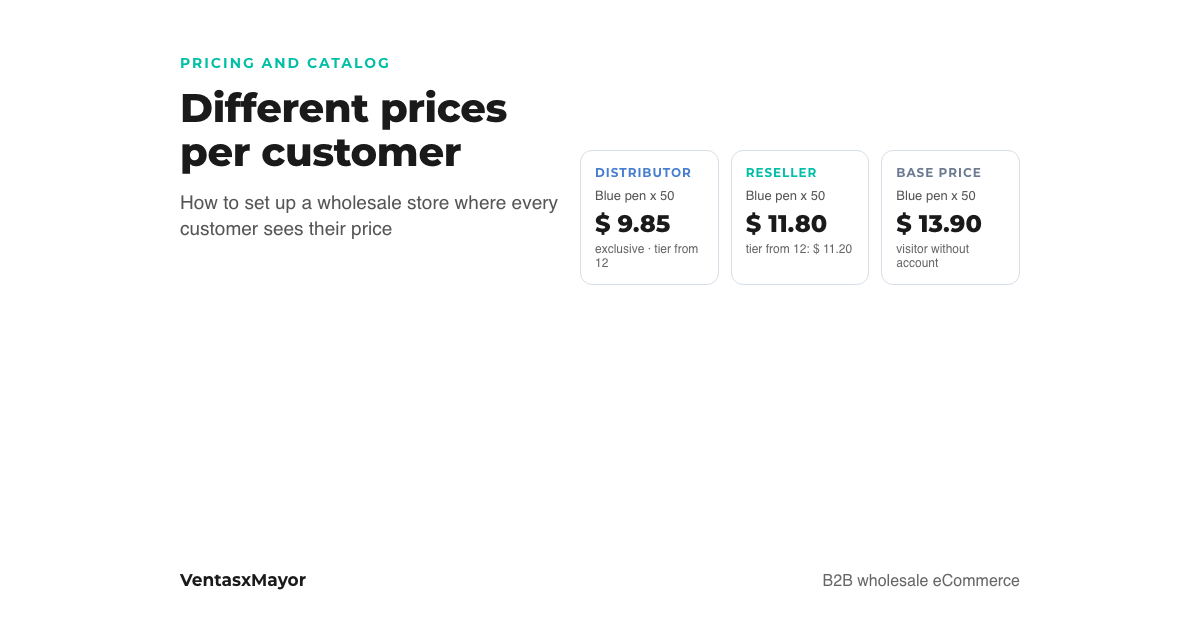
How to set up a wholesale online store with different prices per customer
Price lists by buyer type, per-customer discounts and volume tiers: how they combine, how to set up the store step by step and what a visitor without an account sees.