
How to move wholesale orders from WhatsApp to a store without losing customers
For the wholesaler who has already decided that orders cannot keep coming in as voice notes and photos, but knows customers will not change just because. A four-stage plan, what to tell each customer, the rep's script, what to measure every week and the mistakes that send everything back to the chat.
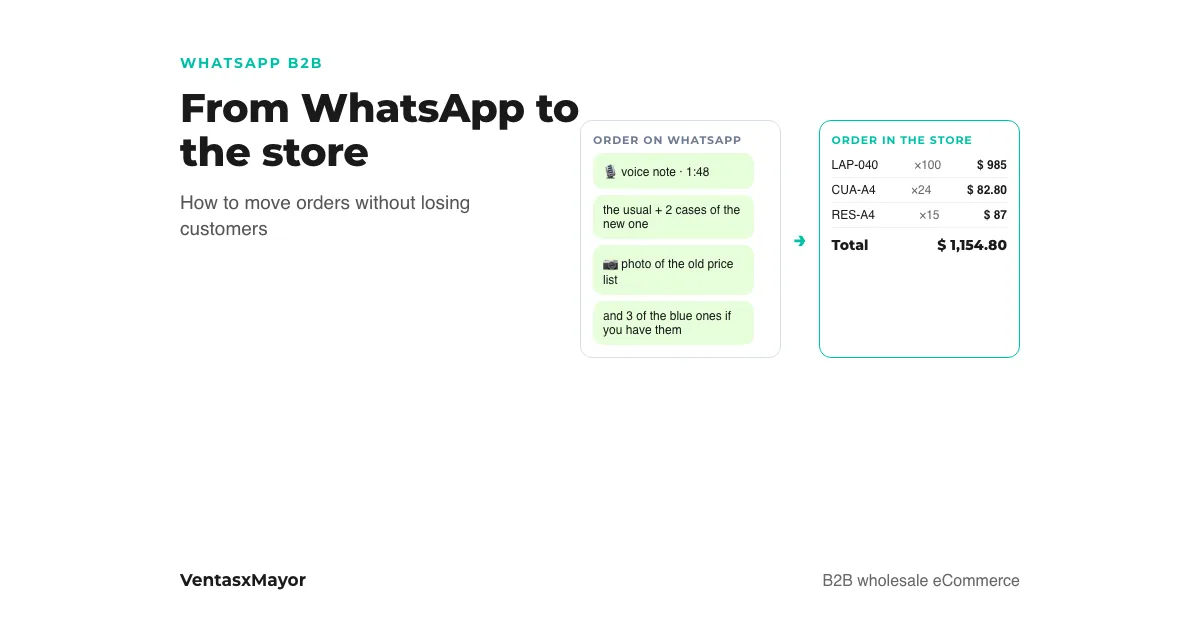
The problem is not WhatsApp. The problem appears when WhatsApp becomes the company's order system: messages to three different people, two-minute voice notes, photos of the old price list with a red circle, SKUs written five different ways, and someone in admin keying everything into the system at seven in the evening. For more than eight years we have seen the same thing at distributors of beverages, cosmetics, stationery and hardware: companies that move a lot of money and receive orders as if they were a favor between friends.
We also see the opposite mistake: announcing on a Monday that "from now on every order goes through the store", and on Friday having an empty store and the same WhatsApp as before. Customers do not change because they are asked to; they change when the new way solves something for them and the old way costs them something. This article is the plan we use to make that change happen, in stages, without losing anyone along the way.
Why the customer keeps ordering on WhatsApp
Because it works for them. They write "the usual plus two cases of the new one" and someone on the other end takes care of understanding it, looking up the price, checking stock and entering it. All the work is done by the supplier. For the customer to move to the store, the store has to be more convenient than that message, not just more convenient for the company.
What makes a wholesale buyer prefer ordering on their own, and we see it in those who already migrated, is four things: seeing their price and real stock without asking, repeating the last order in one click, ordering at ten at night after closing the shop, and getting the confirmation with the total without waiting for someone to send it. Two out of three B2B buyers already prefer self-service over talking to a rep; the one who does not migrate is the one the store did not give those four things to.
- 2/3of B2B buyers prefer remote interactions or digital self-service over in-person visitsMcKinsey B2B Pulse, 2024
- 80%of B2B sales interactions happen in digital channels from 2025, according to Gartner’s projectionGartner, 2020
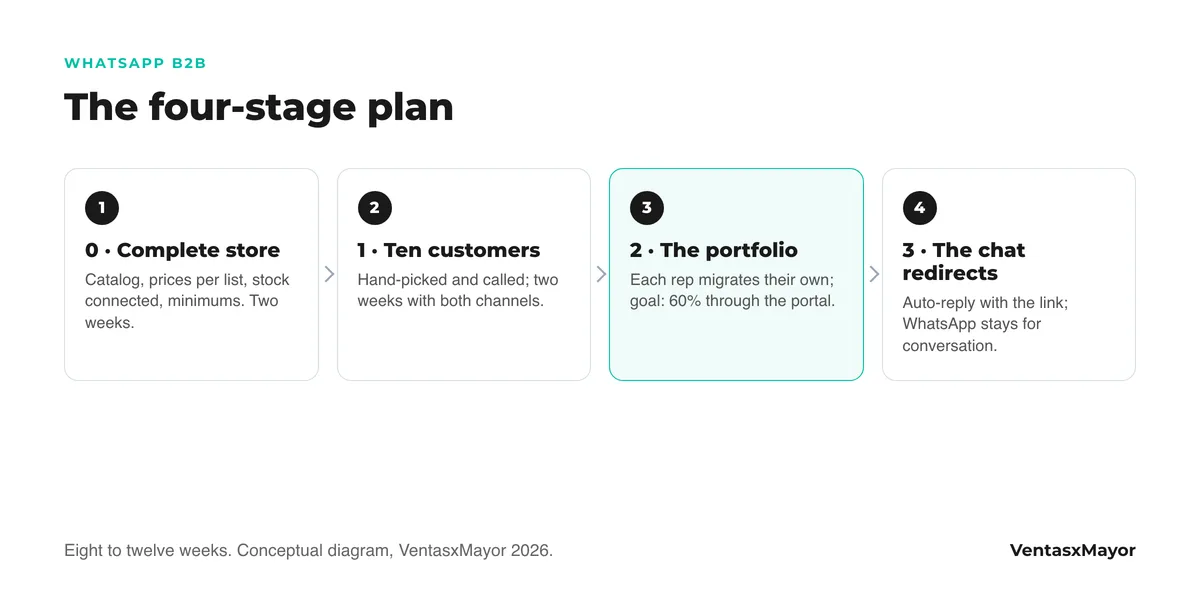
The four-stage plan
- Stage 0: the store has to be complete before inviting anyone. The whole catalog loaded with photos and SKUs, every customer's price on their list, stock connected to the management system, minimum order and payment terms on the record. A customer who logs in and cannot find a product or sees a different price goes back to the chat and does not return. Two weeks.
- Stage 1: ten customers, hand-picked. The ones who order the same thing every week and the ones who already asked "don't you have a website?". Call them, do not email them: "I set up your access, your list is already loaded, try repeating last week's order". For two weeks accept orders through both channels and answer the WhatsApp one with the link to the cart already built.
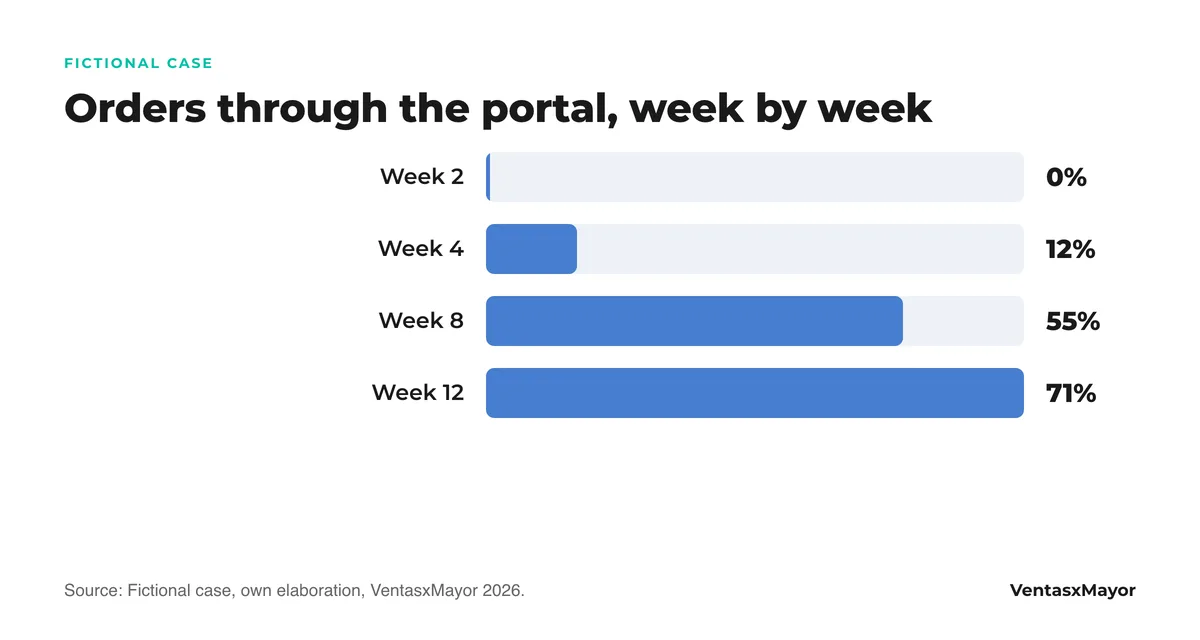
- Stage 2: the whole portfolio, rep by rep. Each rep migrates their customers during their weekly visit or call, with the script below. The month's goal is a number, not an intention: 60% of orders through the store. Orders that still arrive on WhatsApp are entered by the rep in the portal on the customer's behalf, and the confirmation reaches the customer from the store: that is how they learn where their order lives.
- Stage 3: the chat stops taking orders. From a date announced a month ahead, an order message gets an automatic reply with the store link and the rep's number. Those who still have not migrated are few and have names: call them one by one. WhatsApp stays for shipping notices, collections and conversation.
The rep's script
The rep decides whether the migration works, because the rep is the one who talks to the customer every week. And they have a reason to resist: if the customer orders alone, what are they there for? The answer has to be clear from day one: their commission does not change (the portal order is still theirs, because the portfolio is assigned), and the time they stop spending typing goes into selling more lines and opening accounts. With that settled, the script for the visit is short:
1. "I set up your access to the store with your price list: you log in with your email, no password."
2. "What you ordered last week is already saved: one button repeats it and you change whatever you want."
3. "You see real stock, so what happened on Thursday with the two missing items doesn't happen again."
4. "You can order whenever you want, and I still get the notification. If you like, let's enter it together now."
5. "For anything else, message me like always."
Point 4 is the one that converts: entering the first order together, at the customer's store, from the customer's phone. One order entered with the rep standing there is worth more than ten invitation emails.
What to measure every week
| Indicator | How it is calculated | Goal at 8 weeks |
|---|---|---|
| Orders through the store | Portal orders ÷ total orders | 60% or more |
| Customers active in the store | Customers with at least one portal order in 30 days ÷ active customers | 50% or more |
| Repeat orders | Orders placed with "repeat" ÷ portal orders | Growing every week |
| After-hours orders | Portal orders between 7 pm and 8 am ÷ portal orders | Above 20% means the store solved something for the customer |
| Corrections after entry | Orders with at least one SKU, price or quantity change after being entered | Near zero on portal orders |
| Admin time | Hours per week keying orders into the system | Half, and falling |
The mistakes that send everything back to WhatsApp
- Inviting with an incomplete store. One missing product or one different price, and the customer does not come back.
- Still accepting chat orders without sending them back to the store. If the voice note still works, the voice note wins. Every WhatsApp order gets entered in the portal and the confirmation reaches the customer from there.
- Requiring a password. The wholesale buyer signs up from the counter; choosing and remembering a password is where most sign-ups die. Access with email, Google or the phone's fingerprint is just as secure.
- Leaving the rep out. If they cannot see their portfolio or do not earn commission on portal orders, they will keep taking the order by phone so it "stays theirs".
- Announcing instead of accompanying. A mass email migrates 5%; the rep entering the first order at the customer's store migrates 70%.
- Switching WhatsApp off. It does not get switched off: it changes jobs. Notifications, collections, questions and the relationship stay there.
How VentasxMayor solves it
The four things that make the customer prefer the store are in the customer portal: their price and real stock, the whole previous order in one click, orders at any hour and the confirmation with each order's status. Access is passwordless, with email, Google or the phone's fingerprint. For the heavy repeat buyer, Pro Mode puts the whole catalog in one table where the quantity is the cart.
Each rep logs in with their own user, sees only their portfolio, enters orders on behalf of their customers and earns their commission on the ones the customer places alone too. And orders that arrive on WhatsApp are not lost: the rep enters them in the portal, and the store tells the customer by email that their order is received, being picked or shipped. WhatsApp stays for conversation; it stopped being the system.
Checklist to start the migration
- Complete catalog with photos, SKUs and stock connected to the management system.
- Every customer approved with their price list, minimum and assigned rep.
- Ten pilot customers picked and called one by one.
- Rep's script printed and the portal commission spelled out in writing.
- First order entered together with the customer, at their store, from their phone.
- Every WhatsApp order entered in the portal and confirmed from the store.
- Numeric goal for the month: 60% of orders through the portal.
- The six indicators in the table, reviewed every Friday.
- A date announced a month ahead for the chat to stop taking orders.
Frequently asked questions
How do I digitize the orders I get on WhatsApp?+
With a wholesale store where each customer logs in, sees their price and stock and builds the order alone, and a staged plan: complete store, ten pilot customers, the whole portfolio rep by rep and, at the end, the chat that stops taking orders. Orders that still arrive on WhatsApp are entered by the rep in the portal, so the confirmation comes from the store.
Will my customers want to order through a store?+
If the store gives them what the chat does not: their price and stock without asking, repeating the last order in one click, ordering after hours and getting the confirmation. Two out of three B2B buyers already prefer self-service. The one who does not migrate is usually because the store was incomplete or nobody entered the first order with them.
What happens to the reps if the customer orders alone?+
They change jobs, they are not redundant: they stop typing orders and move to opening accounts, winning back inactive customers and selling new lines. For them to support the migration, they need to see their portfolio in the store and earn commission on the orders customers place alone too.
Do I have to stop using WhatsApp?+
No. WhatsApp is excellent for talking and terrible as an order system. It stays for shipping notices, collections, questions and the relationship; what changes is that the order is built in the store and WhatsApp notifies.
Sources
Next step
WhatsApp to talk; the store to order
In VentasxMayor the customer builds the order in their portal at their price and minimum, repeats the last one in one click and gets the notification on WhatsApp; the rep sees their portfolio and enters orders for them when needed. Chat orders do not disappear: they stop being the system.

Wholesale orders on WhatsApp: the complete WhatsApp Business guide to automated messages
Set up automated messages, quick replies and connect WhatsApp with your B2B platform: the portal takes the order, WhatsApp notifies.
B2B customer portal: what it is, what it needs and how to roll it out
What a B2B customer portal is, what it needs for a wholesaler, how it differs from a rep portal and an online store, and how to launch it in five steps.
What is a pre-sell rep: the job, the pay and how online ordering changes it
The pre-sell rep visits stores on a fixed route and takes the order the delivery route ships later. The job, the pay, how it differs from van sales and how distributors run pre-sell.