
VTEX vs VentasxMayor: how each one charges, what it takes to implement, and when each one fits a wholesaler
For the manufacturer, distributor or wholesaler who searched for a "B2B ecommerce platform" and found VTEX first. What VTEX is, how it charges according to its own annual report, what it takes to get it running, and when a vertical wholesale platform makes more sense.
Ask Google or an AI assistant for B2B ecommerce platforms in Latin America and the first name is often VTEX. That makes sense: it is a company listed on the New York Stock Exchange, it processed more than 20 billion dollars in orders in 2025, and it sells to brands such as Mondelēz, Colgate-Palmolive and Stanley Black & Decker. Nobody serious disputes that it is a strong platform.
The question we hear every week is a different one. Does a distributor with 300 accounts, five reps and a price list in a spreadsheet need the same tool as Colgate? This comparison sets what VTEX publishes about itself, checked on September 24, 2026, next to what VentasxMayor offers, and says plainly when VTEX is the better choice.
What VTEX is and who it is built for
VTEX is an enterprise digital commerce platform born in Brazil. It describes itself as composable and headless: storefront, checkout, catalog and front end are assembled from pieces, and the front end is built with FastStore, a React and Next.js kit. It serves B2C, B2B and marketplaces, and it appears as a "Challenger" in the 2025 Gartner Magic Quadrant for Digital Commerce.
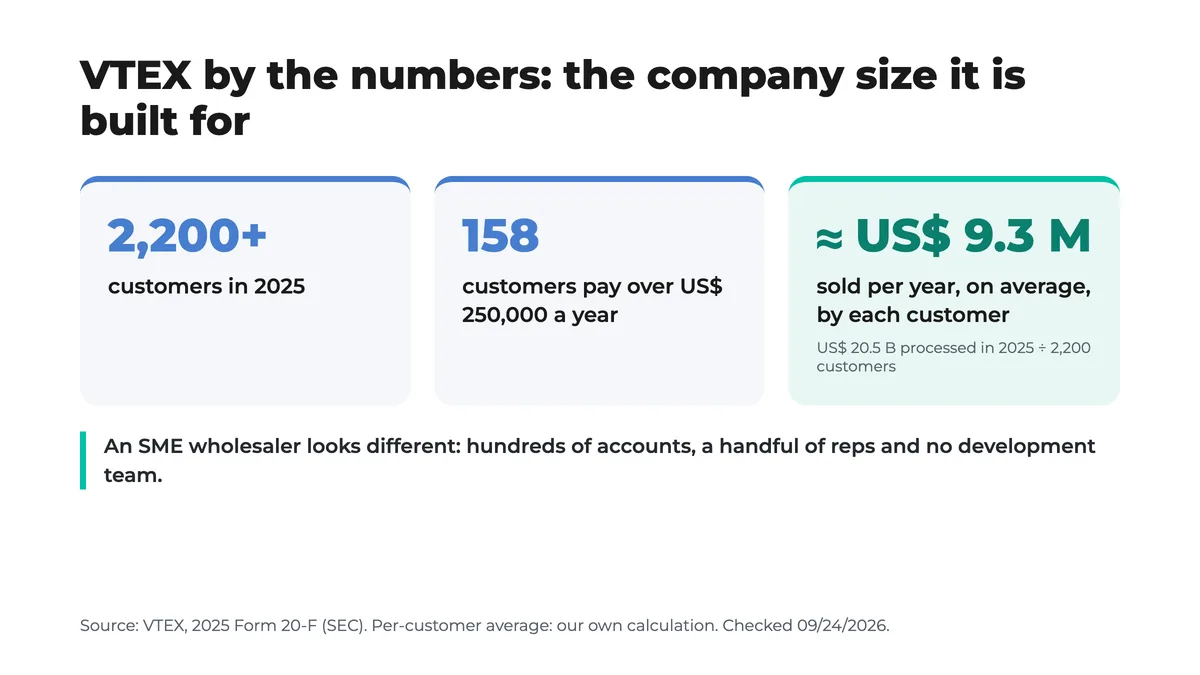
Its own annual report shows where it is aimed. In 2025 it had more than 2,200 customers, and 158 of them paid it more than 250,000 dollars a year. Dividing the volume processed by the number of customers, each one sells on average around 9 million dollars a year through the platform. It is a tool built for large brands and teams with developers, and that is fine.
How VTEX charges and how VentasxMayor charges
VTEX's pricing page shows no plans or amounts: it offers a call with sales. The model is written down, though, in its annual report to the SEC. VTEX charges a subscription with two parts: a fixed fee and a variable part that is a percentage of the value of orders processed, taxes and shipping included. The same report states that the variable part is the most significant share of what it bills.
In practice, the platform's cost grows with every sale. For a large brand that is reasonable: it pays in proportion to what the platform moves. For a wholesaler just moving orders off text messages and into a store, the issue is different: next year's cost cannot be calculated without knowing the rate, which is negotiated case by case.
At VentasxMayor the price is published on each country's pricing page. It is a fixed monthly fee, with no per-user or per-rep charge and no commission on sales. The initial setup is free and happens before billing starts.
| VTEX | VentasxMayor | |
|---|---|---|
| Published price | No; contact sales | Yes, from US$ 49.00 a month |
| Pricing model | Fixed fee + percentage of order value (taxes and shipping included) | Fixed monthly fee, no commission on sales |
| Per-user or per-rep fee | Not published | No |
| Implementation | A project, usually with a partner agency | Free initial setup, in days |
| B2B features | B2B Suite: VTEX IO apps (organizations, cost centers, quotes, price lists per organization) | Built in: per-customer price lists, minimums, account terms, reps with portfolios |
| Storefront | Headless; FastStore in React and Next.js | Store designer, no development |
| ERP | API integration guide; connectors on the ERP side or third-party | Integration with Dux, Contabilium, Bling and Dragonfish, among others, plus an open API |
| Corporate procurement (Ariba, Coupa punchout) | Yes | No |
B2B as apps or B2B as the product
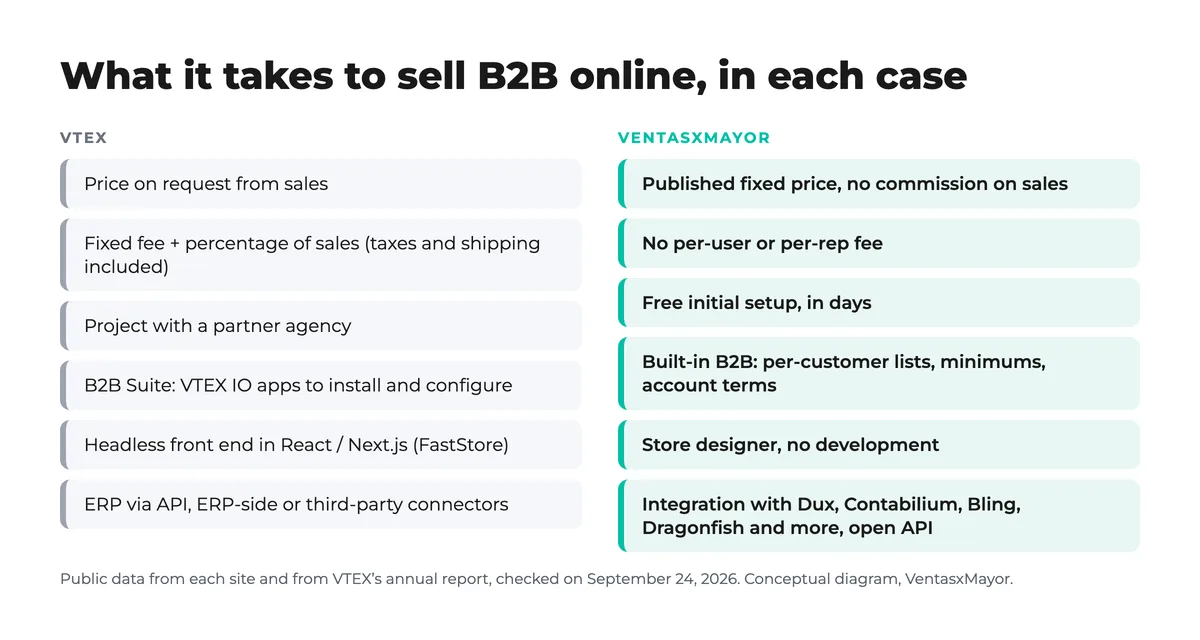
This is the underlying difference, and it is about architecture, not quality. In VTEX, B2B is assembled: its own documentation defines the B2B Suite as "a collection of VTEX IO apps." Organizations with their own price lists and payment methods, cost centers, quotes, saved carts, buyer permissions. All of it exists and is well built, but it is installed, configured and, in most projects, rolled out by an agency.
In a vertical wholesale platform B2B is not added on: it is what the product does from day one. The customer logs in and sees their price list, their case minimums and their account balance. The rep has a portfolio. The order flows to the ERP. We say it often and we stand by it: wholesale ecommerce should not be a pricier version of retail ecommerce, with B2B locked in the top plan or bolted on in pieces.
What VTEX does better
A comparison that does not admit this is useless for deciding. VTEX has things VentasxMayor does not have and does not try to have:
- Corporate procurement. Punchout with Ariba and Coupa, approval workflows and cost centers: what a manufacturer selling to other large companies with purchasing departments needs.
- Enterprise scale and multi-country. One platform for several brands, countries and channels, with B2C, B2B and marketplace in one place.
- Full development freedom. With a tech team, the front end and the flows are built to measure. If the store is a digital product of its own, that is worth a lot.
- Corporate backing. A public company, audited reports and a network of certified agencies in several countries.
When each one fits
VTEX fits when the company sells at large scale, has or can hire a tech team, needs B2C and B2B on the same platform, sells to corporate buyers that require punchout, and a cost tied to sales is reasonable against what the platform moves.
A vertical wholesale platform like VentasxMayor fits when the problem is organizing the wholesale business that already exists: getting orders out of text messages and spreadsheets, letting each customer see their own price without asking a rep, getting the order into the ERP without typing it twice. And when the business needs to know today what the platform will cost a year from now.
How VentasxMayor handles it
VentasxMayor is a B2B ecommerce platform built only for wholesale selling. Each customer logs into their own store with their price list, minimums and account balance. Reps get their own access with their portfolio and commissions. Orders reach the admin panel and the ERPs we integrate with, and the open API covers the rest. The price is published, fixed per month and carries no commission on sales. It is not what Colgate needs; it is what a distributor taking orders by text message today needs. To compare other options, the guide how to choose a B2B ecommerce platform lists the questions to ask before signing.
Checklist before asking for a quote
- Write down how many accounts buy wholesale today and how many different price lists are in use.
- Get the full pricing model in writing: fixed fee, percentage of sales and the base it is calculated on.
- Work out the annual cost at today's sales and at twice that.
- Ask who implements, how long the project takes and what it costs on top of the platform.
- Confirm whether a development team is needed to change the store after launch.
- Check the integration with your own ERP: native, third-party, or to be built.
- Check whether buyers require punchout or corporate approval workflows.
- Ask to see the store the way a customer with their own price list sees it, not the general demo.
Frequently asked questions
How much does VTEX cost?+
VTEX does not publish prices: its pricing page offers a call with sales. According to its 2025 annual report to the SEC, it charges a fixed fee plus a percentage of the value of orders processed, taxes and shipping included, and that variable part is the largest share of its subscription revenue. Implementation is usually done with a partner agency and quoted separately.
Is VTEX good for B2B?+
Yes. It has the B2B Suite, a set of VTEX IO apps with organizations, price lists and payment methods per organization, cost centers and quotes, plus punchout with Ariba and Coupa. It is built for large companies with a tech team or an agency; for an SME wholesaler it is usually more than needed.
What is a vertical B2B ecommerce platform?+
It is a platform built only for selling between businesses, in this case wholesale. Per-customer price lists, case minimums, account terms and reps with portfolios come included, without apps or development. A horizontal platform such as VTEX or Shopify serves many models, and B2B is configured or added on.
Does VentasxMayor charge a commission on sales?+
No. It is a fixed monthly fee published on each country's pricing page, with no commission on sales and no per-user or per-rep charge. The initial setup is free.
Sources
- VTEX, Form 20-F (ejercicio 2025 / fiscal year 2025), SEC — checked 09/24/2026
- VTEX, Pricing — checked 09/24/2026
- VTEX Help Center, B2B Suite overview — checked 09/24/2026
- VTEX, B2B Commerce (Argentina) — checked 09/24/2026
- VTEX Developers, FastStore — checked 09/24/2026
- VTEX named a Challenger in the 2025 Gartner Magic Quadrant for Digital Commerce — checked 09/24/2026
Next step
A wholesale platform with the price on the page
In VentasxMayor B2B is the product: per-customer price lists, minimums, account terms, reps with portfolios and ERP integration, at a fixed monthly price, no sales commissions and free initial setup.
How to choose a B2B ecommerce platform: 12 questions before signing
The three routes to selling B2B online, the rule sheet that comes before any demo, the 12 questions to ask before signing and the costs the plan price hides.
Mercos vs VentasxMayor: per-user pricing, B2B e-commerce as an add-on, and what changes for a wholesaler
Mercos plans and prices checked, what each plan includes, what stays an add-on (B2B e-commerce), what Mercos does better and when each one fits.
Shopify B2B pricing: what wholesale really costs on Shopify, and the alternatives
Verified 2026 pricing for Shopify and Tiendanube, gateway surcharges, what Shopify B2B includes and what no plan includes for a wholesaler: per-customer pricing, minimums and net terms.