
Positivación, sell in, sell out, mix and average ticket: a distributor's KPIs, explained with a month on the route
For the distributor owner who hears "we reached 69% positivación" in the sales meeting and wants to know if that is good, and for the supervisor who has to explain to a rep why selling a lot to a few customers is not enough. The five numbers a sales force is measured by, with the formula, a sample month on the route and what moves each one.

A distributor is not measured only by revenue. It is measured by how many of its customers bought this month (positivación, the Latin American term for active-customer rate), how much each one bought (average ticket), how many different products they took (mix) and whether what was sold to the store is selling through to the consumer (sell out) or sitting in the customer's stockroom. These are the numbers that separate a sales force that sells from one that merely takes orders.
This article defines each KPI, calculates it over a sample month on the route of a fictional distributor and says what moves each one. Who runs the route is in what a pre-sell rep is; which customers to prioritize, in ABC customer analysis.
Sell in, positivación and sell out: where each one is measured
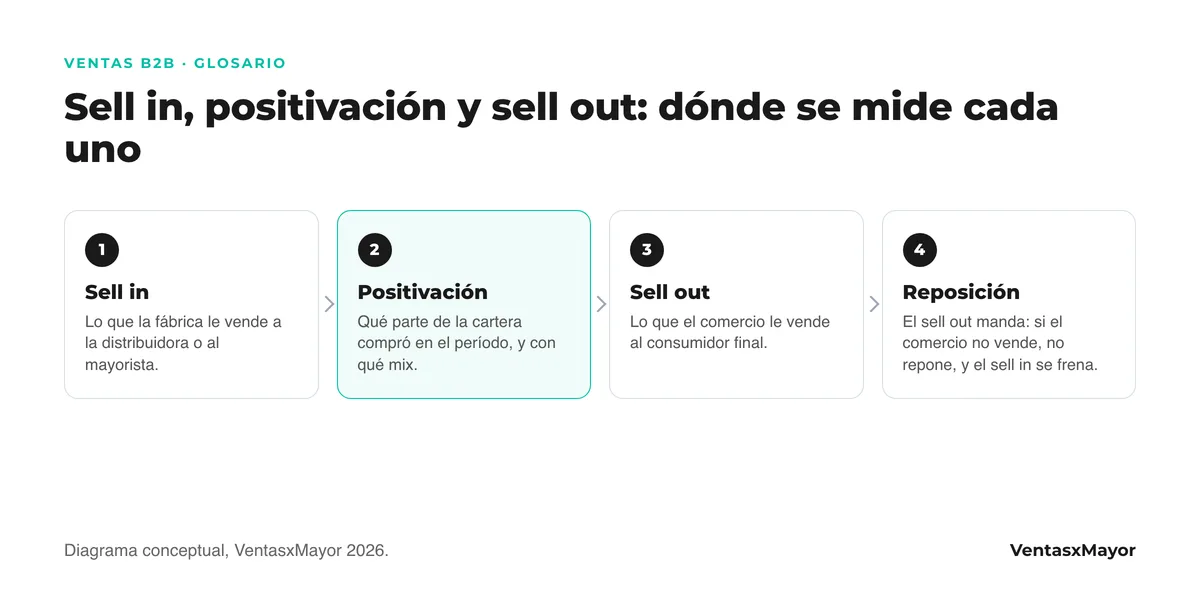
The five KPIs, with formulas
| KPI | What it measures | Formula | What moves it |
|---|---|---|---|
| Positivación | Share of the portfolio that bought in the period | Customers who bought ÷ customers in the portfolio | Visit frequency, ease of ordering, inactive customers cleaned out |
| Average ticket | How much each customer buys per order | Period sales ÷ number of orders | Minimum order, volume discounts, selling by the case |
| Mix | How many different products each customer takes | Distinct products per order (or per customer in the period) | Suggestions in the order, bundles, the rep offering what is new |
| Sell in | What the factory sells into the channel (distributor, wholesaler) | Units or money sold to the channel | Trade agreements, entry promotions, coverage |
| Sell out | What the store sells to the final consumer | Units sold at the point of sale | Shelf price, display, demand; it is what sustains replenishment |
What moves each KPI in practice
- Positivación: make ordering easy. The customer who can repeat their last order in two minutes on a Sunday night counts even if the rep did not stop by. And a portfolio full of inactive accounts inflates the denominator: cleaning it up also raises the KPI.
- Average ticket: minimum and tiers. The minimum order sets the floor; volume discounts visible in the cart push the customer to the next tier. See minimum order.
- Mix: show what they did not ask for. The rep who arrives with the previous order pre-loaded has time to offer what is new; a catalog that suggests related products does the same without a visit.
- Sell out: watch the shelf, not only the stockroom. A store that bought a lot and is not selling does not replenish. Track each customer's replenishment frequency, not just the amount of the last order.
How VentasxMayor solves it
- Portfolio per rep and sales report per rep. Each rep sees only their customers, and the report shows who bought, how much and what in the period: positivación, ticket and mix without a spreadsheet.
- The customer repeats the order alone. From the store, with their price list and minimum; the rep enters from their phone what they sell on the visit.
- Minimums and volume discounts in the cart. The next tier shows while the customer builds the order, which is when they decide.
Frequently asked questions
What is a good positivación rate?+
Are sell in and sell out the same as buying and selling?+
How is mix measured?+
Does online ordering lower the rep's positivación?+
Next step
The KPIs come out of the order on their own
In VentasxMayor each rep has their portfolio and each order is recorded with customer, products and date: the sales report per rep shows who bought, how much and what, with no spreadsheet. The customer who repeats their order from the store counts on their own, and the rep spends the visit selling the mix.
What is a pre-sell rep: the job, the pay and how online ordering changes it
The pre-sell rep visits stores on a fixed route and takes the order the delivery route ships later. The job, the pay, how it differs from van sales and how distributors run pre-sell.
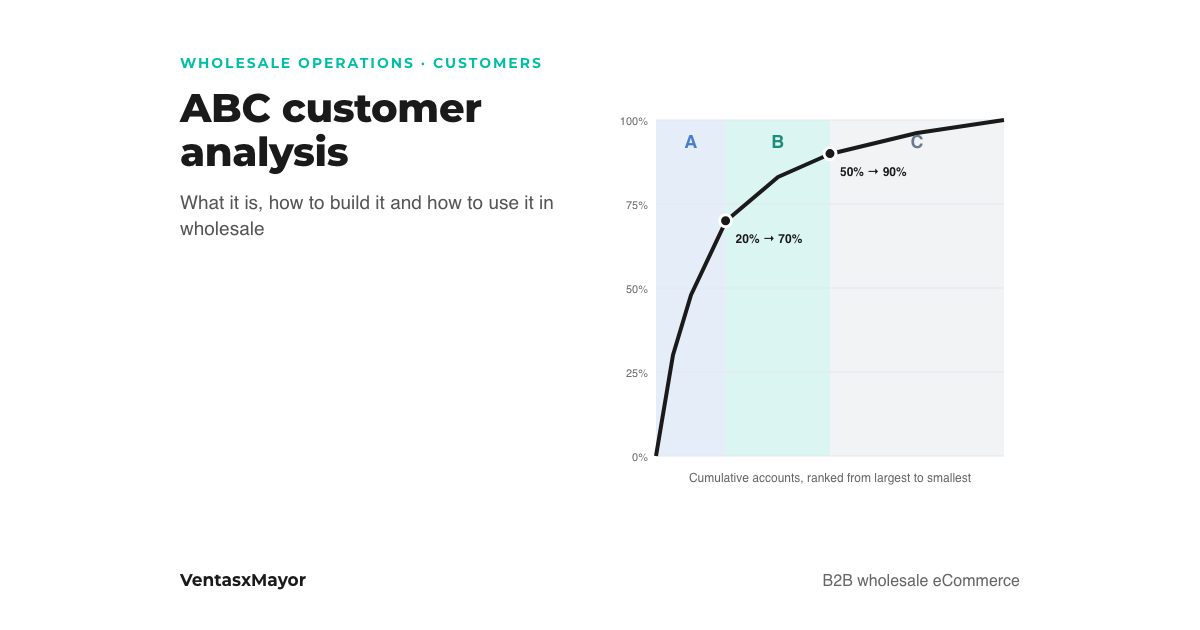
ABC customer analysis: what it is, how to build it and how to use it in wholesale
20% of accounts usually explain 70% of sales. How to build the ABC curve in five steps and what to do with A, B and C accounts.
Outside sales rep in wholesale: the job, the pay and how a portal changes it
What an outside rep does at a wholesaler, how reps are paid, how the role differs from route and inside sales, and what changes with a portal where the order is entered once.